
Clinical picture. M., a man in his early forties, presented with his partner for couples therapy; the stated complaint was chronic emotional distance. During the third session, the clinician introduced the passive-aggressive communication worksheet and walked both partners through the continuum of expression. When the clinician read aloud the example phrase "Wow, you actually did the dishes," M.'s partner turned to him and said quietly, "That is exactly what you say to me every time." M. sat with this for a moment, then acknowledged that he had not registered his own words as hostile because his tone was always calm. Over the following two sessions, work shifted toward identifying the "sting and swallow" cycle that preceded these remarks, giving M. a more accurate map of where his unexpressed irritation was going.
Passive-Aggressive Communication: PDF Worksheet, Tools and Exercises
A structured visual fiche to help clinicians explain passive-aggressive patterns in session, map the pressure-cooker cycle, and build concrete assertive alternatives with patients.
Clinical vignettes
Backhanded Praise in a Couple Session
Procrastination as Quiet Refusal
Clinical picture. T., a woman in her mid-thirties, was referred for low-grade persistent anxiety and conflict at work; she described herself as "too agreeable" and could not explain why tasks she resented always seemed to slip through. The clinician used the informational sheet to name the gap between compliance in words and resistance in behaviour, pointing to procrastination as a form of quiet protest. T. recognised the pattern almost immediately: she consistently said yes to her supervisor's requests, then delayed them until they became urgent problems, while privately feeling both vindicated and guilty. Introducing a shared vocabulary for the pressure-cooker cycle allowed subsequent sessions to focus on what T. was swallowing at the moment she said yes, rather than on the downstream consequences of the delay.
Passive-aggressive communication sits at an awkward angle in clinical work: patients rarely recognise the pattern in themselves, and an oral explanation tends to produce polite bafflement rather than genuine insight. This fiche PDF gives you a concrete, scannable structure to bring the concept into the room and make it immediately workable.
Use this resource with your patients
Handout, exercises and materials ready to use, right inside SessionFuel.
Why passive-aggressive patterns resist explanation in session
The core difficulty is definitional. Patients who rely on passive-aggressive communication have often built a coherent internal logic: they said nothing overtly hostile, so they cannot be held responsible for what followed. When you describe the pattern verbally, many hear a moral accusation rather than a clinical observation. The concept also occupies the least intuitive position on the communication styles spectrum: explaining the two outer poles is manageable, but the sideways middle zone blurs the moment you try to summarise it in a sentence.
There is also a phenomenological gap that pure description cannot bridge. The anger is genuinely not experienced as anger in the moment. It arrives as a tight jaw, a loaded sigh, a task that keeps getting "forgotten." The patient sincerely believes they said "it's fine." Reaching the emotional substrate underneath requires something more tangible than a spoken summary. Pairing this work with the anger iceberg or with a closer look at the behaviour-emotion-underlying need triad can sharpen recognition significantly, but a shared visual map is usually the prerequisite.
What the fiche contains: a map of the sideways move
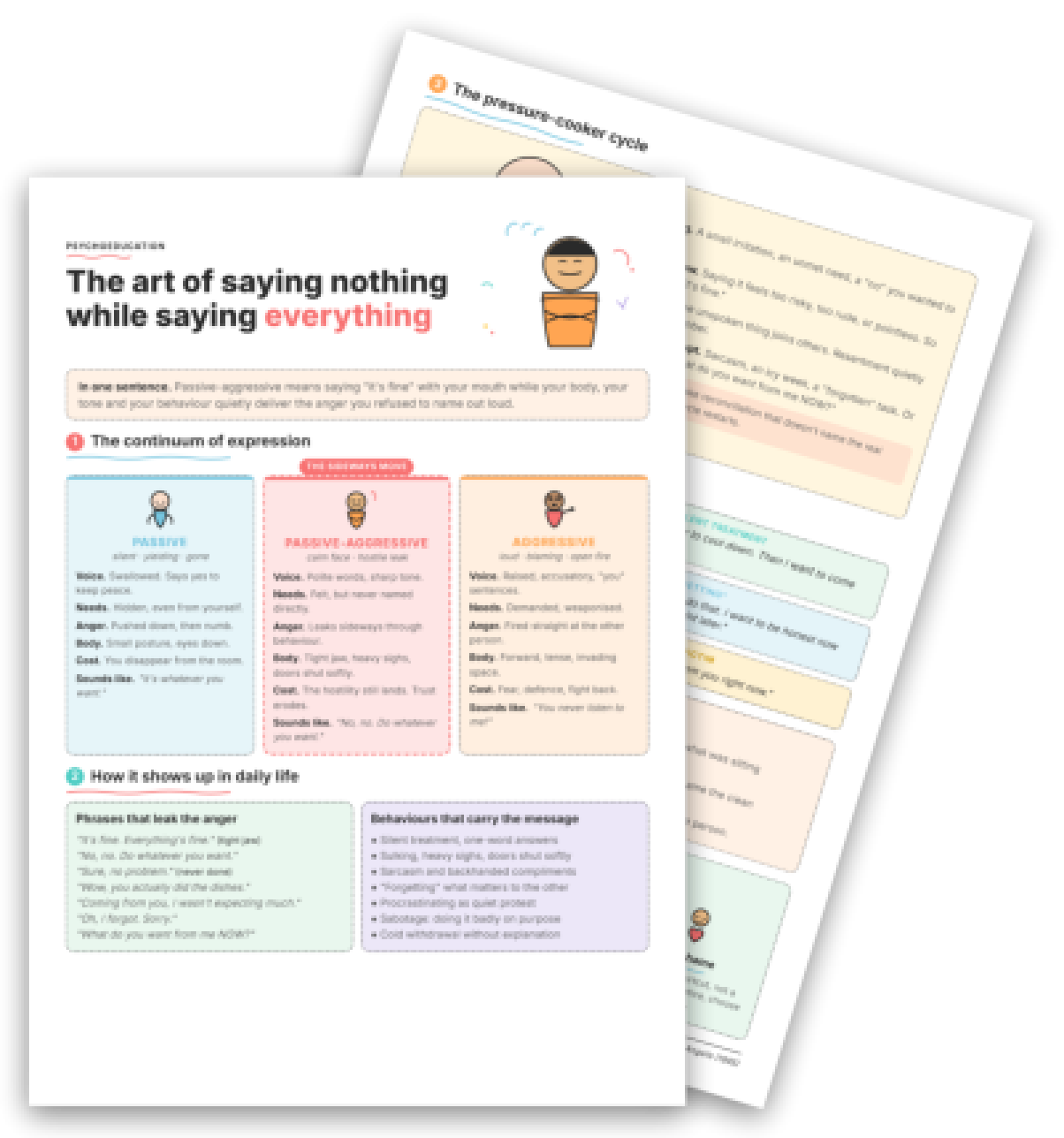
The fiche opens with a one-line definition precise enough to quote verbatim in session: "saying 'it's fine' with your mouth while your body, your tone and your behaviour quietly deliver the anger you refused to name out loud." That single sentence often lands harder than a paragraph.
The centrepiece is a three-column continuum comparing Passive, Passive-Aggressive, and Aggressive communication across six dimensions: voice, needs, anger, body language, relational cost, and a "sounds like" phrase for each. The visual contrast makes the sideways move undeniable in a way that prose rarely achieves. Patients can point to the column that fits their pattern without feeling directly blamed or labelled.
The fiche then maps how the pattern shows up in daily life, with two distinct panels: recognisable phrases ("No, no. Do whatever you want." or "Wow, you actually did the dishes.") alongside concrete behaviours such as sulking, deliberate forgetting, sarcasm, and quiet sabotage. Section 3 presents the pressure-cooker cycle across four named steps: Sting, Swallow, Build, Leak or erupt. The loop structure is particularly useful for patients who frame their outbursts as provoked rather than accumulated over time.
The final section offers six assertive swap sentences, each pairing a passive-aggressive pattern with a clean, direct alternative. Silent treatment is paired with "I need an hour to cool down. Then I want to come back to this." Sarcasm yields to "I'd like us to share the kitchen tasks. Can we agree on something?" These swaps connect naturally to further work with I-Messages, the four-step NVC structure, or the DBT DEAR MAN skill.
> To remember: the fiche is a visual support that facilitates the explanation of passive-aggressive communication in session; the patient leaves with a concrete reference map, not a task to complete alone.
750+ clinical tools
A library built with and for clinicians, ready to use in session and extend between appointments.
Access all the toolsWhen and how to introduce the fiche
The fiche fits naturally in the second or third session, once the relational presenting complaint is clear and the working alliance is solid enough to name patterns without rupture risk. It is particularly indicated for patients who:
- Chronic conflict without awareness: describe persistent friction with a partner, colleague, or family member while insisting they "never said anything"
- Disconnected behaviours: report sarcasm, procrastination, or emotional withdrawal but struggle to link these to unmet needs
- Assertiveness training in progress: are building assertiveness skills but have difficulty locating the passive-aggressive midpoint on the communication styles continuum
Introduce it without labelling the patient first: "I'd like to show you something that maps how anger can travel sideways when it doesn't feel safe to name it directly." Walk through the three-column continuum together, then invite the patient to locate their own pattern. The "To discuss in session" prompts printed at the bottom of the fiche make the debrief structurally straightforward. From there, work on expressing vulnerability directly or move toward assertive communication skills once the patient has named their position on the map.
One clinical note: avoid introducing this fiche in a session where interpersonal tension is currently activated. The three-column layout reads neutrally on paper, but a patient in an emotionally flooded state may still experience the Passive-Aggressive column as pointed. A reflective, lower-arousal session is the right container. For patients presenting with couple conflict, the fair fighting rules fiche works well as a complementary step once the passive-aggressive pattern has been named.
The fiche does not replace the formulation; it makes the explanation precise enough that the real work can begin.
Use it with your patients
Share this tool in the mobile app and follow the work between sessions.
Sources
- Long, J. E., Long, N. J., & Whitson, S. (2009). The Angry Smile: The Psychology of Passive-Aggressive Behavior in Families, Schools, and Workplaces. Pro-Ed.
- Rakos, R. F. (1991). Assertive Behavior: Theory, Research, and Training. Routledge.
Your session continues in your patients' pocket
Use with a patientYour resources, available everywhere
The handouts, exercises, programs and audios above: you choose which ones to make available to your patients, in the mobile app dedicated to them.
And far more than a library
The app goes well beyond resources, to support your patients every day:
Related categories
Explore other clinical resources by category.

Identity
Clinical resources for self-identity work in therapy: CBT, ACT, schema tools for clinicians addressing self-concept, core beliefs, and identity disruption.

Emotions
Clinical resources on emotion regulation: worksheets, coping tools, CBT, REBT, and ACT exercises for therapists working across diagnoses and age groups.

Relationships
Clinical worksheets and tools on relational functioning: attachment, schemas, assertiveness, and communication skills for therapists. Printable PDF resources.

Understand
Clinical hub for the therapeutic aim 'Understand': worksheets and tools to build patient insight across CBT, ACT, schema therapy and more.

Build awareness
Clinical worksheets and tools to build awareness in therapy: cognitive distortions, schemas, emotions, ACT and CBT resources for practitioners.

Integrative
Integrative therapy clinical resources: worksheets, psychoeducation programs, and exercises for eclectic, multimodal practice across orientations.