
Clinical picture. A, a woman in her early thirties, presented with emotionally unstable personality disorder and a longstanding pattern of either avoiding conflict at work or erupting in frustration after prolonged silence. She described repeated episodes of accepting extra caseload until she broke down, then sending emails she later regretted. In session, the clinician introduced the DEAR MAN worksheet and walked through each letter using a concrete upcoming situation: her supervisor had again assigned her a file she had no capacity to take. A drafted her sentences aloud, practising the Describe and Assert steps until the request was specific rather than apologetic. At the following session she reported having delivered her refusal without cancelling it mid-sentence, noting that the conversation felt uncomfortable but contained.
DBT DEAR MAN Skill: PDF Worksheet, Tools and Exercises
A printable PDF worksheet, clinical tools, and structured exercises to help patients ask for what they need assertively using the DBT DEAR MAN framework.
Clinical vignettes
DEAR MAN for Workplace Boundary
Rehearsing a Relationship Request
Clinical picture. T, a man in his mid-forties with recurrent depressive episodes and marked interpersonal avoidance, struggled to ask his partner for alone time without framing the request as self-criticism. He anticipated rejection and typically withdrew rather than speaking. The clinician used the DEAR MAN informational sheet to separate the steps, focusing session time on the Reinforce and Negotiate components, which T found least intuitive. Role-play revealed that his voice dropped and his sentences trailed off at the Assert step, so the work shifted briefly to the Appear Confident component before content. T rated the rehearsed version as credible enough to attempt, and reported the following week that his partner had agreed to a modified arrangement, adding that the conversation had gone shorter and calmer than any previous attempt.
Most patients who struggle with interpersonal requests already know, at some level, what they want. What breaks down is the execution: they freeze mid-sentence, drop the ask as soon as the other person frowns, or escalate in ways that derail the conversation entirely. Explaining the DBT DEAR MAN skill verbally is possible, but handing them this PDF worksheet mid-session changes the quality of the work immediately.
Use this resource with your patients
Handout, exercises and materials ready to use, right inside SessionFuel.
Why DEAR MAN resists verbal explanation alone
DEAR MAN is a seven-step acronym from Linehan's DBT interpersonal effectiveness module, and its very structure creates a specific teaching problem: patients hear the list, nod, and then collapse the steps in their actual behavior. The most common collapses are predictable. They skip Describe (jumping straight to the emotional request), conflate Express with blame ("you make me feel..." rather than an "I" statement), and abandon Negotiate the moment they feel mild resistance, interpreting any counter-offer as a defeat.
Without a visual structure in front of them, patients also lose track of which letter they are on under social pressure. The acronym becomes a blur. The same patients who struggle with assertiveness generally often present with this specific gap: they can describe the theory but cannot sequence it in vivo.
A visual support changes this. When the seven steps are laid out spatially, with contrasting correct and incorrect examples side by side, patients can point to where they went off-track rather than relying on memory to reconstruct it. That is exactly what this PDF worksheet provides.
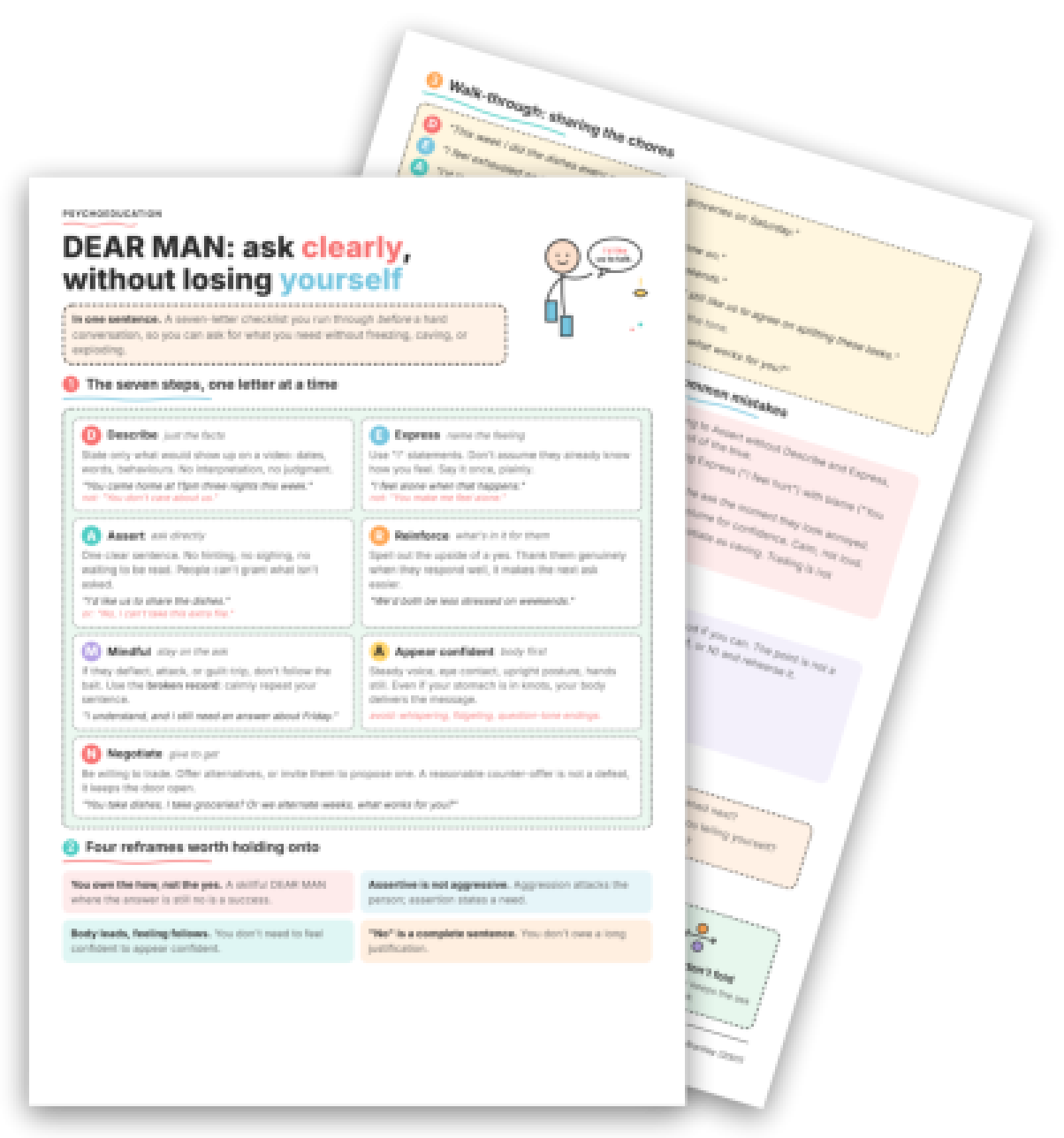
What the fiche contains: a step-by-step visual map
The fiche moves through each letter of the acronym in a dedicated panel, combining a plain-language definition with a concrete positive example and a labelled negative counterexample. For instance, under E (Express), the contrast is direct: "I feel alone when that happens" versus "You make me feel alone". Under M (Mindful), the broken-record technique is named explicitly, with a sample line: "I understand, and I still need an answer about Friday." This is the kind of precision that a verbal walkthrough rarely preserves once the patient is back home.
Beyond the seven-letter breakdown, the fiche includes four reframes designed to address the most clinically common distortions around assertiveness: the equation of assertiveness with aggression, the belief that a "no" requires lengthy justification, and the misreading of negotiation as capitulation. These map directly onto aggressive communication patterns and the schema-level beliefs you are likely already tracking.
Two fully worked examples follow, one on domestic task negotiation, one on refusing an added workload, running the complete D-E-A-R-M-A-N sequence step by step. A Common Mistakes panel names the five most frequent errors (including "Dropping the ask the moment they look annoyed"), and a Plan Your Own section offers one-line writing prompts for each letter, explicitly flagging that "the point is to notice what you'd skip under pressure (usually D, M, or N)." A closing To Discuss in Session block provides three targeted debriefing questions, ready to use the week after.
> To retain: this fiche is a visual support that facilitates the explanation of DEAR MAN in session; the patient leaves with a concrete reference, not a self-administered questionnaire.
750+ clinical tools
A library built with and for clinicians, ready to use in session and extend between appointments.
Access all the toolsWhen and how to propose it
The worksheet fits naturally in the interpersonal effectiveness phase of a DBT protocol, but it also integrates well in standard CBT work with patients presenting social anxiety, chronic conflict avoidance, or passive communication styles. It is equally relevant when working on I-messages and assertive expression outside a formal DBT frame.
Introduce it after an initial mapping of the patient's interpersonal pattern, once there is enough alliance to examine a specific failed request without activating shame. A straightforward framing: "I want to show you a structure that breaks down exactly what happens in a hard conversation, step by step. Let's go through it together and then apply it to the situation you described."
Go through the seven steps on the fiche together, pausing at whichever letter corresponds to the patient's habitual collapse point. Patients who drop the ask under pressure will need more time on M (Mindful) and the broken-record technique. Patients who avoid the conversation entirely will need assertiveness behavioral practice before DEAR MAN sequencing becomes useful. For those who confuse firmness with hostility, pair the session with a look at assertive body language and communication styles.
Send the patient home with the fiche and ask them to complete the Plan Your Own section before the next session, targeting one real upcoming conversation. The To Discuss in Session questions built into the worksheet structure your debrief directly: which letter did they skip, and what story were they telling themselves when they did?
One limit worth noting: patients with significant distress tolerance deficits may need stabilization work before the DEAR MAN sequence holds under emotional activation. For these patients, the fiche is better introduced as aspirational scaffolding after core regulation skills are in place.
The fiche does not replace the therapeutic framing; it makes the explanation precise and leaves the patient with something to return to between sessions.
Use it with your patients
Share this tool in the mobile app and follow the work between sessions.
Sources
- Linehan, M. M. (2015). DBT Skills Training Manual, Second Edition. The Guilford Press.
- Linehan, M. M. (2015). DBT Skills Training Handouts and Worksheets, Second Edition. The Guilford Press.
Your session continues in your patients' pocket
Use with a patientYour resources, available everywhere
The handouts, exercises, programs and audios above: you choose which ones to make available to your patients, in the mobile app dedicated to them.
And far more than a library
The app goes well beyond resources, to support your patients every day:
Related categories
Explore other clinical resources by category.

Identity
Clinical resources for self-identity work in therapy: CBT, ACT, schema tools for clinicians addressing self-concept, core beliefs, and identity disruption.

Emotions
Clinical resources on emotion regulation: worksheets, coping tools, CBT, REBT, and ACT exercises for therapists working across diagnoses and age groups.

Relationships
Clinical worksheets and tools on relational functioning: attachment, schemas, assertiveness, and communication skills for therapists. Printable PDF resources.

Build awareness
Clinical worksheets and tools to build awareness in therapy: cognitive distortions, schemas, emotions, ACT and CBT resources for practitioners.

Build skills
Skill-building resources for clinicians: printable worksheets and exercises for coping, assertiveness, and communication skills training in therapy.

DBT
DBT worksheets and exercises for clinicians: distress tolerance, emotion regulation, and interpersonal skills tools for dialectical behavior therapy practice.