
Clinical picture. M., a 34-year-old teacher presenting with mild depression and persistent fatigue, described a pattern of agreeing to colleagues' requests even when she felt overwhelmed, then ruminating with resentment afterward. The clinician introduced the assertive sentence structure from the worksheet, distinguishing it from the passive and aggressive poles, and asked M. to rehearse scenario three (covering a colleague's shift) aloud in session. She initially softened the sentence until the refusal was nearly invisible; with gentle prompting she held the wording steady and noted a brief bodily relief she had not expected. Over the following two weeks she reported using a similar phrasing once at work, describing the outcome as unremarkable in the best sense.
Setting Personal Limits: PDF Worksheet, Tools and Exercises for Clinical Practice
A visual PDF worksheet built around eight rehearsal scenarios, three communication style columns, and a borrowable phrase bank, to make limit-setting concrete in session.
Clinical vignettes
Rehearsing Limits After Chronic Acquiescence
Late-Night Calls and Sleep Disruption
Clinical picture. T., a 28-year-old graduate student treated for generalised anxiety, identified a recurring difficulty: a close friend habitually called after 10 pm, and T. always answered, then lay awake for hours. The clinician used the worksheet's friend-calls-at-11pm example to illustrate the acknowledge-state-offer structure, and the pair rehearsed the sentence until T. could say it without an apologetic qualifier appended to the end. T. was asked to picture the friend's likely reaction before the next call and to notice where in the body the anticipatory anxiety sat. At the following session T. reported having sent a brief text version of the limit; the friend had replied without visible upset, and sleep onset that night had been shorter than usual.
Patients who struggle with setting personal limits almost always understand the concept when you explain it verbally. What they cannot do is feel their way through a real situation quickly enough to respond assertively rather than defaulting to compliance or aggression. This PDF worksheet is a visual support that makes the leap from understood principle to rehearsed behaviour concrete, used by the clinician in session, not completed by the patient alone.
Use this resource with your patients
Handout, exercises and materials ready to use, right inside SessionFuel.
Why Limit-Setting Resists Oral Explanation
The difficulty is tripartite: cognitive (what sentence structure to use), somatic (the chest tightening that arrives before the words do), and relational (the conviction that a respectful refusal will cost the relationship). An oral explanation addresses the cognitive strand reasonably well. It does almost nothing for the other two.
Patients also cannot easily recall a clean assertive sentence when working memory is compressed under interpersonal pressure, exactly the moment they need it. Passive communication and aggressive communication both offer a kind of instant relief that assertiveness, unfamiliar and effortful, does not yet provide. Laying out all three styles side by side visually shifts the comparison from abstract ("assertiveness is better") to visceral ("I can see what each one actually costs me").
750+ clinical tools
A library built with and for clinicians, ready to use in session and extend between appointments.
Access all the toolsWhat the Worksheet Contains
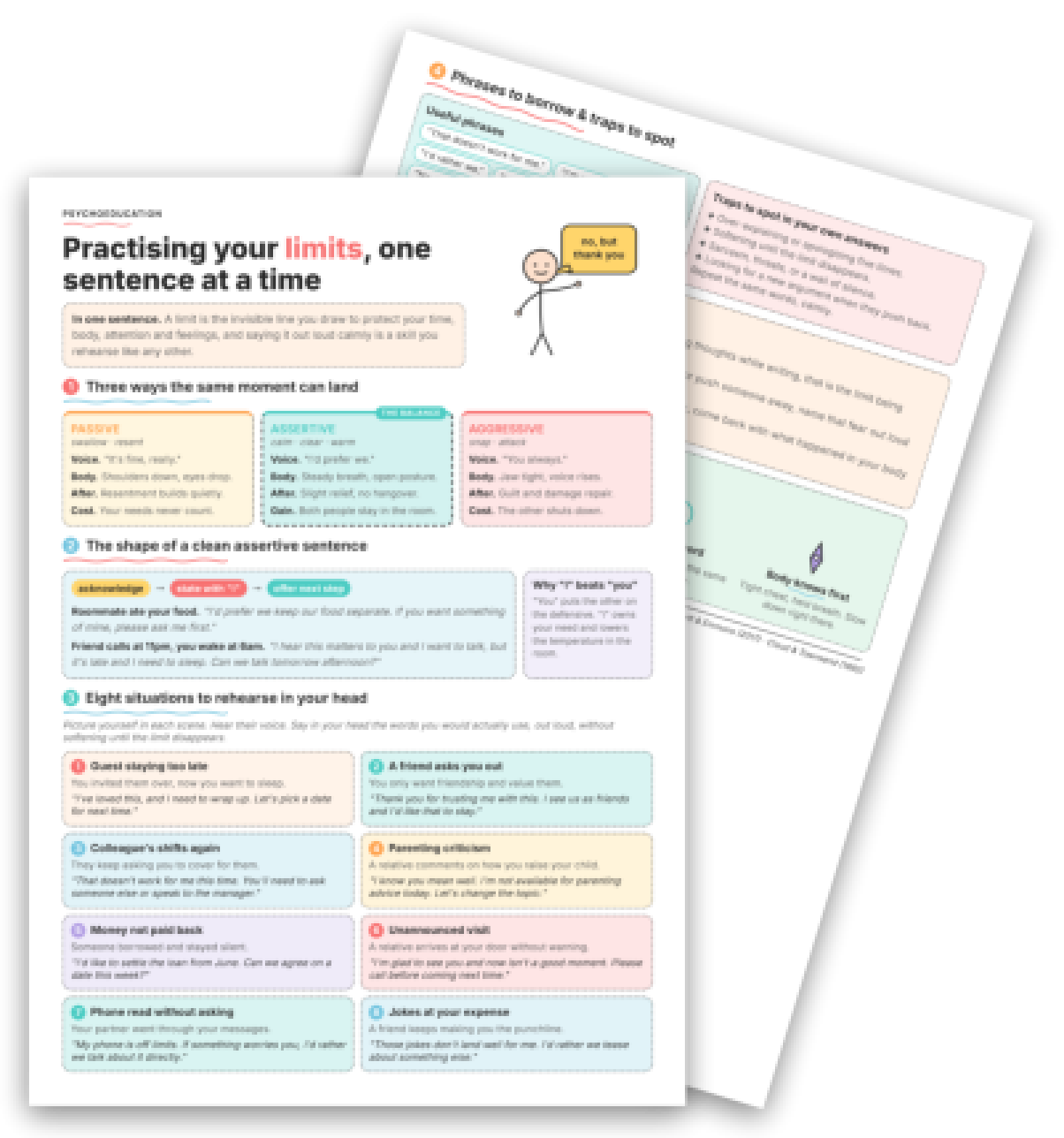
The fiche runs across four numbered panels.
Panel 1 places passive, assertive, and aggressive styles in a three-column layout, mapping each across voice, body, and aftermath. The passive column reads "resentment builds quietly"; the assertive column, "slight relief, no hangover." Patients who have never articulated why chronic compliance feels so corrosive often locate themselves in this visual in under a minute, faster than any anamnèse item would surface it. This connects naturally to the boundary styles framework you may already be using.
Panel 2 gives the structural skeleton of a clean assertive sentence: acknowledge → state with "I" → offer next step, illustrated with two worked examples (a roommate conflict, a late-night phone call). The panel also explains, briefly, why first-person framing lowers relational temperature, anchoring what patients encounter in I-message work.
Panel 3 is the practical core: eight rehearsal scenarios (a guest who stays too late, a colleague offloading shifts, unsolicited parenting criticism, money not returned, an unannounced visit, a partner reading private messages, jokes at the patient's expense, a friend's romantic proposition), each paired with a model response. Patients are instructed to "hear their voice, say in your head the words you would actually use, out loud, without softening until the limit disappears."
Panel 4 collates a borrowable phrase bank ("That doesn't work for me," "I'm not available for that," "No, but thank you") alongside self-traps to recognise: over-explaining, softening the limit until it vanishes, looking for a new argument when pushed back. The broken record principle in this panel maps directly onto what DBT practitioners know from the DEAR MAN skill.
A dedicated "To discuss in session" block closes the fiche with three clinician-facing prompts: somatic signals while rehearsing, catastrophic relational predictions tied to saying no, and the homework invitation to report back what happened "in your body and in theirs" when a rehearsed response was actually used.
> To remember: this worksheet is a visual support that facilitates the explanation of limit-setting in session. The clinician walks through it with the patient, builds a shared vocabulary from it, and sends it home as a concrete reference between appointments, not a questionnaire to complete alone.
Use it with your patients
Share this tool in the mobile app and follow the work between sessions.
When and How to Introduce the Worksheet
The fiche fits naturally into mid-phase work, once the alliance is solid and the avoidance pattern is named. It is particularly well-suited to patients presenting with self-sacrifice schemas (see the self-sacrifice schema worksheet), approval-seeking patterns, or chronic relational resentment without clear awareness of its source.
A low-threshold introduction: "I'd like to show you a visual that maps three ways a limit can land, passive, assertive, aggressive, and what each one costs. Most people recognise themselves in one of the columns straight away." Framing it as pattern recognition rather than skill deficit keeps the alliance intact and reduces the shame that can surface with more directive introductions.
In session, work through Panel 1 together before moving to Panel 2. Then ask the patient which scenario in Panel 3 feels most charged for them this week, that becomes the rehearsal anchor. With patients showing marked social anxiety or strong fears tied to the abandonment schema, slow down at the "To discuss in session" block: the prompt about catastrophic relational predictions often opens material worth an entire session on its own.
The worksheet pairs well with assertive body language practice when somatic expression is underdeveloped, and with the assertiveness behavioral experiment once the patient is ready to test a limit in vivo. One clear contraindication: in contexts of domestic violence or significant power imbalance, assertive limit-setting may carry genuine safety risk, assess carefully before assigning.
The fiche does not replace clinical formulation. It gives your explanation the traction it otherwise lacks, and leaves the patient with a phrase bank, a structural formula, and a somatic cue ("tight chest, held breath, slow down right there") ready when the moment actually arrives.
Your session continues in your patients' pocket
Use with a patientYour resources, available everywhere
The handouts, exercises, programs and audios above: you choose which ones to make available to your patients, in the mobile app dedicated to them.
And far more than a library
The app goes well beyond resources, to support your patients every day:
Related categories
Explore other clinical resources by category.

Identity
Clinical resources for self-identity work in therapy: CBT, ACT, schema tools for clinicians addressing self-concept, core beliefs, and identity disruption.

Relationships
Clinical worksheets and tools on relational functioning: attachment, schemas, assertiveness, and communication skills for therapists. Printable PDF resources.

Build awareness
Clinical worksheets and tools to build awareness in therapy: cognitive distortions, schemas, emotions, ACT and CBT resources for practitioners.

Build skills
Skill-building resources for clinicians: printable worksheets and exercises for coping, assertiveness, and communication skills training in therapy.

Engage & motivate
Clinical hub: printable worksheets and exercises to build therapeutic engagement and motivation across ACT, CBT, and integrative practice. For clinicians.

CBT
CBT worksheets, cognitive restructuring exercises & behavioral tools for clinicians. Evidence-based resources for every phase of cognitive behavioral therapy.