
Clinical picture. T., a man in his early forties, presents with low-grade relational dissatisfaction following a period of professional burnout; his partner does not attend sessions. The clinician introduces the weekly check-in as a between-session homework task, asking T. to rate the week and then work through the remaining questions in writing before the next appointment. On question four, T. notes that he had wanted to ask his partner to slow down their social schedule but said nothing, fearing an argument. Bringing this written response into session allowed a focused exploration of his avoidance pattern, and T. identified one specific sentence he intended to say to his partner before the following week. The exercise did not resolve the underlying dynamic, but it gave the clinician concrete material to work with rather than a general complaint.
Weekly Couples Relationship Check-In: A Guided Exercise
A structured homework tool helping patients reflect on shared moments, communication gaps, and relational intentions week by week.
Clinical vignettes
Surfacing Unspoken Frustration in a Distanced Couple
Rebuilding Intentionality After Repeated Conflict
Clinical picture. M., a woman in her mid-thirties, is seen individually while her couple is in a post-crisis stabilisation phase after repeated escalating arguments. The clinician suggests completing the structured check-in each Sunday evening, explaining that question five, focused on intentions for the coming week, is often the hardest to answer honestly. M. initially rated every week between three and four and left the intentions question blank. By the fourth week she wrote a brief but specific intention: to greet her partner without her phone in hand at least twice. The clinician used this small behavioural anchor to discuss the gap between her stated relational values and her habitual withdrawal, without framing the exercise as a measure of progress.
What makes weekly relational reflection so hard to sustain
Couples rarely lack goodwill. What they often lack is a structured pause. The week accumulates, interactions blur into one another, and by the time a patient sits down with you, they struggle to recall what actually happened between them and their partner, let alone what they felt about it or what they failed to say. Oral exploration in consultation can only go so far: memory is compressed, affect flattens, and the unsaid remains unsaid.
This is where a structured, written review becomes clinically useful. For patients working on relationship maintenance behaviors, communication patterns, or relational conflict, the gap between sessions is not dead time. It is the actual terrain. Capturing it with precision, in writing, before it dissolves, is something no amount of retrospective questioning can fully replicate.
Use this resource with your patients
Handout, exercises and materials ready to use, right inside SessionFuel.
What the exercise contains
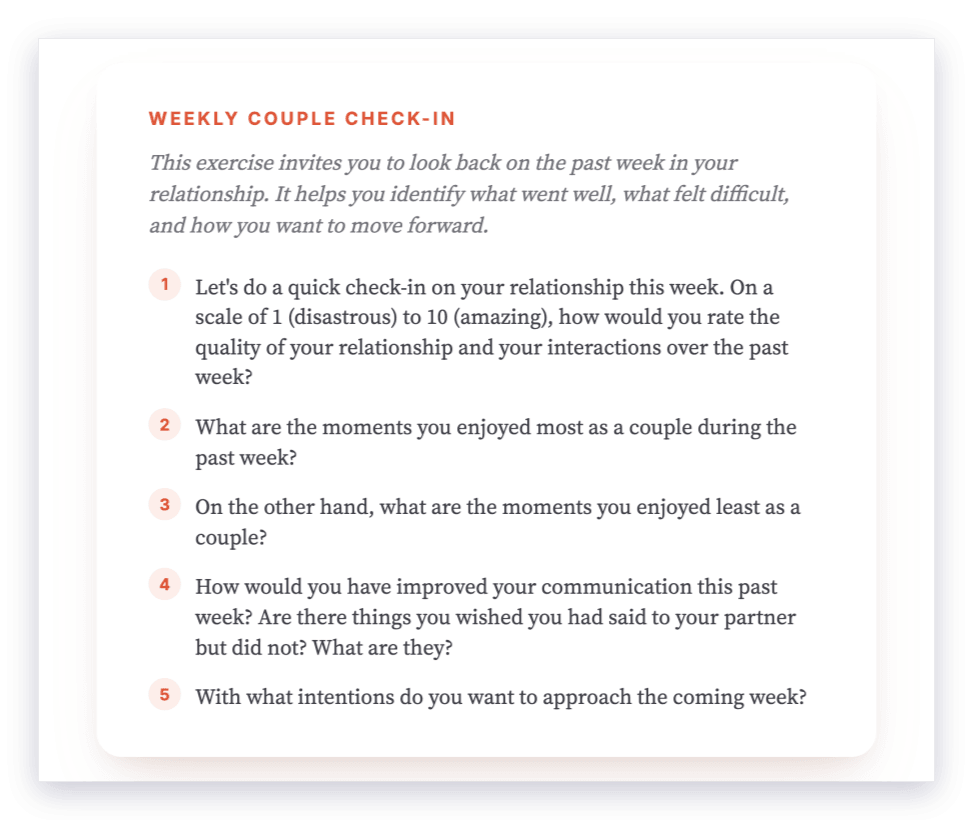
The exercise "Recapping our week" is a five-question structured reflection patients complete on their own between two appointments. The questions move in a deliberate arc:
Note: this image is a static preview listing the questions only. The full guided exercise, with patient-facing instructions and space to write, is experienced by the patient directly on their own in the app, not through this image.
The opening numerical rating (question 1) gives both patient and clinician an anchor, comparable across weeks, that bypasses the vague "it was fine." Questions 2 and 3 build a concrete ledger of positive and difficult moments, moving the patient from global impression to specific relational events. Question 4 targets the unsaid: what was held back, and what alternative communication might have looked like. This is a natural clinical entry point into tools such as nonviolent communication for couples, I-messages, or the LACE empathic assertion framework. Question 5 closes with intentional orientation toward the next week, a move from retrospection to committed direction.
This exercise is available to patients through the SessionFuel patient app, the mobile companion reserved for patients of clinicians who use SessionFuel: once you assign it, your patient completes the five questions independently on their phone, between two consultations.
Key insight: A numerical weekly rating repeated over time becomes a relational time series, letting you and your patient track fluctuations, identify patterns, and test whether specific changes are landing.
750+ clinical tools
A library built with and for clinicians, ready to use in session and extend between appointments.
Access all the toolsHow to integrate it as between-session homework
This exercise suits a wide range of couples-focused work: early-stage relational assessment, maintenance phases, or post-conflict stabilisation. It also works well in individual therapy with patients working on their contribution to a relational dynamic, alongside resources like Detecting Couple Misalignment or Relational Gratitude.
Introduce it by framing it as a weekly relational log: not a performance tool, not a complaint register, but a structured way to stay in contact with what is actually happening between them and their partner. Normalise that some weeks will score low, and that this is data, not failure.
Between-session, the patient completes the exercise autonomously. When they return, the written output becomes your starting material. You can open with the numerical rating from question 1 and compare it to previous weeks. The unsaid items from question 4 are often the richest clinical material: they surface avoidance patterns, fear of conflict, or gaps in assertive communication worth exploring with tools like fair fighting rules or expressing vulnerability in relationships. The intentions named in question 5 can be revisited at the following session, creating a brief accountability loop that makes homework feel meaningful rather than performative.
For patients also working on desire and sexual satisfaction, mental load imbalance, or trust rupture, this weekly check-in provides a consistent relational baseline alongside more targeted exercises.
Use it with your patients
Share this tool in the mobile app and follow the work between sessions.
Adapting across clinical contexts
The five-question structure is deliberately light enough to sustain across weeks without fatigue. For patients with a tendency toward avoidance or difficulty accessing positive experiences, you may want to pair question 2 with the Couple's Strengths Exploration fiche, which provides a richer vocabulary for naming what works. For patients working on communication more broadly, the Romantic Life Assessment can serve as a longer punctual review alongside this weekly rhythm.
Your session continues in your patients' pocket
Use with a patientYour resources, available everywhere
The handouts, exercises, programs and audios above: you choose which ones to make available to your patients, in the mobile app dedicated to them.
And far more than a library
The app goes well beyond resources, to support your patients every day:
Related categories
Explore other clinical resources by category.

Relationships
Clinical worksheets and tools on relational functioning: attachment, schemas, assertiveness, and communication skills for therapists. Printable PDF resources.

Build skills
Skill-building resources for clinicians: printable worksheets and exercises for coping, assertiveness, and communication skills training in therapy.

Engage & motivate
Clinical hub: printable worksheets and exercises to build therapeutic engagement and motivation across ACT, CBT, and integrative practice. For clinicians.

Integrative
Integrative therapy clinical resources: worksheets, psychoeducation programs, and exercises for eclectic, multimodal practice across orientations.

Solution-focused
Clinical hub for Solution Focused Therapy resources: worksheets, exercises and programs for goal-oriented, strengths-based practice across individual and couple work.

Anxiety
Clinical hub for anxiety disorders: CBT and ACT worksheets, psychoeducation sheets, and exercises for assessment and treatment across the anxiety spectrum.