
Clinical picture. M., a woman in her early forties, presented with low-grade dysthymia and a long history of relationship anxiety; she had spent two prior therapies cataloguing what was wrong in her current partnership. Her clinician introduced the Relationship Green Flags sheet midway through a session focused on a recent argument, inviting her to score each of the twelve qualities against a concrete recent example rather than a general impression. M. paused at safety and conflict repair, noting with some surprise that her partner had circled back the following morning to apologise without prompting. The exercise did not reframe her concerns away, but it gave her a differentiated map: several flags were genuinely present, two were partly present, and one (independence) she identified as her own longstanding difficulty rather than a relational failure. She left with a self-assigned task to name one appreciative observation aloud each day, a small and observable action she felt she could monitor honestly.
Relationship Green Flags: PDF Worksheet, Tools and Exercises
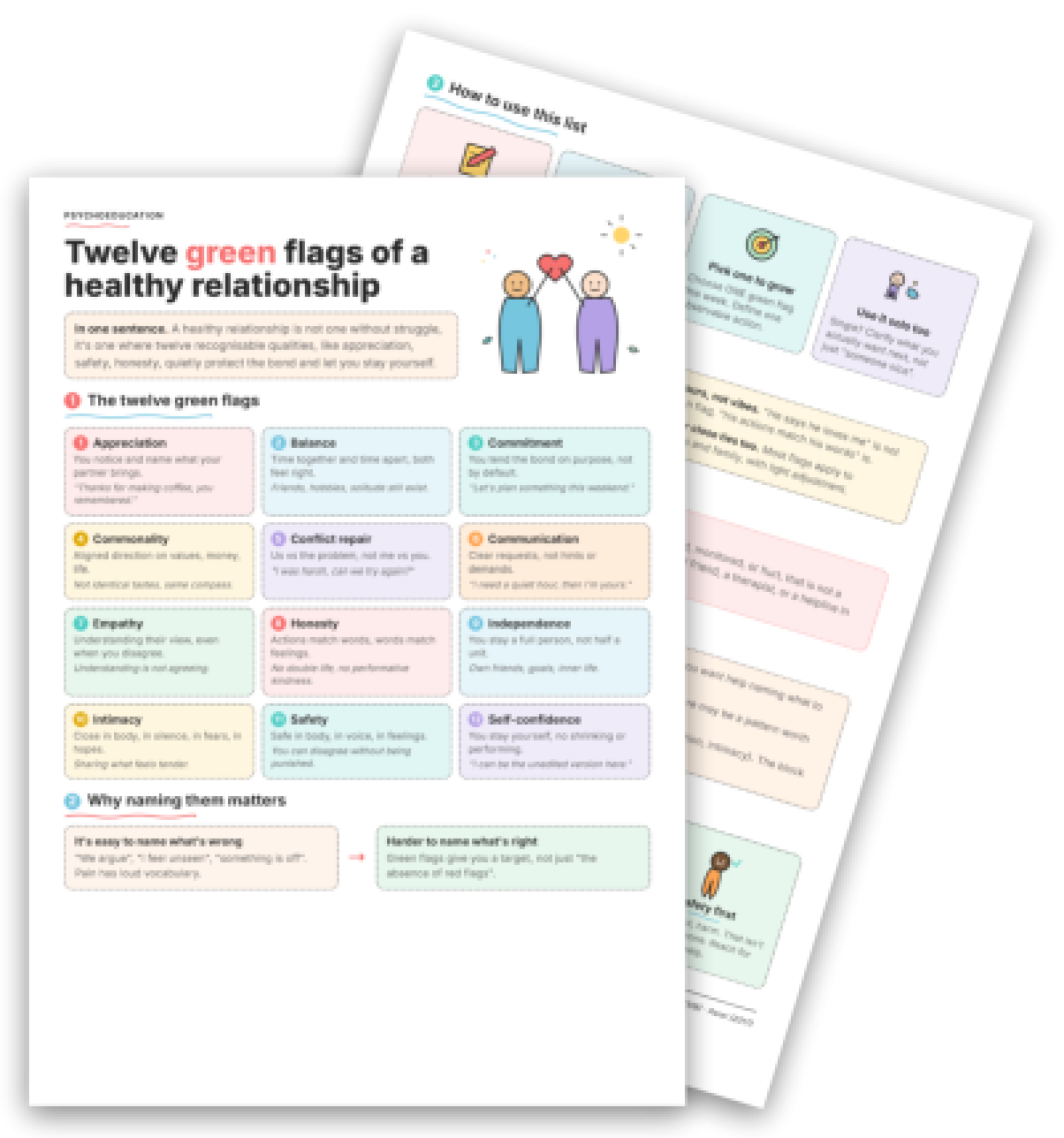
A printable fiche with twelve named relationship qualities to use as a visual psychoeducation tool in couples or individual therapy sessions.
Clinical vignettes
Naming Strengths After Chronic Conflict
Early Relationship, Uncertain Reference Points
Clinical picture. T., a man in his late twenties with a history of an emotionally coercive previous relationship, entered therapy reporting confusion about whether his new partnership was healthy or whether he was simply unaccustomed to the absence of tension. The clinician offered the informational sheet as a structured reference point, explaining that the twelve flags describe observable qualities rather than idealised states, and that partial presence is meaningful data. Working through the list, T. was struck by the self-confidence item; he noted he no longer rehearsed conversations before having them, something he had done habitually for three years prior. One flag, honesty, prompted more ambivalence, and this became the focus of the following session, grounding subsequent clinical work in a concrete, patient-generated example rather than abstract reassurance.
Patients navigating relational distress can articulate their pain with precision: "we argue constantly," "I feel invisible," "something has broken." Positive relationship qualities, by contrast, sit in a lexical void. This asymmetry creates real clinical friction, goals stay vague, formulation lacks a shared language, and psychoeducation about what healthy relationships actually look like becomes an abstract lecture. This relationship green flags fiche PDF resolves that by putting twelve named, behaviorally defined qualities on a single printable page your patient takes away.
Use this resource with your patients
Handout, exercises and materials ready to use, right inside SessionFuel.
Why Relationship Green Flags Are Hard to Articulate Without a Visual Support
The clinical problem is not that patients don't value healthy relationships. It's that "absence of red flags" is not the same as a positive target, and most patients have never been asked to name one concretely. When you work within schema therapy frameworks, the abandonment fear schema or the mistrust/abuse pattern structure the whole presenting picture; asking "what would a secure bond look like to you?" often produces silence or platitudes.
The same gap appears in attachment work. Patients can describe their insecure pattern fluently; they struggle to describe the behaviours, not the feelings, of a securely attached relationship. Without concrete anchors, psychoeducation about what is working stays impressionistic and hard to operationalise in homework.
A visual support that names twelve specific qualities, each with a one-sentence behavioural example, immediately gives both clinician and patient a working vocabulary. It also makes case formulation more precise: which flags are present, which are missing, which are present from one partner but blocked in the other.
What This Fiche Contains: Twelve Behavioural Green Flags on One Page
The fiche is structured across seven panels. The spine is a numbered list of twelve green flags: Appreciation, Balance, Commitment, Commonality, Conflict Repair, Communication, Empathy, Honesty, Independence, Intimacy, Safety, and Self-Confidence. Crucially, each is defined by a concrete behavioural example, not a trait or a feeling. The flag for Honesty, for instance, is framed as "actions match words, words match feelings," not "he says he loves me." The flag for Safety specifies "you can disagree without being punished," which immediately grounds the concept for patients who have normalised low-level relational punishment.
A second panel addresses why naming positives matters: pain has vocabulary; direction toward health requires a target, not merely an absence. A third panel provides four operational instructions: score each flag as present, partly present, or missing; notice which ones produce a somatic or emotional flinch; select one flag to develop this week; and apply the list to close friendships or solo work on partner selection.
The fiche explicitly flags its own limits: "green flags are not a tool to convince yourself to stay" if physical or psychological safety is compromised. A final "To discuss in session" panel lists three clinical prompts, including what to explore when a flag is consistently absent across successive relationships and when a flag is offered by the partner but hard for the patient to receive.
> Key takeaway: The fiche functions as a visual psychoeducation tool to use during the session, not a questionnaire patients complete alone. The visual layout does what oral explanation cannot: it presents all twelve qualities simultaneously, allowing the clinician and patient to scan the whole picture and locate the areas of growth together.
750+ clinical tools
A library built with and for clinicians, ready to use in session and extend between appointments.
Access all the toolsWhen and How to Propose the Fiche in Session
The fiche fits naturally at several points in a care plan. In early sessions with couples, it provides a formulation anchor before going deeper into conflict cycles: you might introduce it alongside the four Gottman horsemen and their antidotes or the EFT infinity loop. In individual therapy, it works well once the presenting relational complaint is mapped, as a bridge toward positive goal-setting, pair it with a romantic life assessment exercise or work on expressing vulnerability.
For patients working on communication patterns in couples, the Communication and Conflict Repair flags serve as concrete behavioural targets alongside assertiveness and fair fighting skill-building. For patients exploring singlehood, the fiche is explicitly designed to function solo: it clarifies what they are actually seeking in a future relationship, well beyond "someone nice."
One clinical formulation worth having ready: "I'd like us to look at this list together, not to grade your relationship, but to find the specific behaviours worth building toward." That framing prevents the instrument from reading as an implicit verdict.
A contraindication: avoid using the fiche with patients in active abusive dynamics as a goal-setting tool. The fiche itself names this boundary clearly. Pair your clinical judgment with resources addressing safety and the cycle of abuse before any positive-qualities frame is introduced.
For longer follow-up work, the fiche pairs well with a healthy relationships psychoeducation program, a trust-building curriculum, the keeping the flame alive exercise, or a couples conflict program. The five love languages fiche complements the Appreciation and Intimacy flags specifically.
The fiche does not replace the therapeutic frame. It makes the explanation faster, more precise, and leaves the patient with a behavioural map they can return to between sessions.
Use it with your patients
Share this tool in the mobile app and follow the work between sessions.
Sources
- Gottman, J. M., Silver, N. (1999). The Seven Principles for Making Marriage Work. Crown Publishers.
- Johnson, S. (2008). Hold Me Tight: Seven Conversations for a Lifetime of Love. Little, Brown and Company.
- Brogaard, B. (2024). 10 Green Flags for Great Relationships. Psychology Today.
Your session continues in your patients' pocket
Use with a patientYour resources, available everywhere
The handouts, exercises, programs and audios above: you choose which ones to make available to your patients, in the mobile app dedicated to them.
And far more than a library
The app goes well beyond resources, to support your patients every day:
Related categories
Explore other clinical resources by category.

Identity
Clinical resources for self-identity work in therapy: CBT, ACT, schema tools for clinicians addressing self-concept, core beliefs, and identity disruption.
Relationships
Clinical worksheets and tools on relational functioning: attachment, schemas, assertiveness, and communication skills for therapists. Printable PDF resources.
Build awareness
Clinical worksheets and tools to build awareness in therapy: cognitive distortions, schemas, emotions, ACT and CBT resources for practitioners.

Build skills
Skill-building resources for clinicians: printable worksheets and exercises for coping, assertiveness, and communication skills training in therapy.

Engage & motivate
Clinical hub: printable worksheets and exercises to build therapeutic engagement and motivation across ACT, CBT, and integrative practice. For clinicians.
CBT
CBT worksheets, cognitive restructuring exercises & behavioral tools for clinicians. Evidence-based resources for every phase of cognitive behavioral therapy.