
Clinical picture. A., a woman in her early thirties, presents with recurrent low mood and a pattern of short-lived relationships she describes as "always ending the same way." She has never been asked to articulate, in structured terms, what she actually looks for in a partner or how she conceptualises love. The clinician introduces the guided exercise as a self-reflection tool to be completed between sessions, framing it as a way to map her romantic life rather than to judge it. Working through the questions, A. notices for the first time that her expectations of a partner centre heavily on emotional availability, yet she consistently chooses partners she already perceives as emotionally distant at the outset. This observation becomes a productive focus for the subsequent session, without any claim that insight alone will change the pattern.
Romantic Life Assessment: A Guided Self-Reflection Exercise
Help patients articulate their vision of love, relationship status, partner expectations, and the concrete gaps in their romantic life.
Clinical vignettes
Clarifying Romantic Expectations After Repeated Breakups
Addressing Ambiguous Relationship Status in Chronic Anxiety
Clinical picture. M., a man in his mid-forties, attends therapy for generalised anxiety and mentions his romantic life only in passing, calling it "complicated." The clinician offers the guided exercise to help him put words to a situation he has so far kept vague, noting that the questions require no particular outcome and carry no evaluative weight. M. returns the following week having written that he and his long-term partner have been living separately for eight months but have not discussed separation openly; completing the question on positives and areas for improvement surfaced a level of ambivalence he had been avoiding. The exercise does not resolve the ambivalence, but it gives the clinician and M. shared, concrete material to work with.
The Clinical Gap: What Resists a Purely Verbal Exploration
Romantic life is one of the most emotionally dense domains a patient brings to therapy, and one of the most difficult to map with precision. Patients rarely arrive with a coherent account. They come with a feeling: something is missing, something hurts, or things are "fine, but not really." The distance between lived experience and articulated understanding is often wide, and a direct in-session question frequently yields a rehearsed answer rather than a genuine exploration.
Several dynamics compound this difficulty. Schemas about love are among the earliest and most resistant to conscious inspection. A patient shaped by the emotional deprivation schema, or carrying a mistrust/abuse pattern, may not recognise how those blueprints are quietly organising their romantic choices right now. Similarly, patients who have never clearly named what they expect from a partner often cannot identify why repeated relationships follow the same arc. And for patients who are single, the question of what singlehood means to them, beyond the social narrative, rarely gets asked directly (the Being Single exercise addresses exactly that layer).
This exercise answers a concrete clinical need: building a clear personal baseline of the patient's romantic life, produced autonomously, before it enters the therapeutic conversation.
Use this resource with your patients
Handout, exercises and materials ready to use, right inside SessionFuel.
What the Exercise Contains
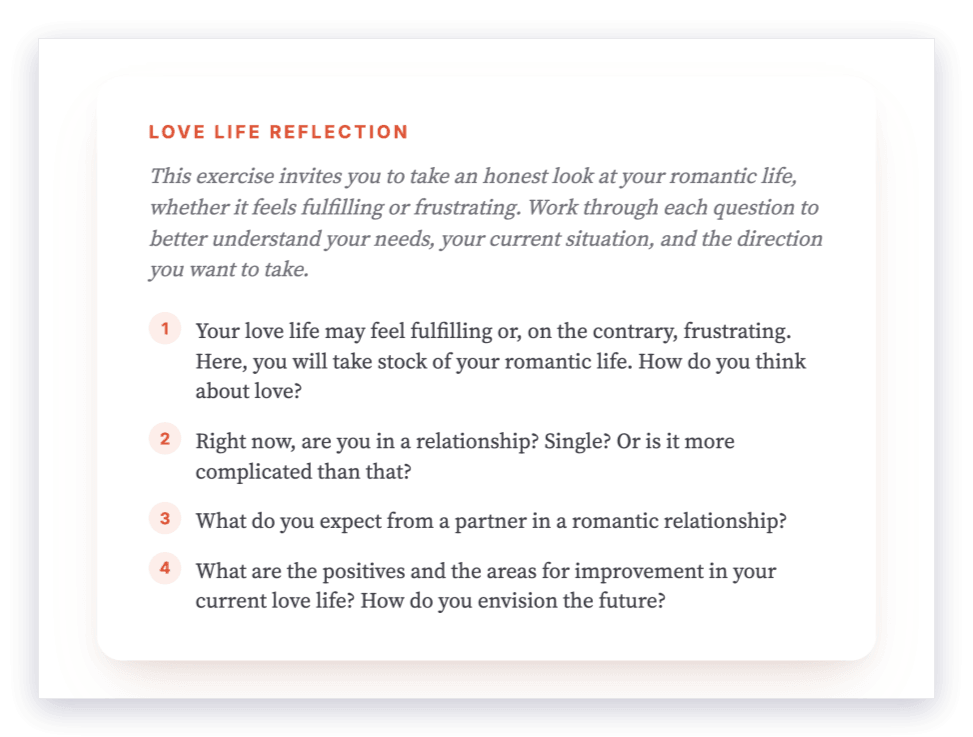
The tool is built around four sequential questions. The first asks the patient how they envision love in general, an open conceptual entry point that surfaces core relational assumptions without requiring the patient to name them as schemas. The second grounds the reflection in the present: are they in a couple, single, or somewhere more complicated? That "more complicated" option matters; it gives space for ambivalence, non-conventional situations, and relational states that resist simple labels. The third question asks directly what they expect from a partner in a romantic relationship, a values and needs probe that can be read alongside the Relationship Values fiche or the Behavior, Emotion, Underlying Need framework when unmet needs appear clearly. The fourth asks for a personal audit: what is working, what needs improving, and how does the patient envision the future of their romantic life?
The image above lists the four questions in order, with a brief orienting introduction.
This image is a static preview of the question list only. The full guided exercise, including patient-facing instructions and writing space for each answer, is experienced by the patient autonomously in the app, not through this image.
This exercise is available to your patients through the mobile application that is the dedicated patient-side interface of SessionFuel: you assign it from your SessionFuel account, and your patient completes it on their own phone, between appointments, entirely on their own.
Key insight: A romantic life assessment done in writing, between sessions, yields richer and more honest material than an improvised in-session answer. The patient has time to sit with the questions, and you receive a genuine first draft of their relational world.
750+ clinical tools
A library built with and for clinicians, ready to use in session and extend between appointments.
Access all the toolsUse it with your patients
Share this tool in the mobile app and follow the work between sessions.
Integrating It as Between-Session Homework
Assign this exercise at a natural opening moment: when a patient mentions relational dissatisfaction without being able to say exactly where it comes from, when a new patient signals that their romantic life is a concern, or when you are beginning work on attachment styles, relationship compatibility, or recurring couple dynamics. It suits patients working individually, whether they are partnered or not, and it is equally useful before engaging with more targeted tools such as the Weekly Couples Relationship Check-In, the Trust Rupture in Couples exercise, or the Mental Load Imbalance in Couples reflection.
When introducing it, keep the framing simple: tell the patient you would like them to take some quiet time, on their own, to reflect on their romantic life in writing. Frame it as an honest personal snapshot, not a test or a complaint inventory.
When the patient returns the completed exercise, the four answers give you four distinct clinical entry points. The first answer often reveals relational core beliefs worth examining with the 12 Beliefs That Damage Relationships fiche. The second and third together map the gap between current reality and relational expectations, a productive starting point for boundary exploration or NVC-based communication work. The fourth, especially the future-oriented part, connects naturally to life goals work and values clarification. For patients who struggle to name anything positive, that absence is itself significant clinical data, pointing toward schemas worth exploring with the Early Maladaptive Schemas fiche.
The exercise does not diagnose or prescribe. Its value is precisely that it is the patient's own account, written without the therapist present, and brought into the session as shared material to work from together.
Your session continues in your patients' pocket
Use with a patientYour resources, available everywhere
The handouts, exercises, programs and audios above: you choose which ones to make available to your patients, in the mobile app dedicated to them.
And far more than a library
The app goes well beyond resources, to support your patients every day:
Related categories
Explore other clinical resources by category.

Relationships
Clinical worksheets and tools on relational functioning: attachment, schemas, assertiveness, and communication skills for therapists. Printable PDF resources.

Build awareness
Clinical worksheets and tools to build awareness in therapy: cognitive distortions, schemas, emotions, ACT and CBT resources for practitioners.

Humanistic
Printable clinical resources for humanistic therapy: worksheets, exercises, and psychoeducation programs for practitioners using person-centered and experiential approaches.

Solution-focused
Clinical hub for Solution Focused Therapy resources: worksheets, exercises and programs for goal-oriented, strengths-based practice across individual and couple work.
Anxiety
Clinical hub for anxiety disorders: CBT and ACT worksheets, psychoeducation sheets, and exercises for assessment and treatment across the anxiety spectrum.
Trauma
Clinical hub on trauma and PTSD: assessment, differential diagnosis, treatment phases, and printable resources for practitioners. 155 chars.