
Solution Focused Therapy: Clinical Resources for Goal-Oriented Practice
Solution Focused Therapy (SFT), also known as Solution Focused Brief Therapy (SFBT), is a goal-directed, competency-based clinical orientation that prioritises client strengths and preferred futures over problem aetiology. This page is designed for clinicians integrating SFT principles into individual, couple, or group therapy contexts. It brings together a curated set of printable worksheets, guided exercises, and structured programs that operationalise the core mechanisms of the approach. Whether you work within a purely SFT framework or blend it with CBT, ACT, or systemic methods, these resources extend what is possible within and between sessions.

Core Assumptions and the Constructivist Underpinning
Solution Focused Therapy was developed by Steve de Shazer and Insoo Kim Berg at the Brief Family Therapy Center in Milwaukee during the 1980s. Its epistemological roots sit in social constructionism and strategic brief therapy: the premise that language shapes reality, that problems and solutions are co-constructed in dialogue, and that clients already possess the resources needed for change. This is not a deficit model. The clinician functions less as an expert diagnostician and more as a curious, competency-amplifying collaborator.
The clinical mechanism rests on a redirection of attentional focus. Where most psychotherapeutic models ask, "What is wrong and how did it come to be?" SFT asks, "What is already working, and what would more of it look like?" This shift is not superficial positivity; it is a deliberate linguistic and cognitive reframe with measurable effects on self-efficacy, agency, and behavioural activation. The approach is particularly well-suited to time-limited contracts, primary care interfaces, and settings where brief, structured intervention is indicated.
Key Techniques: Exceptions, Scaling, and the Miracle Question
Three techniques form the operational core of SFT. First, exception-finding: the therapist elicits times when the problem was absent or less severe, surfacing competencies the client has already demonstrated. Second, scaling questions: the client rates their current position on a 0-to-10 continuum relative to a defined goal, generating a concrete, observable metric for progress. Third, the miracle question ("Suppose tonight, while you sleep, a miracle happens and the problem is resolved. How would you know? What would be different?"): this question bypasses ruminative problem-talk and directs attention toward a vivid, emotionally charged preferred future.
These techniques translate directly into session structure. A well-constructed between-session task derived from a scaling conversation, for example, carries far more therapeutic weight than a generic homework assignment. The printable exercises in this category are built around exactly this logic.
Identifying Suitable Presentations: Clinical Repérage in Consultation
Presentations Where SFT Adds Immediate Value
SFT is not restricted to any single diagnostic category. Its utility spans a wide range of presentations, and several clinical features tend to signal a particularly productive fit:
- The client articulates distress primarily in terms of unmet goals rather than unprocessed trauma
- There is evidence of motivational ambivalence that benefits from strengths-based activation rather than further problem exploration
- The clinical relationship is time-limited (student health, EAP contracts, primary care psychology)
- The client has already engaged in prior insight-oriented work and is now seeking behavioural consolidation
- Interpersonal or occupational stressors dominate the presenting complaint
For clients struggling with motivational dips across a therapeutic arc, the Motivational Dips in Practice: A Guided Clinical Exercise offers a structured way to map fluctuations in commitment and identify exception periods where motivation was stronger. This aligns directly with the SFT principle that no problem is constant.
Presenting Problems Amenable to Goal-Oriented Framing
Occupational distress is one of the most common presentations where SFT techniques prove immediately applicable. Complaints of professional dissatisfaction, role ambiguity, or work-related boredom often reflect an absence of clear goal structures rather than a deep characterological issue. The Work Boredom Exercise: A Structured Clinical Tool for Therapy and the Professional Life Assessment: A Guided Clinical Exercise both invite the client to articulate where they are, where they want to be, and what small steps are already in motion. Pairing these with a scaling question in session can produce a rapid shift in perceived agency.
For clients presenting with work-life boundary difficulties, the Work-Life Balance: A Structured Self-Assessment Exercise supports the SFT process of identifying domains where balance already exists (however partially) before addressing those where it breaks down.
Comorbidities, Differential Considerations, and Model Limits
When SFT Complements a Broader Formulation
SFT does not preclude diagnostic rigour. A client presenting with major depressive disorder will benefit from a full biopsychosocial formulation; the SFT frame is then deployed selectively to activate behavioural domains where the client retains some efficacy. The My Fight Against Depression: A Guided Exercise for Clinicians exemplifies this integrative use: it is not presented as a cure for depression but as a tool for eliciting exception narratives and reinforcing incremental behavioural gains within a broader treatment plan.
Similarly, anxiety disorders can be addressed using SFT-compatible progress review tools. The My Fight Against Anxiety: A Structured Progress Review Exercise operationalises the scaling technique by supporting the client in tracking their own competency gains across sessions, rather than cataloguing symptom severity alone. This reframe from symptom monitoring to progress monitoring is clinically significant.
Contraindications and Points of Vigilance
SFT's strengths-focus carries a clinical risk that must be actively managed: premature closure on problem experience. Moving too quickly toward solutions before adequate validation of distress can rupture the therapeutic alliance, particularly with clients presenting with complex trauma, personality pathology, or grief. The clinician must hold the tension between the SFT commitment to forward movement and the relational need to feel sufficiently understood before change is attempted.
Additional vigilance is warranted in the following situations:
- Active suicidality or recent self-harm: SFT techniques do not substitute for structured risk assessment and safety planning
- Severe alexithymia: exception-finding requires sufficient emotional self-awareness to identify experiential contrasts
- Clients in early-stage trauma processing: the directive toward preferred futures can feel invalidating or dissociative
- High intellectual defences: the miracle question can be intellectualised in ways that bypass affective engagement
Goal Construction in SFT: Translating the Preferred Future into Actionable Steps
SMART Goals and the SFT Commitment to Specificity
One of SFT's most operationally distinctive features is its insistence on well-formed goals: specific, observable, achievable within the client's own sphere of influence, and framed in positive (presence-of) rather than negative (absence-of) language. A goal such as "I want to be less anxious" is not well-formed in SFT terms; "I want to be able to sit through a team meeting without leaving early three times out of five next week" is.
The Structured Goal-Setting Exercise to Help Patients Commit to Change scaffolds this process directly. It guides the client from a broad aspiration to a time-bound behavioural commitment, building in the specificity that SFT requires. In session, this can follow a miracle question or scaling conversation as a consolidation step.
Short, Medium, and Long-Term Goal Horizons
SFT is often characterised as exclusively brief and present-focused, but this is an oversimplification. Preferred-future work can and should extend across multiple time horizons, particularly in longer-term contracts. The Setting 6 and 12-Month Goals: A Guided Clinical Exercise allows the clinician to structure a mid-range preferred future narrative, while the 10-Year Goal Projection: A Clinical Exercise for Values Work bridges SFT with values clarification techniques characteristic of ACT. Both tools generate the detailed, emotionally vivid preferred-future descriptions that SFT theory identifies as generative of change.
For clients working on personal development axes, the Mapping Personal Growth Axes: A Guided Clinical Exercise provides a broader life-domain mapping that supports goal prioritisation and avoids the tunnel vision that can emerge from single-domain work.
A structured, step-by-step approach to goal construction in SFT typically follows this sequence:
- Elicit the preferred future using miracle question or equivalent
- Identify exceptions (times when elements of that future were already present)
- Develop a scaling baseline (Where are you now? Where do you want to be by next session?)
- Construct a well-formed goal using specificity criteria
- Assign a between-session task derived from exception or scaling work
- Review at next session: what worked, what moved the scale, what to amplify
Solution Focused Therapy in Couple Work
Applying SFT Principles to Relational Presentations
Couples therapy represents a particularly fertile domain for SFT, given its emphasis on co-constructed preferred futures. In a two-person system, exception-finding takes on a relational dimension: "Tell me about a time recently when things between you felt more like how you want them to be." This question frequently bypasses the blame attribution cycles that characterise distressed couples and moves the pair toward shared competency.
The Assessing Couple Compatibility: A Psychoeducation Program offers a structured psychoeducational framework for exploring relational fit and shared values, which supports the preferred-future construction phase. For couples where misalignment around direction, priorities, or values is the primary presenting concern, the Couple Misalignment: a Guided Clinical Exercise provides a scaffolded process for externalising the blockage and identifying steps toward a shared goal state.
Specific Relational Domains: Mental Load, Desire, and Conflict
SFT-aligned couple work benefits from domain-specific exercises that focus the preferred-future question precisely. Three clinical areas deserve particular attention:
- Mental load imbalance: The Unequal Mental Load in Couples: A Guided Clinical Exercise invites both partners to map their current distribution of cognitive and domestic load, then to articulate what a more equitable distribution would look like in behavioural terms.
- Sexual desire discrepancy: The Sexual Desire Check-In: A Guided Weekly Reflection Tool operationalises a regular scaling and exception-finding process within the domain of intimacy, a context where SFT's non-pathologising stance is particularly valuable.
- Relational vitality: The Keeping the Flame Alive: A Guided Exercise for Couples directs couple attention toward existing positive interactions and toward what more of them would require, a classic SFT amplification of exceptions.
For ongoing relational maintenance between sessions, the Weekly Relationship Review: A Guided Couples Exercise structures a regular check-in that sustains the SFT process across the weeks of a clinical contract. Conflict, when it arises, can be addressed directly using the Conflict Resolution Exercise: A Structured Clinical Tool, which moves the couple from the problem narrative toward a jointly constructed resolution pathway.
> A clinician's perspective from practice: "A couple came in after seven years together, describing their relationship as 'broken.' In the first session, after a miracle question, the husband said: 'She would laugh at something I said at breakfast.' His wife looked up and said, 'That happened last Thursday.' We spent the next twenty minutes on Thursday. That was our turning point. Not the argument they had described for forty minutes before it."
Integrating Growth Mindset Work with Solution Focused Principles
Competency Beliefs as a Therapeutic Target
Growth mindset, as described by Carol Dweck, maps closely onto the SFT assumption that capacities are not fixed and that change is always possible. Clients who hold a rigid fixed mindset about their abilities will resist the exception-finding process: they will attribute past successes to luck rather than skill, and will struggle to generalise competency from one domain to another. Addressing this belief system directly is therefore a legitimate preparatory step in SFT-oriented work.
The Adopting a Growth Mindset: PDF Worksheet, Tools and Exercises for Clinical Practice provides a structured clinical resource for targeting these competency beliefs explicitly. Used early in a course of SFT, it can lower resistance to exception-finding and increase the client's willingness to attribute positive outcomes to their own agency, a prerequisite for the preferred-future work that follows.
Clinical Integration: Using These Resources Within a Care Plan
Sequencing and Session Placement
These resources are designed as between-session consolidation tools, not as substitutes for clinical dialogue. Each exercise is most effective when introduced following an in-session SFT conversation that has already surfaced the relevant preferred future or exception. The clinician explains the rationale ("I want you to take this away and notice what comes up"), the client completes it in their own time, and the completed exercise becomes material for the following session.
Printed resources serve a second function in SFT: they externalise the therapeutic conversation. A completed worksheet is a tangible artefact of the client's own words, goals, and competencies. Returning to it across sessions reinforces continuity and tracks the scaling trajectory over time. This is particularly valuable in brief therapy contexts where the number of sessions is limited and between-session work carries a proportionally greater clinical weight.
Tools in this category
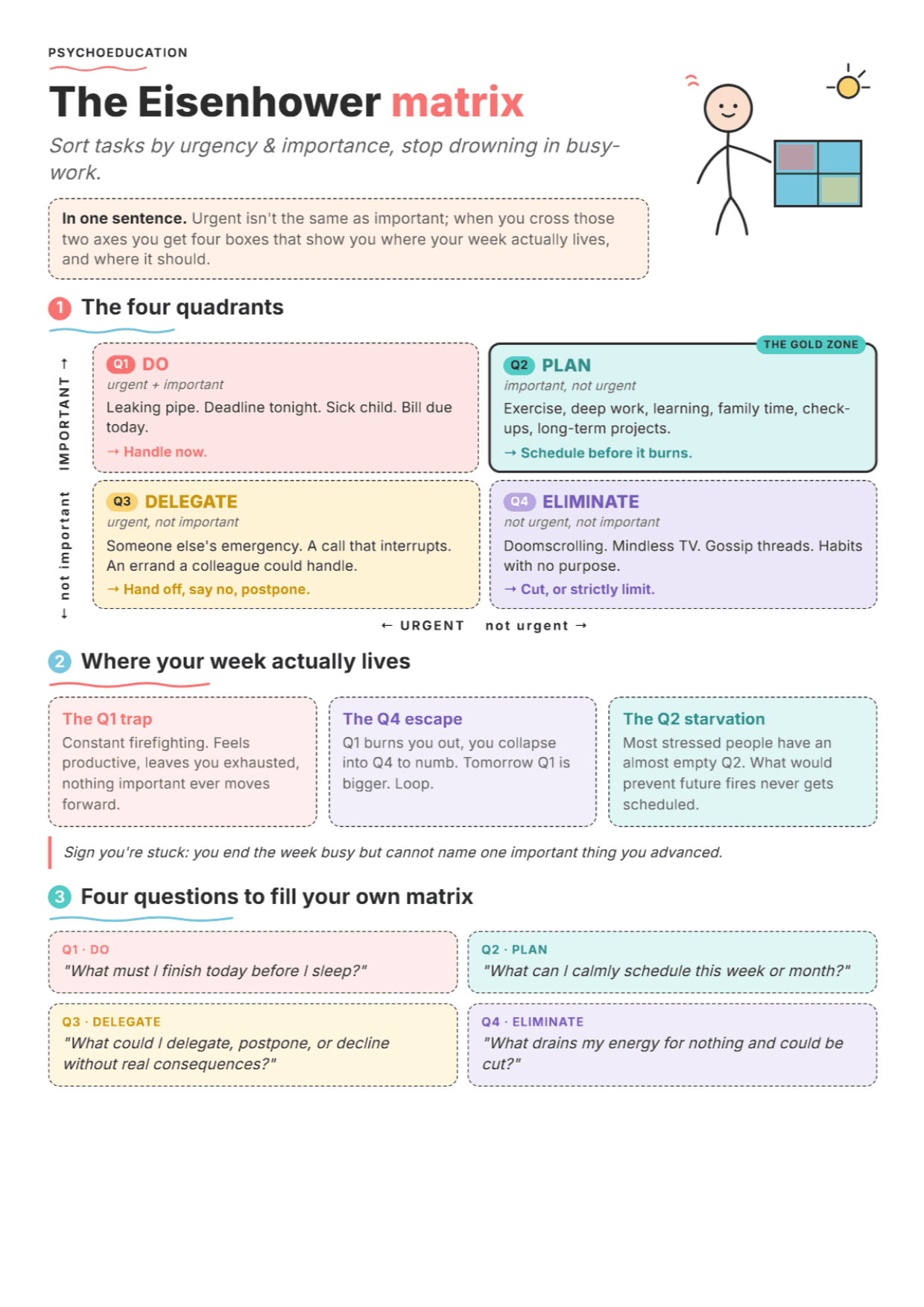
Handout
Eisenhower Urgency-Importance Matrix: PDF Worksheet, Tools and Exercises
A printable PDF worksheet, concrete clinical tools, and structured exercises for helping patients sort priorities, protect recovery time, and stop the burnout loop.
Emotions & stressBehaviours & addictions
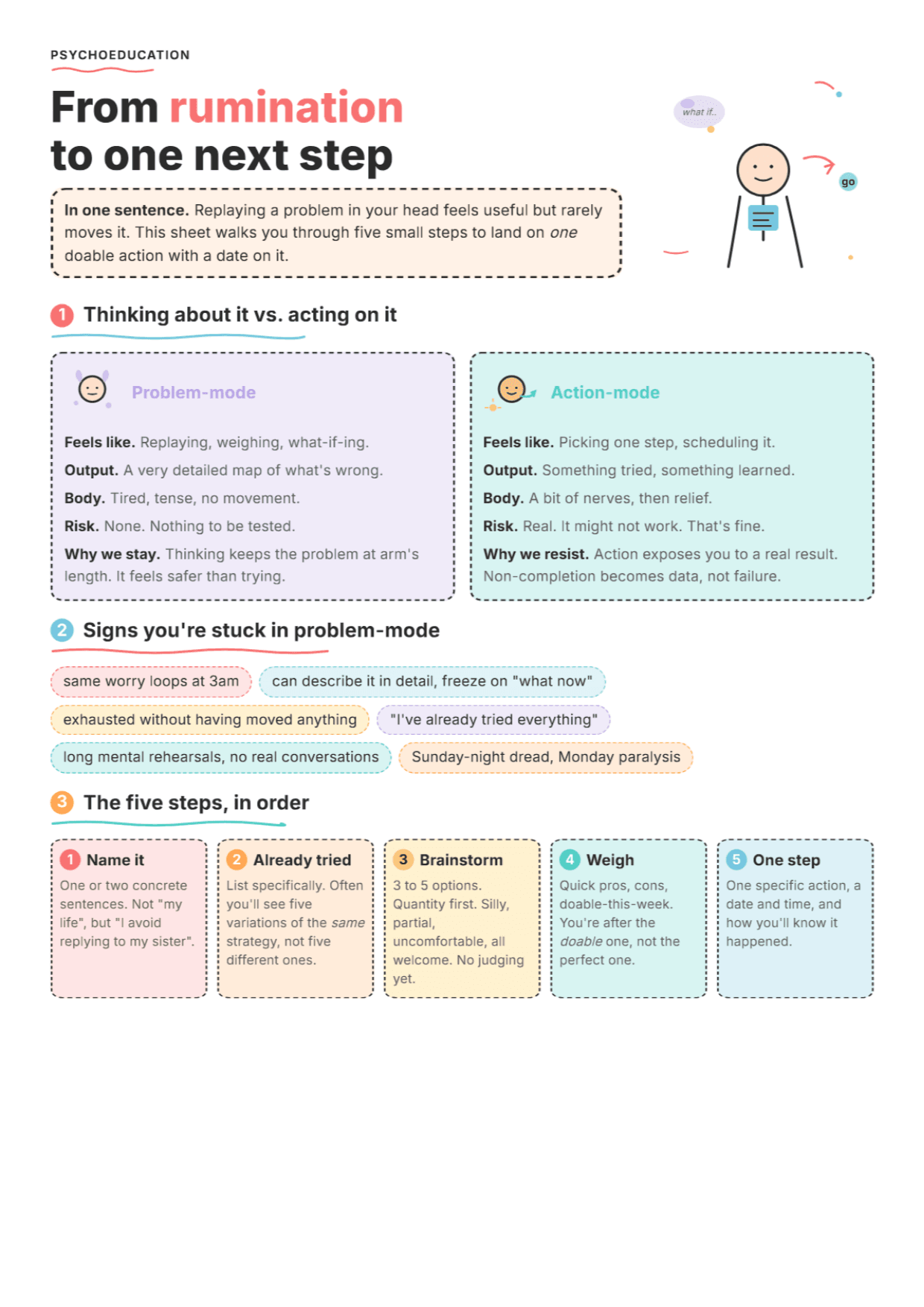
Handout
Focusing on Solutions: PDF Worksheet, Tools and Exercises for Clinical Practice
A visual PDF worksheet with structured tools and exercises to help patients move from ruminative problem-mode to one concrete, scheduled next step in session.
Thoughts & cognitionEmotions & stress
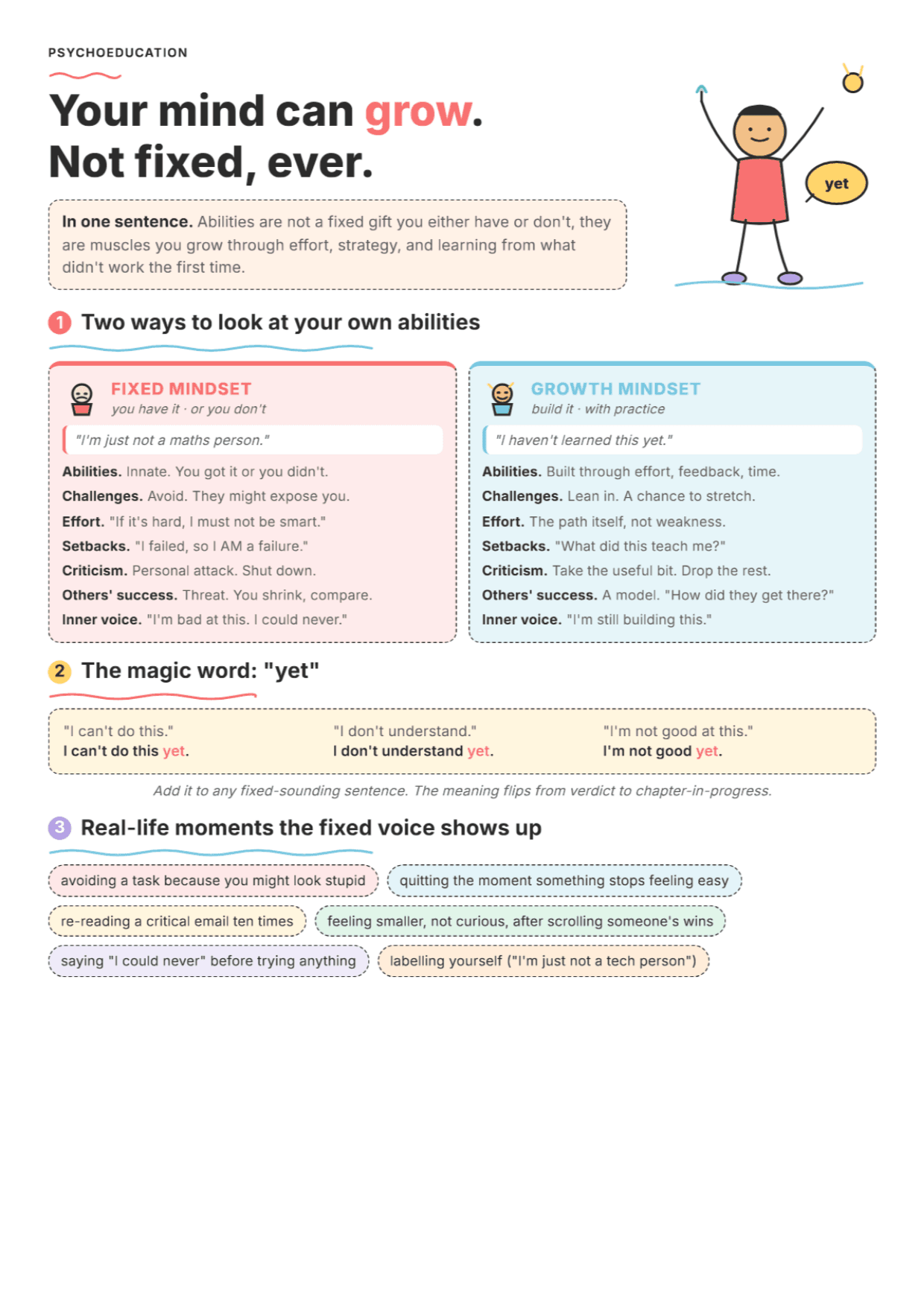
Handout
Growth Mindset: PDF Worksheet, Tools and Exercises for Clinical Practice
A printable PDF worksheet, clinical tools, and concrete exercises to make the growth mindset tangible in session and leave patients with a lasting conceptual anchor.
Self & identityMood & depression
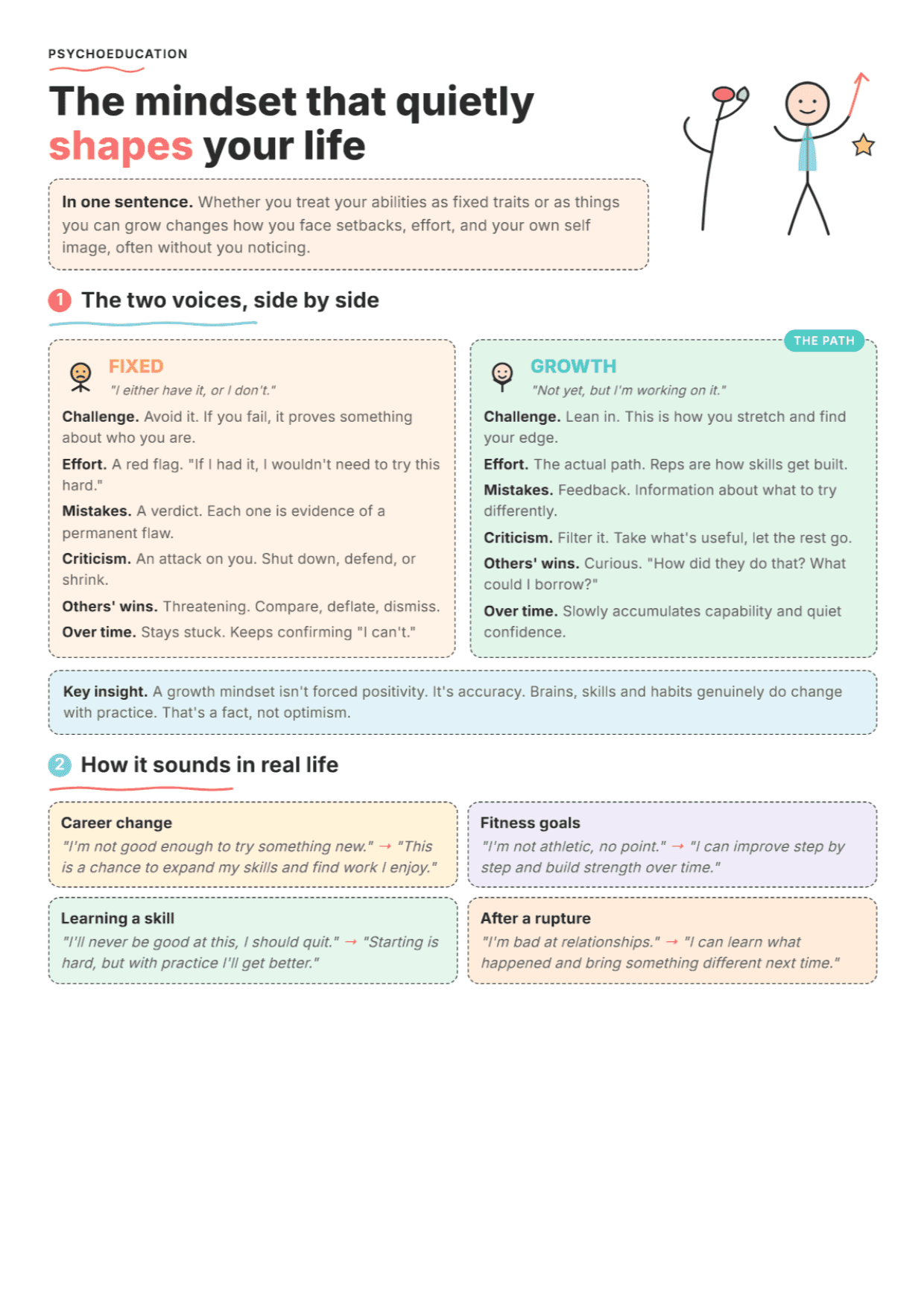
Handout
Growth vs. Fixed Mindset: PDF Worksheet, Tools and Exercises for Clinical Practice
A printable PDF fiche, clinical tools, and structured exercises to explain the growth vs. fixed mindset distinction clearly and accurately in session.
Self & identityMood & depression
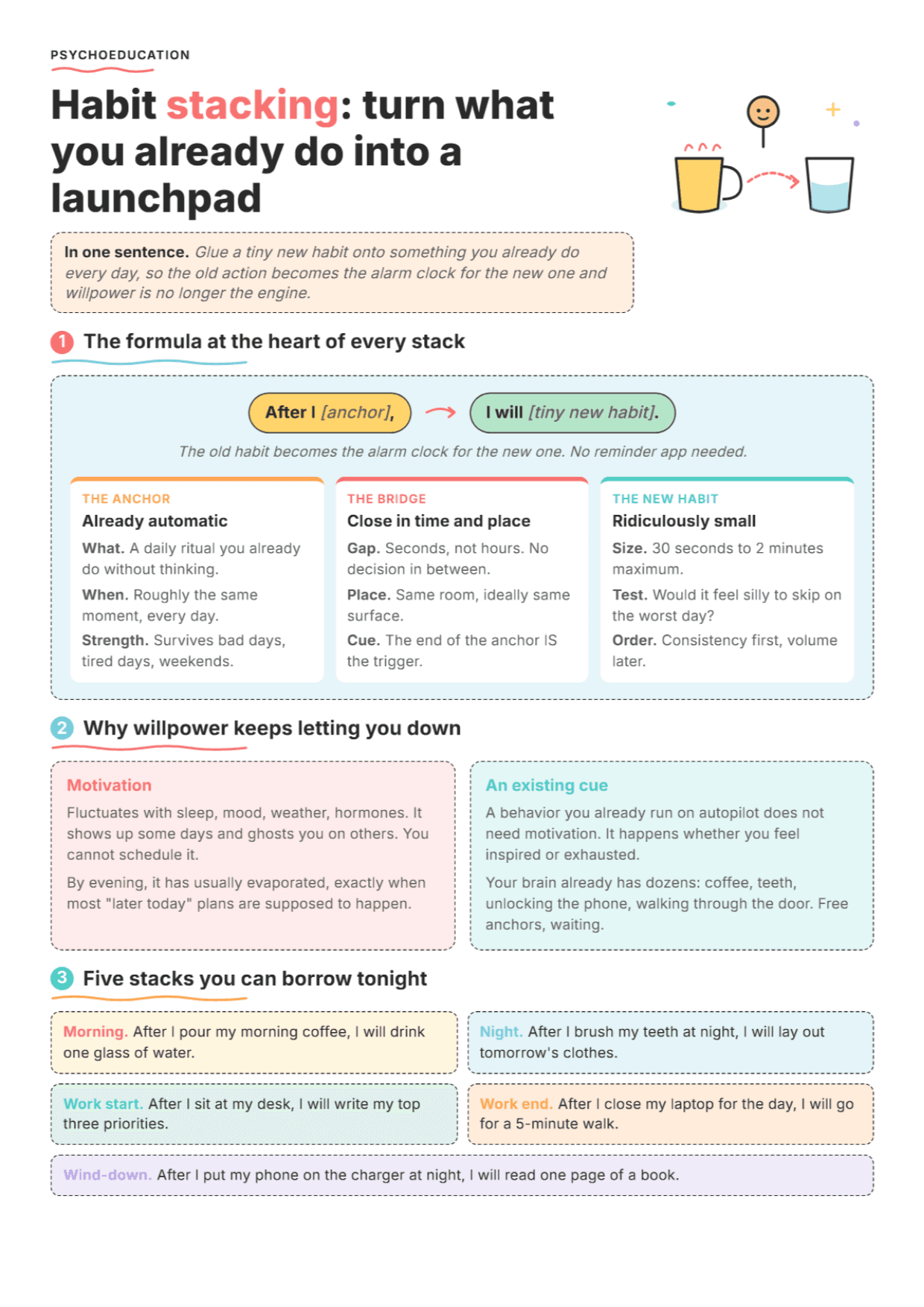
Handout
Healthy Habit Plan: PDF Worksheet, Tools and Exercises
A printable PDF worksheet and visual psychoeducation tool helping clinicians explain habit stacking, reduce willpower dependence, and build durable behavioral change with patients.
Behaviours & addictionsEmotions & stress
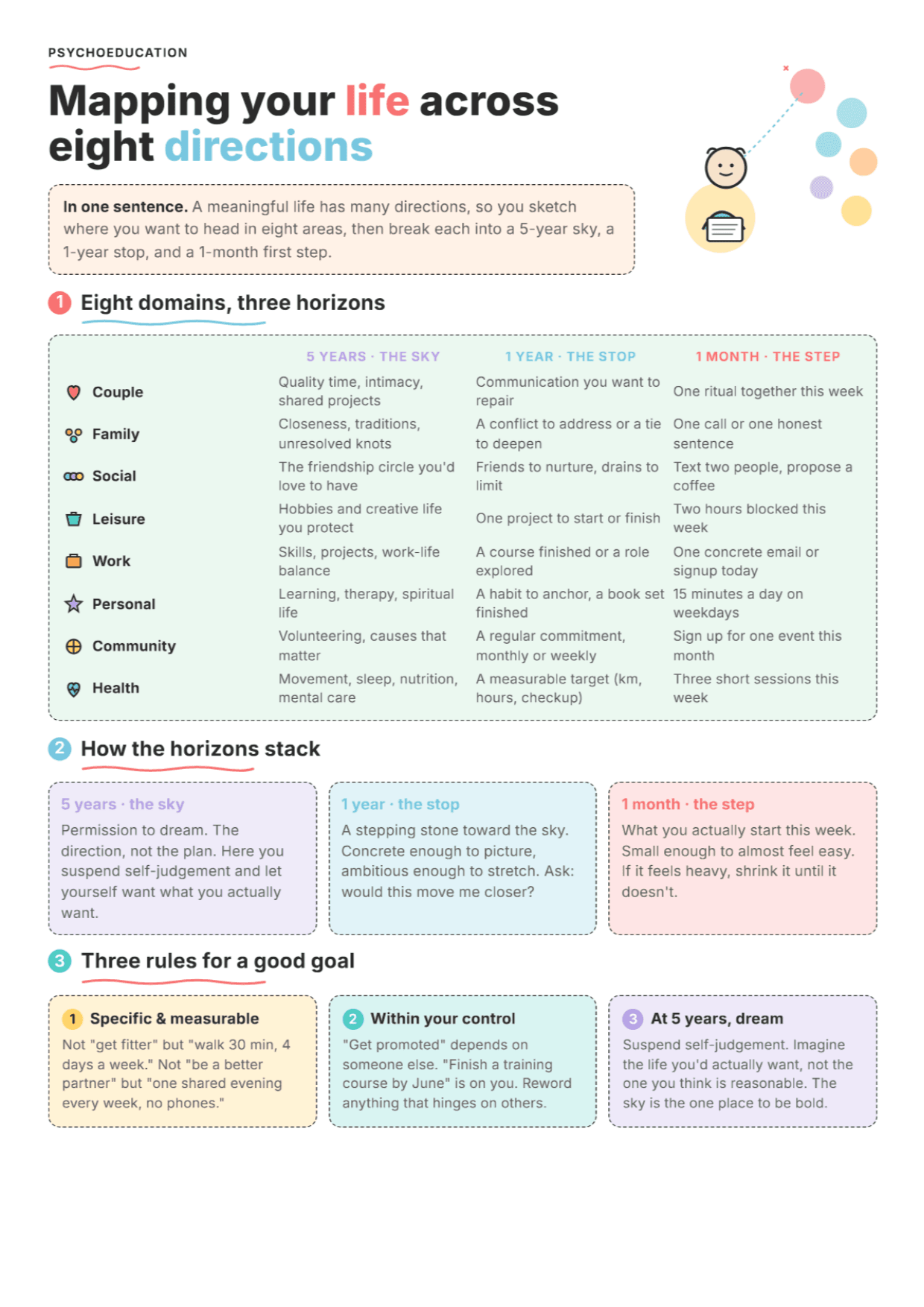
Handout
Life Goals Across Eight Domains: PDF Worksheet, Tools and Exercises
A visual PDF worksheet that maps goals across eight life areas and three time horizons, giving clinicians a structured in-session tool for values-based goal work.
Self & identityLife transitions
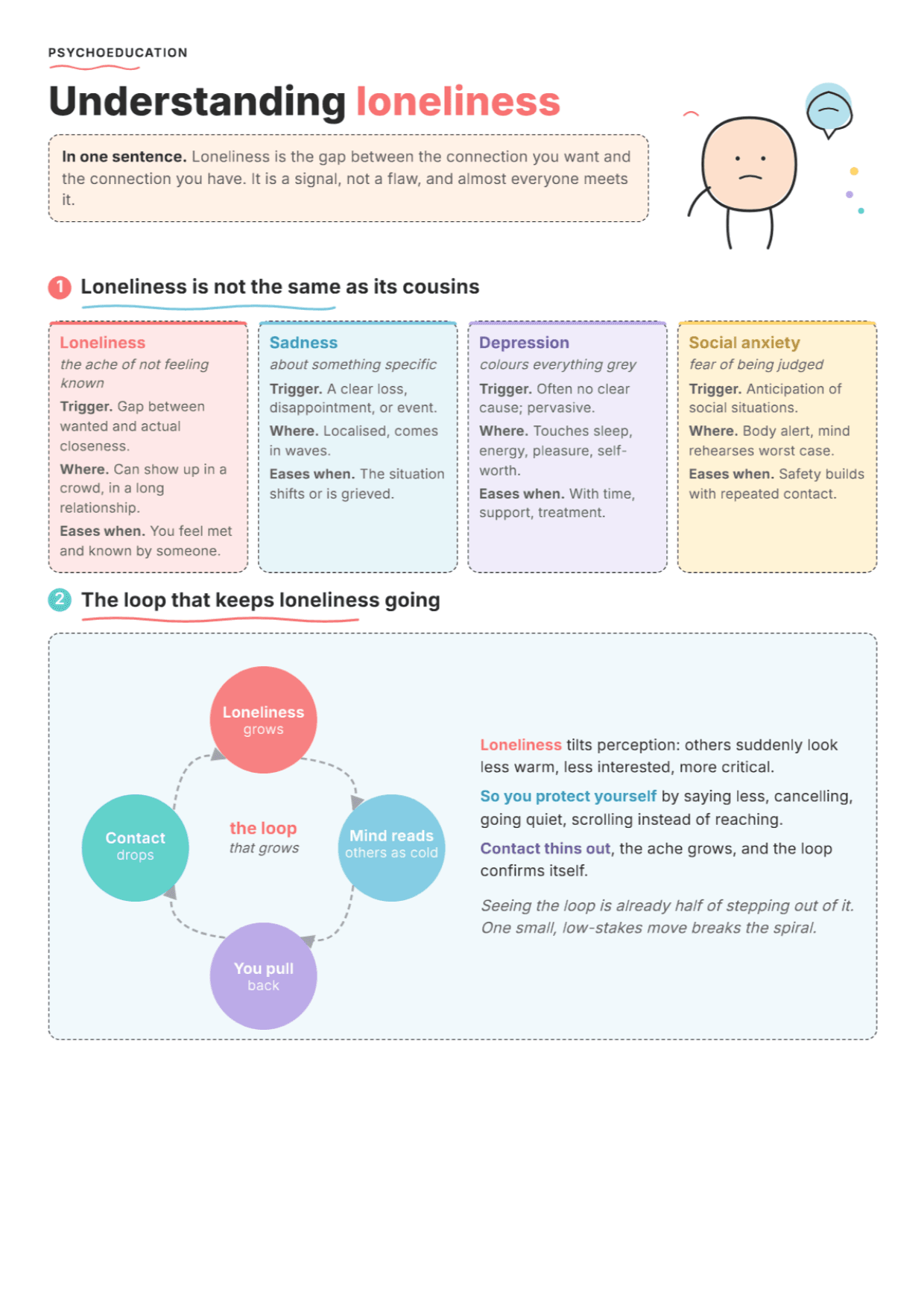
Handout
Loneliness: PDF Worksheet, Tools and Exercises for Clinical Practice
A printable PDF worksheet, tools and exercises to explain loneliness in session, map its self-reinforcing loop, and open the work on shame and reconnection.
Mood & depressionRelationships
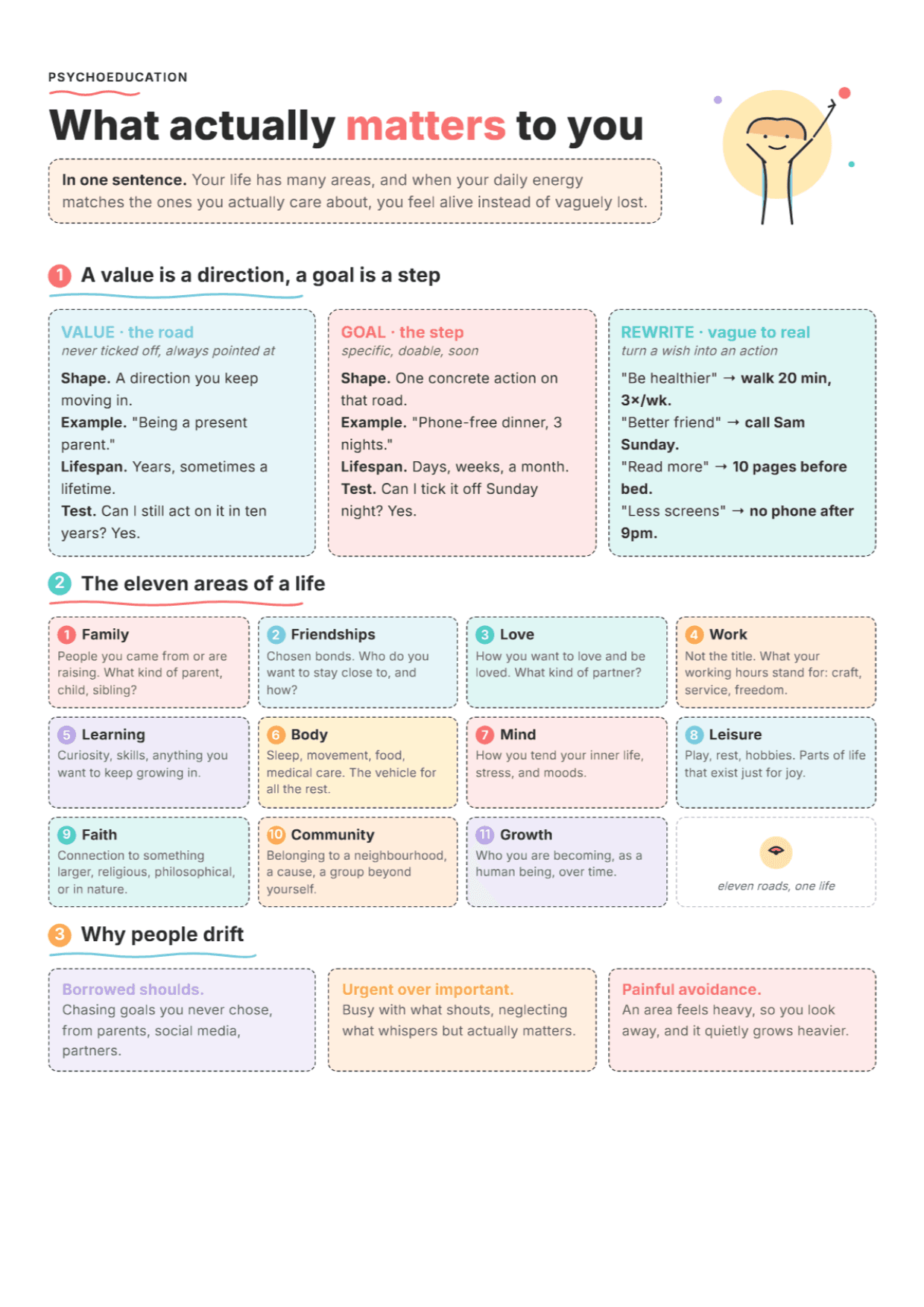
Handout
Personal Meaning and Direction: PDF Worksheet, Tools and Exercises
A visual psychoeducation fiche PDF to help clinicians clarify values, identify life-area gaps, and translate meaning into committed action during session.
Self & identityLife transitions
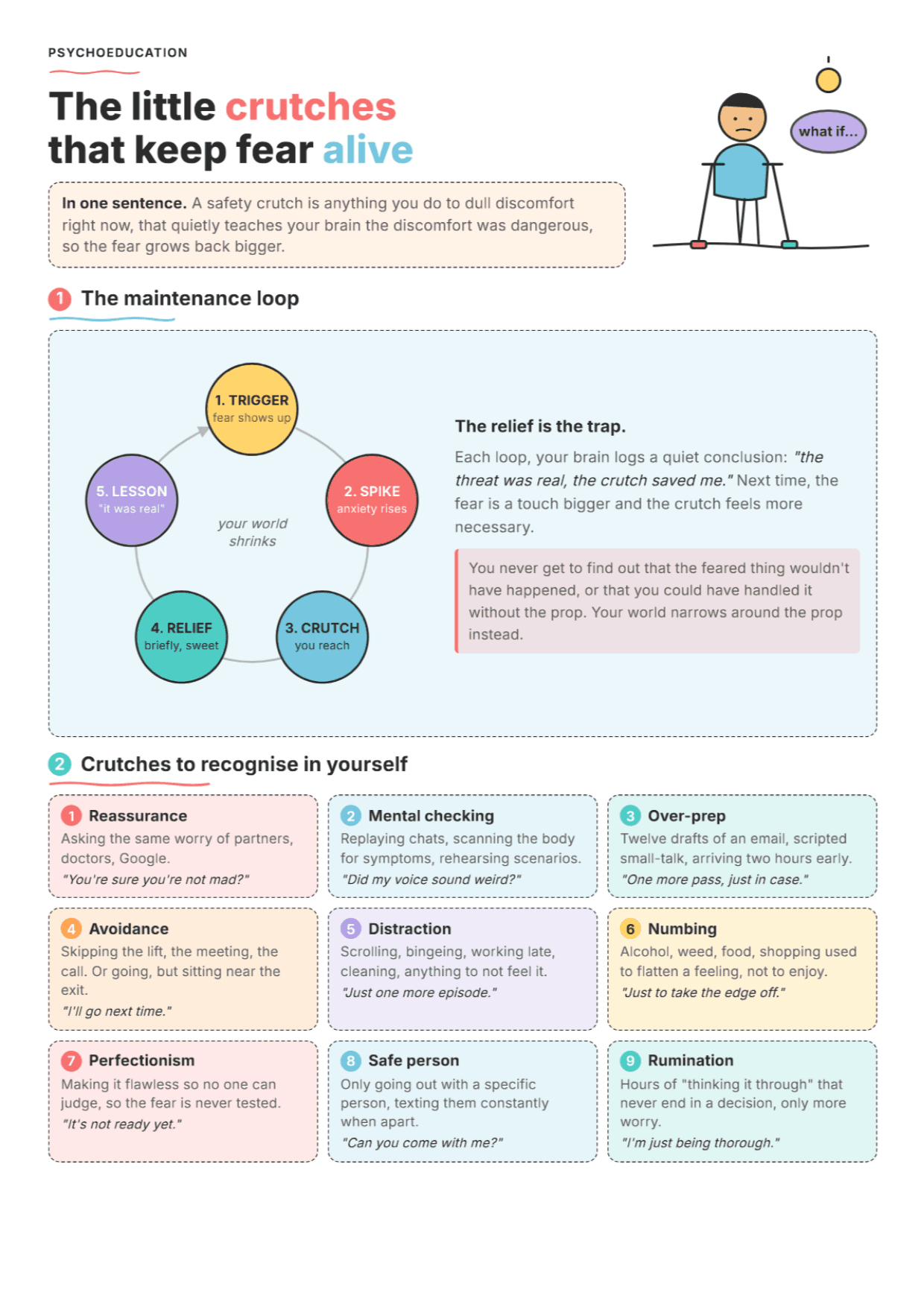
Handout
Psychological Safety Crutches: PDF Worksheet, Tools and Exercises
A visual PDF fiche for explaining safety behaviors in session: tools and exercises to help patients recognise the maintenance loop keeping their fear alive.
AnxietyMood & depression