
Clinical picture. M., a 34-year-old woman, presents with generalised anxiety of three years' duration and a history of multiple self-directed attempts to manage her symptoms, including diaphragmatic breathing, physical exercise, and avoidance of triggering situations. Her clinician introduces the exercise as structured homework, asking her to work through the questions in writing between sessions. At the next appointment, M. reports that mapping her past attempts helped her recognise that she had been abandoning techniques after a single trial rather than practising them consistently, a pattern she had not previously named. She identifies paced breathing as genuinely useful and avoidance as counterproductive, and drafts a short list of two concrete progression goals for the coming month. The letter she writes to her future self is brief and factual, yet she describes feeling unexpectedly steadied by having formulated it.
My Fight Against Anxiety: A Structured Clinical Exercise
A guided homework exercise helping anxious patients audit their coping strategies, reclaim past resilience, and write to their future self.
Clinical vignettes
Auditing Coping Strategies in Chronic Anxiety
Reclaiming Resilience After Repeated Setbacks
Clinical picture. T., a 47-year-old man seen in private practice, describes his anxiety as a condition he has "never managed to beat," despite several prior treatment episodes. The clinician proposes the exercise specifically to counter this global sense of defeat, drawing attention to the questions about past successful recoveries. T. returns the following week having written, with some initial reluctance, three specific episodes in which he had contained a panic-level spike and resumed daily activity within hours. Reading those accounts aloud in session visibly shifted his affect and softened the all-or-nothing framing he had applied to his progress. He and his clinician then used his self-assessment of less effective strategies to reprioritise the treatment focus, replacing relaxation training with graduated exposure to avoided professional situations.
The clinical need this exercise answers
Working with anxiety in therapy involves two parallel challenges that are rarely easy to hold together. The first is cognitive and strategic: helping the patient build an honest, nuanced picture of what actually works for them, rather than defaulting to global self-assessments like "nothing helps" or "I've tried everything." The second is motivational and identity-based: helping the patient recognise that they already carry real competence in managing their symptoms, even when the overall fight feels exhausting.
These two things are hard to convey through conversation alone. When you ask a patient "what have you tried?" in a session, the answer is often compressed, coloured by current distress, and disconnected from any sense of personal agency. Similarly, inviting someone to recall past victories while they are sitting in a consultation room, with you watching, rarely produces the same depth of reflection they can reach privately. What is needed is a structured written format that patients complete autonomously, at their own pace, away from the performance pressure of the consulting room.
This exercise also speaks directly to what the Coping Strategy Effectiveness and Coping Strategies Map fiches open up conceptually: the patient needs not just a list of tools, but a personalised audit of which tools belong to them, which ones have proved their worth, and which deserve more deliberate effort.
Use this resource with your patients
Handout, exercises and materials ready to use, right inside SessionFuel.
What the exercise contains
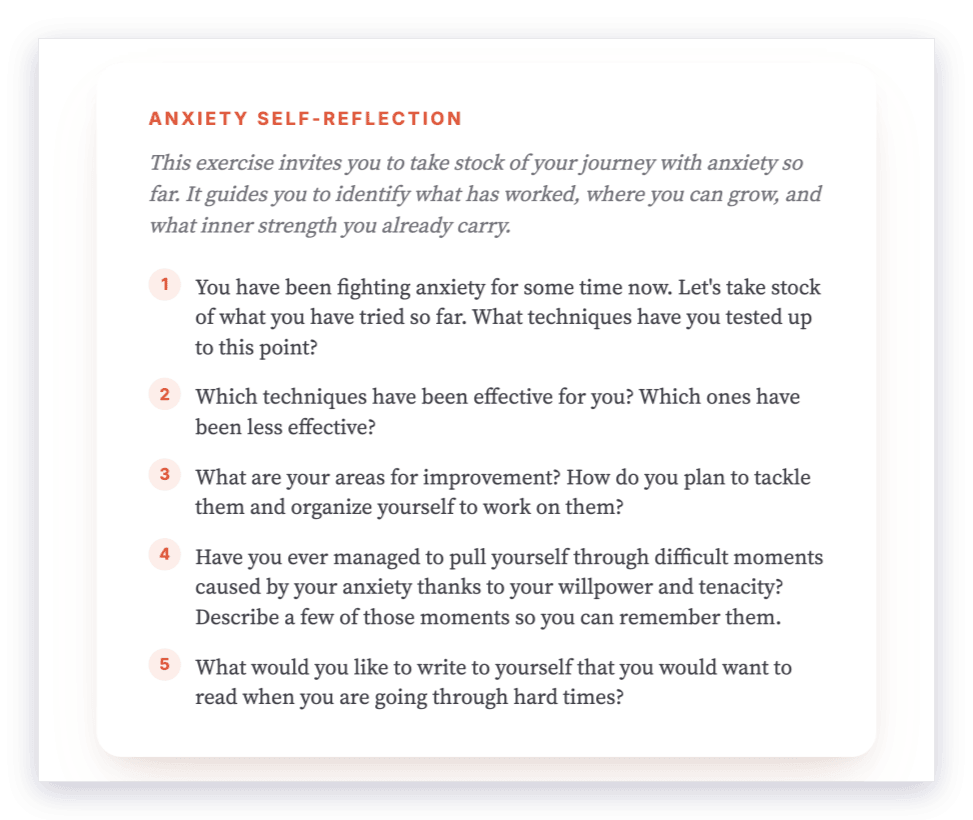
The exercise guides the patient through five sequential questions, each building on the previous one.
The first two questions form a retrospective coping inventory: the patient lists the techniques they have tested so far, then sorts them by effectiveness, naming both what has worked and what has not. This mirrors the kind of structured review you might build using the Exploring Your Anxiety Experience fiche, but places the analytical work squarely in the patient's hands, in writing, between sessions.
The third question shifts to forward planning: the patient identifies their areas for improvement and thinks concretely about how they intend to tackle them. This question connects naturally to the goals work clinicians often do with resources such as Identifying Patient Growth Axes or the SMART Goals worksheet.
The fourth question is clinically pivotal. It invites the patient to retrieve specific past episodes where they successfully navigated an anxiety-driven difficult moment through their own willpower and tenacity. This is not positive thinking; it is evidence-based self-efficacy work, grounded in concrete autobiographical memory. It connects to what Celebrating Personal Successes targets more broadly, and reinforces the Growth Mindset framing that progress is built from real prior performance.
The fifth question invites the patient to write a letter to themselves for future hard moments. This is a powerful clinical move: it externalises self-compassion, creates a durable personal resource, and addresses what the Speaking to Your Future Self fiche makes explicit psychoeducationally. The patient essentially becomes their own future therapist for a moment.
The image above lists the five questions in order, with a brief introductory framing. Please note that this image is a static preview of the question structure only; the full guided exercise, with patient-facing instructions and space to write answers, is experienced by the patient directly in the app, not through this image.
This exercise is available to patients through the mobile application that is the dedicated patient-side interface of SessionFuel: once you assign it in your SessionFuel account, your patient receives it directly on their phone and completes it on their own, between sessions.
750+ clinical tools
A library built with and for clinicians, ready to use in session and extend between appointments.
Access all the toolsUse it with your patients
Share this tool in the mobile app and follow the work between sessions.
How to integrate this as between-session work
This exercise suits patients who are past the psychoeducation phase and have already accumulated some experience with anxiety management strategies, whether formal CBT techniques, mindfulness, breathing, or behavioural experiments. It works particularly well with patients who report a motivational dip or a sense of stagnation, whose question is less "what should I do?" and more "why isn't it working well enough?" The Motivational Dip exercise can serve as a complementary homework tool if motivational flatness is the dominant presenting issue.
Introduce the exercise simply: "Between now and our next session, I'd like you to do a written review of your fight with anxiety so far. There are five questions. Take your time with each one, especially the one asking you to recall specific moments where you held your ground." Framing it as a stocktaking exercise, not a test, is important.
When the patient returns, the material they bring is rich. The coping inventory from questions one and two can directly inform a Control, Influence, Accept conversation, clarifying what is genuinely changeable. The growth axes from question three translate naturally into a session goal-setting discussion, using the structure of Identifying Patient Growth Axes. The past-victory narratives from question four are clinical gold: read them aloud together, reinforce the competence they demonstrate, and connect them to Protective Factors or Progress in Therapy work. The self-letter from question five can be shared, discussed, refined, and saved by the patient as a concrete crisis resource.
Key takeaway: This exercise turns the patient's own history of fighting anxiety into a clinical document, a personalised audit of what works, what to build on, and what to say to themselves when the next hard moment arrives.
For patients whose anxiety involves a strong compulsive or control-seeking dimension, consider pairing this exercise with the Compulsive Control exercise or the Managing Worry homework tool, which address the attentional and behavioural mechanics the coping audit may surface. For patients whose work on anxiety connects to broader questions of relapse prevention, the Lapse and Relapse Management fiche provides a complementary framework that sits well alongside the self-letter the patient writes in question five.
Your session continues in your patients' pocket
Use with a patientYour resources, available everywhere
The handouts, exercises, programs and audios above: you choose which ones to make available to your patients, in the mobile app dedicated to them.
And far more than a library
The app goes well beyond resources, to support your patients every day:
Related categories
Explore other clinical resources by category.
Anxiety
Clinical hub for anxiety disorders: CBT and ACT worksheets, psychoeducation sheets, and exercises for assessment and treatment across the anxiety spectrum.

Prevent relapse
Prevention as a therapeutic aim: clinical framing, risk stratification, and printable resources for relapse prevention and early intervention in mental health.

CBT
CBT worksheets, cognitive restructuring exercises & behavioral tools for clinicians. Evidence-based resources for every phase of cognitive behavioral therapy.

Solution-focused
Clinical hub for Solution Focused Therapy resources: worksheets, exercises and programs for goal-oriented, strengths-based practice across individual and couple work.

Trauma
Clinical hub on trauma and PTSD: assessment, differential diagnosis, treatment phases, and printable resources for practitioners. 155 chars.

Mood
Evidence-based worksheets and clinical tools for mood disorders: CBT, ACT, and positive psychology resources for psychologists and therapists.