
Clinical picture. P., a woman in her early forties with a third episode of major depressive disorder, presented with low initiative and a pervasive sense that nothing she tried made any difference. Her psychiatrist introduced the exercise as structured homework between sessions, framing it as an audit rather than a task she could fail. Working through the first three questions across two weeks, P. identified that behavioural activation and a fixed sleep schedule had each produced modest but measurable relief in past episodes, while rumination-focused journalling had tended to worsen her mood. The fourth question prompted her to recall managing her workload during a bereavement two years earlier, a memory she had not connected to personal resilience before. She brought the completed letter to herself into the next session; the clinician used it as a reference point when discussing relapse prevention planning.
My Fight Against Depression: A Structured Progress Review
A guided homework exercise helping depressed patients audit coping strategies, claim past resilience, and write a letter to their future self.
Clinical vignettes
Reclaiming Agency in Recurrent Depression
Structuring Coping Review in a Young Adult
Clinical picture. T., a man of 28 with a first depressive episode following academic burnout, reported feeling passive and without direction despite six weeks of antidepressant treatment. His psychologist proposed the exercise to give shape to gains that T. struggled to articulate verbally in session. Questions one and two helped him distinguish strategies he had used out of obligation from those he had genuinely found grounding, notably brief daily walks and limiting social media in the evening. The third question surfaced a concrete area for progression: irregular meal times that he had not previously linked to mood fluctuation. The self-addressed letter he drafted was brief and unsentimental; he noted it felt less abstract than verbal encouragement from others, and he photographed it to keep on his phone for low-mood mornings.
The Clinical Challenge: When Depression Erases the Evidence of Effort
Depression distorts autobiographical memory selectively. Patients frequently arrive convinced they have never coped, never improved, never acted with any genuine agency. Documenting coping history is not something most patients do on their own, and asking them to recall it verbally in a consultation rarely reaches far enough. The emotional flatness of depression makes retrieval effortful, and the session is too short to do that work justice.
What clinicians need is a structure that gets patients to sit with the evidence at their own pace, outside the room. This exercise, built around a deliberate personal audit of the fight against depression, creates exactly that space. It pairs naturally with Coping Skills for Depression and the Understanding Depression: A 4-Lesson Psychoeducation Program as part of a broader psychoeducation sequence. If the patient is simultaneously working on the behavioral side, Situational Avoidance in Depression is a close companion.
Use this resource with your patients
Handout, exercises and materials ready to use, right inside SessionFuel.
What the Exercise Contains: Five Questions, One Full Arc
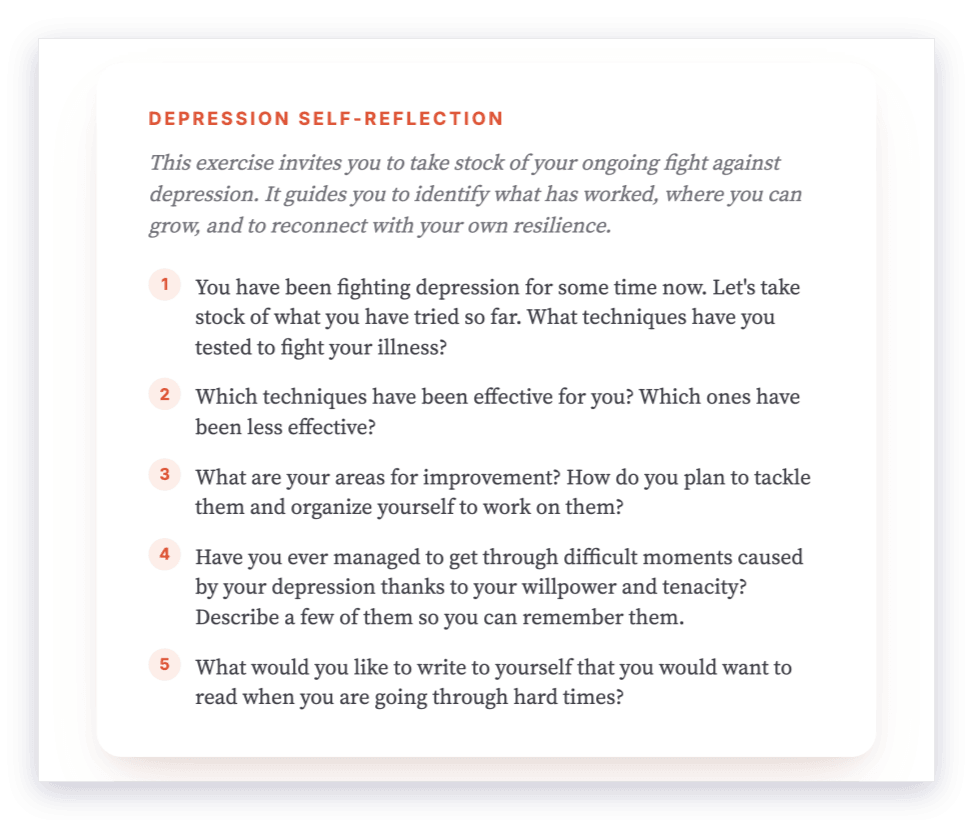
The five questions take the patient through a complete metacognitive review of their own coping history.
The first question asks for an honest inventory: what techniques has the patient actually tried to fight their depression? The second asks them to evaluate those strategies, separating what worked from what did not, building a personal map of coping effectiveness similar to what the Coping Strategy Effectiveness fiche supports in session. The third question pushes forward: what are the remaining growth axes, and how does the patient plan to tackle them? This step connects naturally to the Identifying Patient Growth Axes exercise and to Finding Motivation for Change: A 5-Lesson Clinical Program.
The fourth question is clinically distinctive: it asks patients to recall specific past moments where willpower and tenacity carried them through something hard. Writing those moments down matters. Memory for positive self-efficacy is fragile in depression, and externalising it creates a durable record to return to. The fifth question invites a letter to the future self, a concrete act of anticipatory self-compassion for the difficult moments ahead. That letter does work no verbal exchange can replicate.
Above is a static preview of the exercise questions as they appear in the tool. This image simply lists the questions in order; the full guided exercise, with patient-facing instructions and space to write each answer, is experienced by the patient on their own in the app, not in this image.
This exercise is available to patients directly through the patient app of SessionFuel, the mobile application reserved for the patients of clinicians who use SessionFuel: the clinician assigns the exercise, and the patient completes it on their own phone between appointments, without any clinician present.
750+ clinical tools
A library built with and for clinicians, ready to use in session and extend between appointments.
Access all the toolsUse it with your patients
Share this tool in the mobile app and follow the work between sessions.
How to Integrate It as Between-Session Homework
This exercise suits patients who are past the acute trough of depression and have enough reflective capacity to look back with some distance, typically from the middle phase of treatment onward. It is not a first-session tool. It works best after the patient already has some vocabulary for their coping strategies, for instance following work with Four Strategies to Overcome Depression or Lapse and Relapse Management.
Introducing it is simple: "I want you to take stock of everything you have already done to fight this, and write it down for yourself." Framing the assignment as recognition of effort already invested rather than evaluation lowers resistance considerably.
Key insight: The letter to the future self (question 5) is the element most likely to carry clinical weight on a genuinely hard day. Encourage the patient to write it with care; it will do its work long after the consultation where you debrief it.
When the patient returns with their answers, the richest material usually sits in questions 2 and 4. The contrast between what worked and what did not opens a direct route to refining the coping repertoire, and the recalled resilience moments become anchors for Maintaining Hope in Therapy work. The self-letter can be revisited alongside the Celebrating Progress in Depression exercise as a milestone check later in treatment.
For patients managing both depression and anxiety, the structurally parallel My Fight Against Anxiety: A Structured Progress Review Exercise covers the same arc and can be assigned in sequence. For a macro-level complement, pairing it with Progress in Therapy gives the patient perspective on the non-linear nature of recovery as a whole.
Your session continues in your patients' pocket
Use with a patientYour resources, available everywhere
The handouts, exercises, programs and audios above: you choose which ones to make available to your patients, in the mobile app dedicated to them.
And far more than a library
The app goes well beyond resources, to support your patients every day:
Related categories
Explore other clinical resources by category.

Mood
Evidence-based worksheets and clinical tools for mood disorders: CBT, ACT, and positive psychology resources for psychologists and therapists.

Cognition
Printable cognitive therapy worksheets and clinical tools for therapists: CBT, ACT, schema work, defusion, distortions, and belief restructuring.

Prevent relapse
Prevention as a therapeutic aim: clinical framing, risk stratification, and printable resources for relapse prevention and early intervention in mental health.

CBT
CBT worksheets, cognitive restructuring exercises & behavioral tools for clinicians. Evidence-based resources for every phase of cognitive behavioral therapy.

Solution-focused
Clinical hub for Solution Focused Therapy resources: worksheets, exercises and programs for goal-oriented, strengths-based practice across individual and couple work.

Anxiety
Clinical hub for anxiety disorders: CBT and ACT worksheets, psychoeducation sheets, and exercises for assessment and treatment across the anxiety spectrum.