
Clinical picture. M., a man in his early forties, presents with a moderate depressive episode and has progressively stopped attending his weekly five-a-side football game, telling himself he would be poor company. His clinician introduces the guided exercise, and M. works through the questions in session: he identifies the avoided situation (the sports hall), names the downstream costs (growing distance from friends, a reinforced sense of being burdensome), and surfaces the core thought he has been sidestepping ('they will notice something is wrong with me'). When asked whether the avoidance is helping him move forward, he pauses and acknowledges it has not. By the final question he proposes one concrete step: sending a brief message to the group chat before the next session, without committing to attend.
Situational Avoidance in Depression: A Guided Clinical Exercise
Help depressed patients name the situation they avoid, map its real cost, and commit to one concrete step beyond the avoidance pattern.
Clinical vignettes
Naming the Cost of Social Withdrawal
Avoidance of Work Tasks in Mild Depression
Clinical picture. S., a woman in her mid-thirties with a mild to moderate depressive episode, reports that she has not opened her professional emails for three weeks, describing the inbox as 'impossible to face.' Using the exercise questions as a framework, the clinician invites her to articulate what she fears finding there ('evidence that I am falling behind') and to consider how the avoidance has affected her sleep and her relationship with her line manager. S. recognises that each day she delays, the perceived weight of the inbox grows rather than shrinks. She decides, as her one step beyond avoidance, to open the inbox for ten minutes the following morning, read only the subject lines, and close it without acting, then report back at the next appointment.
The Clinical Challenge of Avoidance in Depression
Avoidance is one of the most self-reinforcing processes in depression, and one of the most resistant to verbal explanation alone. Patients often understand intellectually that withdrawing from situations is making things worse. Yet the relief avoidance provides is immediate, while its costs accumulate slowly and out of sight. That asymmetry is exactly what keeps the pattern alive.
Resources like The Cycle of Depression can make the maintenance loop visible in broad strokes, and the Changing Avoidance or Confronting Avoidance worksheets can anchor psychoeducation to the concept. But a patient's avoidance is always personal. Naming a generic loop is not the same as examining one's own specific situation, articulating the exact thoughts being ducked, or asking honestly whether the strategy is working. That focused self-inquiry is what this exercise creates space for, between appointments, in the patient's own time.
Use this resource with your patients
Handout, exercises and materials ready to use, right inside SessionFuel.
What the Exercise Contains
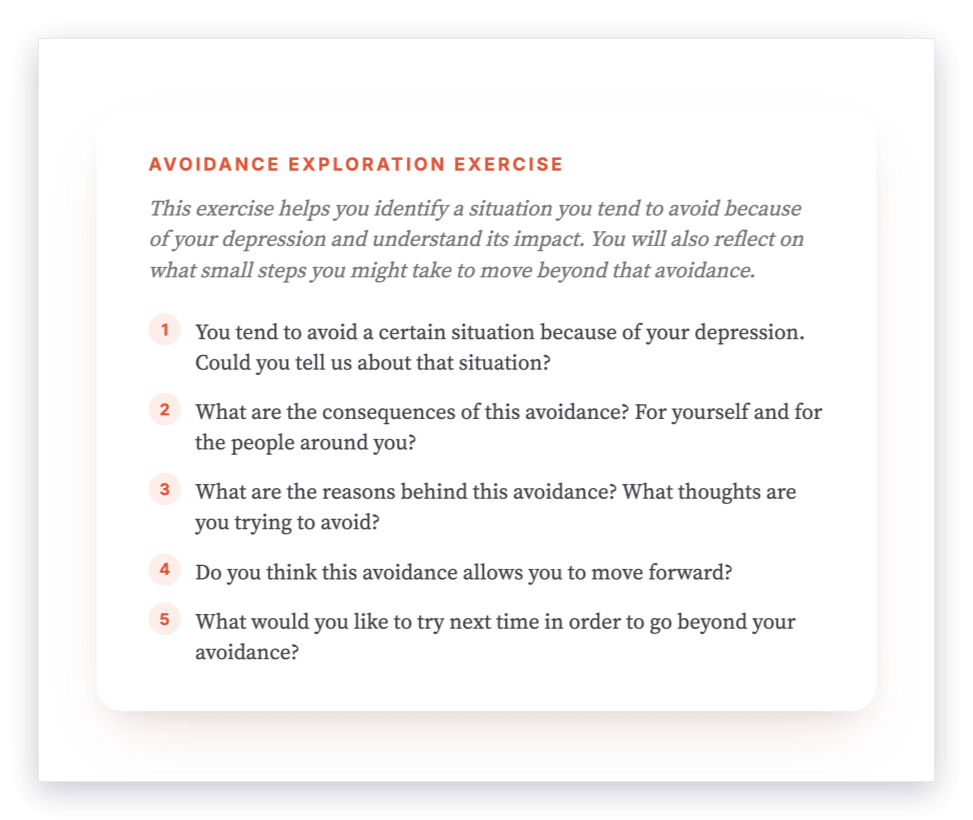
The exercise is structured around five sequential questions. The image above lists them in order with a brief introductory framing. This image is a static preview of the questions only: the full guided exercise, complete with patient-facing instructions, explanatory context, and space to write, is experienced by the patient autonomously in the app, not here.
The exercise opens by asking the patient to name the specific situation they are avoiding because of depression. Generalities dissolve; concrete situations anchor the work. Question two maps consequences for both the patient and their close circle, a dual lens that matters clinically because many depressed patients minimise personal impact while remaining sensitive to interpersonal costs.
Question three reaches into the cognitive layer: what thoughts is the patient trying to avoid? This is where the exercise does some of its most important clinical work, surfacing the automatic thoughts and feared mental states that function as the true engine of avoidance. The output pairs naturally with tools such as CBT Maintaining Processes or the Depression and Behavioral Activation exercise, which approach the same cycle from a different entry point.
Question four introduces a direct reflective check: does this avoidance actually allow the patient to move forward? Asking for an honest appraisal of the strategy's utility is a metacognitive move that often shifts the ground noticeably. The fifth question closes the exercise with something behaviorally concrete: what would the patient try next time? Modest and specific, it ends on a small committed action rather than vague aspiration, which integrates cleanly into weekly activity planning or behavioral activation work.
This exercise is available to patients through the mobile application that is the dedicated patient-side interface of SessionFuel: the clinician assigns it as between-session homework, and the patient completes it directly on their phone, on their own, before the next appointment.
750+ clinical tools
A library built with and for clinicians, ready to use in session and extend between appointments.
Access all the toolsUse it with your patients
Share this tool in the mobile app and follow the work between sessions.
Integrating This as Between-Session Work
This exercise suits patients who are already aware they are avoiding but have not yet articulated the mechanism clearly to themselves. It fits well after a session that has introduced shared vocabulary around the depression cycle, using a resource like Four Strategies to Overcome Depression or The Cycle of Depression as a primer. It also works well with patients who understand behavioral activation rationally but remain stuck at the level of intention.
To introduce it, a simple instruction is enough: before our next meeting, I would like you to reflect on one situation you have been avoiding, using these five questions as a guide. No elaborate framing is required.
When the patient returns with their written answers, the clinician has a concrete clinical object to examine together. Question three tends to be the richest entry point: the thoughts named there can feed directly into cognitive restructuring with exercises like Feeling Useless or Sadness in Therapy. Question five gives a testable micro-commitment to revisit, and can be tracked through a weekly self-review or woven into a current activity inventory. For patients in whom avoidance overlaps with procrastination, the Procrastination exercise addresses the same loop from a slightly different angle and can follow naturally in subsequent weeks.
Key takeaway: Avoidance explains itself only partially in spoken words. An exercise that asks the patient to name the situation, surface the hidden thoughts, evaluate the strategy's real utility, and commit to one next step turns an abstract clinical concept into a written, workable object the following session can actually build on.
Your session continues in your patients' pocket
Use with a patientYour resources, available everywhere
The handouts, exercises, programs and audios above: you choose which ones to make available to your patients, in the mobile app dedicated to them.
And far more than a library
The app goes well beyond resources, to support your patients every day:
Related categories
Explore other clinical resources by category.

Anxiety
Clinical hub for anxiety disorders: CBT and ACT worksheets, psychoeducation sheets, and exercises for assessment and treatment across the anxiety spectrum.

Mood
Evidence-based worksheets and clinical tools for mood disorders: CBT, ACT, and positive psychology resources for psychologists and therapists.

Behaviours
Clinical hub for behaviors in therapy: worksheets and tools for coping, eating disorders, CBT formulation, and maladaptive behavioral patterns.

Cognition
Printable cognitive therapy worksheets and clinical tools for therapists: CBT, ACT, schema work, defusion, distortions, and belief restructuring.

CBT
CBT worksheets, cognitive restructuring exercises & behavioral tools for clinicians. Evidence-based resources for every phase of cognitive behavioral therapy.

Trauma
Clinical hub on trauma and PTSD: assessment, differential diagnosis, treatment phases, and printable resources for practitioners. 155 chars.