
Clinical picture. M., a woman in her early 40s, presented with recurrent low mood linked to the anniversary of her mother's death, reporting that she felt blocked between sessions with no language for what she was experiencing. Her therapist introduced the five-question guided exercise as a between-session writing task, asking her first to name the specific trigger and then to list, without filtering, every thought attached to the sadness. At the next session M. brought a written list that included the belief "I should be over this by now," which opened a productive cognitive restructuring conversation grounded in her own words rather than the clinician's prompts. She was able to identify two past bereavements she had navigated and used that evidence to answer question four. She left with a small behavioural commitment, attending a weekly choir rehearsal she had been avoiding, which she framed herself as acting despite the pain rather than waiting for it to pass.
Sadness: A Guided Cognitive and Behavioral Exercise for Clinicians
Help patients name what triggered their sadness, restructure sustaining thoughts, and commit to action despite the pain, between sessions.
Clinical vignettes
Grief Reactivated by a Work Anniversary
Adolescent Sadness After Peer Rejection
Clinical picture. T., a 17-year-old referred for mild depressive symptoms, described a pervasive sense of sadness following a falling-out with his close friend group but struggled to articulate anything beyond "I just feel bad." The clinician offered the exercise as a structured way to slow down the rumination he reported at night, framing each question as a prompt he could answer in a notes app on his phone. When T. returned the following week, his response to question three revealed that he had spontaneously recalled a similar social rupture at age 14 that had resolved, which he had not mentioned in any prior session. The clinician used question five to explore, collaboratively, one concrete action, rejoining a lunchtime coding club, that T. agreed was worth attempting before the next appointment. The exercise did not eliminate the sadness but gave T. a repeatable structure he could apply independently.
Why Sadness Is Hard to Work With Verbally
Sadness is not a simple emotion to engage clinically. Most patients arrive with a vague, global sense of heaviness that resists precise articulation. They know something is wrong; they struggle to say what, and they struggle even more to see that their interpretation of the triggering event is shaping the pain as much as the event itself. When you try to unpack this in conversation, the emotion often floods the analysis before it can happen.
A second difficulty: tolerating sadness rather than escaping it is a genuinely counterintuitive therapeutic goal. Patients who have spent months avoiding the feeling need more than an explanation of distress tolerance; they need structured contact with their own evidence that they have survived it before. Oral prompts during a consultation rarely give them the time or the space to search for that evidence honestly.
This is the gap this exercise addresses. It moves cognitive restructuring and behavioral commitment out of the abstract and into a reflective process the patient completes at their own pace, when the emotion is actually present.
Use this resource with your patients
Handout, exercises and materials ready to use, right inside SessionFuel.
What the Exercise Contains
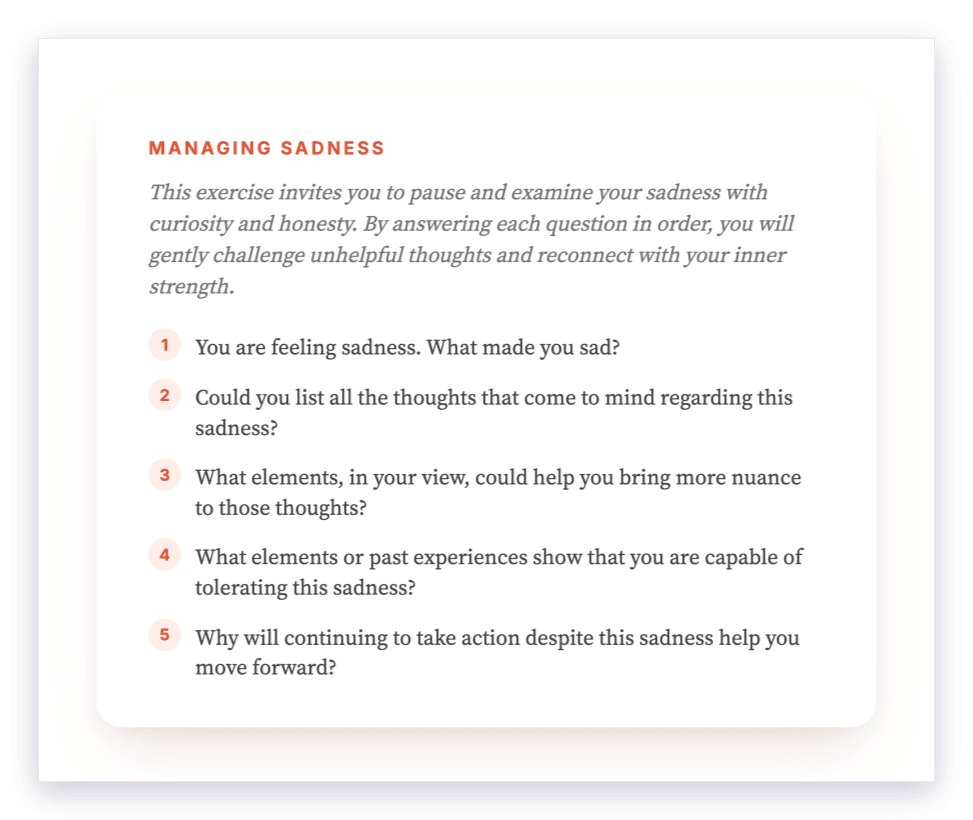
The image above lists the five questions that make up this exercise, with a short introductory frame. Note that this image is a static preview of the question sequence only; the full guided exercise, including patient-facing instructions and space to write responses, is experienced by the patient autonomously inside the app, not in this image.
The exercise opens by anchoring the emotion in a specific trigger (question 1), which immediately moves the patient from a diffuse mood state toward a situated, examinable event. Question 2 asks them to list every thought linked to the sadness, building the raw material for restructuring without editorial pressure. Question 3 introduces nuancing, prompting the patient to find elements that complicate or soften those thoughts, a move that mirrors the work you would do together using a tool like the Challenging Automatic Thoughts worksheet or the Five-Column Thought Record. Question 4 turns to past experience as evidence of distress tolerance capacity, an approach grounded in the same principles as Active Acceptance: PDF Worksheet, Tools and Exercises. The final question asks why acting despite the sadness serves the patient's forward movement, connecting directly to the behavioral activation rationale you might illustrate with The Cycle of Depression worksheet or Coping Skills for Depression.
Key insight: This exercise does not ask patients to dismiss or minimize their sadness. It asks them to examine its cognitive architecture and then choose behavior, which is the core therapeutic move in both CBT and ACT approaches to mood work.
This exercise is available to patients through the mobile application that is the dedicated patient-side interface of SessionFuel: you assign it directly from your SessionFuel account, and your patient completes it on their own phone, between two appointments, without any additional setup on their part.
750+ clinical tools
A library built with and for clinicians, ready to use in session and extend between appointments.
Access all the toolsHow to Assign and Use It in Your Practice
This exercise works best as between-session homework assigned at the end of a consultation in which sadness or a depressive episode has been the central theme. It is not a task for the session itself; its value lies in the patient completing it when the emotion is live, outside the consultation room.
Which patients suit it: patients who are aware of their sadness but have difficulty articulating or examining it; patients already introduced to the CBT Cognitive Model or the cognitive triangle who are ready to apply that framework autonomously; patients working on Breaking Action Inertia in Depression who need a structured prompt to reconnect with their capacity to act. It is less appropriate for patients in acute crisis or those who have not yet built a basic psychoeducational foundation.
How to introduce it: frame it concretely. Tell the patient that next time sadness surfaces, before they withdraw or ruminate, you are asking them to spend ten minutes with these five questions. Pair the assignment with a brief mention of why listing thoughts without immediately judging them matters, referencing tools like Cognitive Distortions: PDF Worksheet, Tools and Exercises if the patient is familiar with that vocabulary.
What to do with what they bring back: the patient's written answers are clinical material, not homework to be marked. Question 2 typically surfaces the automatic thoughts most worth examining. Question 4 often reveals underused strengths the patient discounts. Question 5 can open a direct conversation about values and behavioral direction, connecting to broader work on Situational Avoidance in Depression or Weekly Activity Scheduling. The exercise creates a written trace you can both return to across several sessions, making progress visible.
Use it with your patients
Share this tool in the mobile app and follow the work between sessions.
A Note on Complementary Tools
For patients whose sadness is entangled with self-criticism, pairing this exercise with Feeling Useless: A Guided Cognitive and Behavioral Exercise or Feeling Not Good Enough: A Guided Self-Criticism Exercise deepens the work. When rumination is prominent, Restructuring Mental Ruminations provides a complementary psychoeducation scaffold. The combination gives patients both a cognitive entry point and a behavioral anchor, which is often what moves the work forward.
Your session continues in your patients' pocket
Use with a patientYour resources, available everywhere
The handouts, exercises, programs and audios above: you choose which ones to make available to your patients, in the mobile app dedicated to them.
And far more than a library
The app goes well beyond resources, to support your patients every day:
Related categories
Explore other clinical resources by category.

Anxiety
Clinical hub for anxiety disorders: CBT and ACT worksheets, psychoeducation sheets, and exercises for assessment and treatment across the anxiety spectrum.

Mood
Evidence-based worksheets and clinical tools for mood disorders: CBT, ACT, and positive psychology resources for psychologists and therapists.

Identity
Clinical resources for self-identity work in therapy: CBT, ACT, schema tools for clinicians addressing self-concept, core beliefs, and identity disruption.

Emotions
Clinical resources on emotion regulation: worksheets, coping tools, CBT, REBT, and ACT exercises for therapists working across diagnoses and age groups.

Behaviours
Clinical hub for behaviors in therapy: worksheets and tools for coping, eating disorders, CBT formulation, and maladaptive behavioral patterns.

Cognition
Printable cognitive therapy worksheets and clinical tools for therapists: CBT, ACT, schema work, defusion, distortions, and belief restructuring.