
Clinical picture. M., a woman in her late thirties, presented with recurrent depressive episodes and a pattern of social withdrawal she described as "just needing space." In session, the clinician introduced the cognitive triangle worksheet and walked her through a recent specific moment: her manager had passed her desk without making eye contact. M. identified her automatic thought as "she thinks my work is worthless," which had produced shame and a heavy sense of dread, followed by calling in sick the next morning. Mapping the three corners made visible how the avoidance had prevented any disconfirming information from reaching her. Over the following week, M. tracked two further situations using the worksheet independently, noting that naming the thought separately from the emotion reduced its felt intensity somewhat.
The Cognitive Triangle: PDF Worksheet, Tools and Exercises
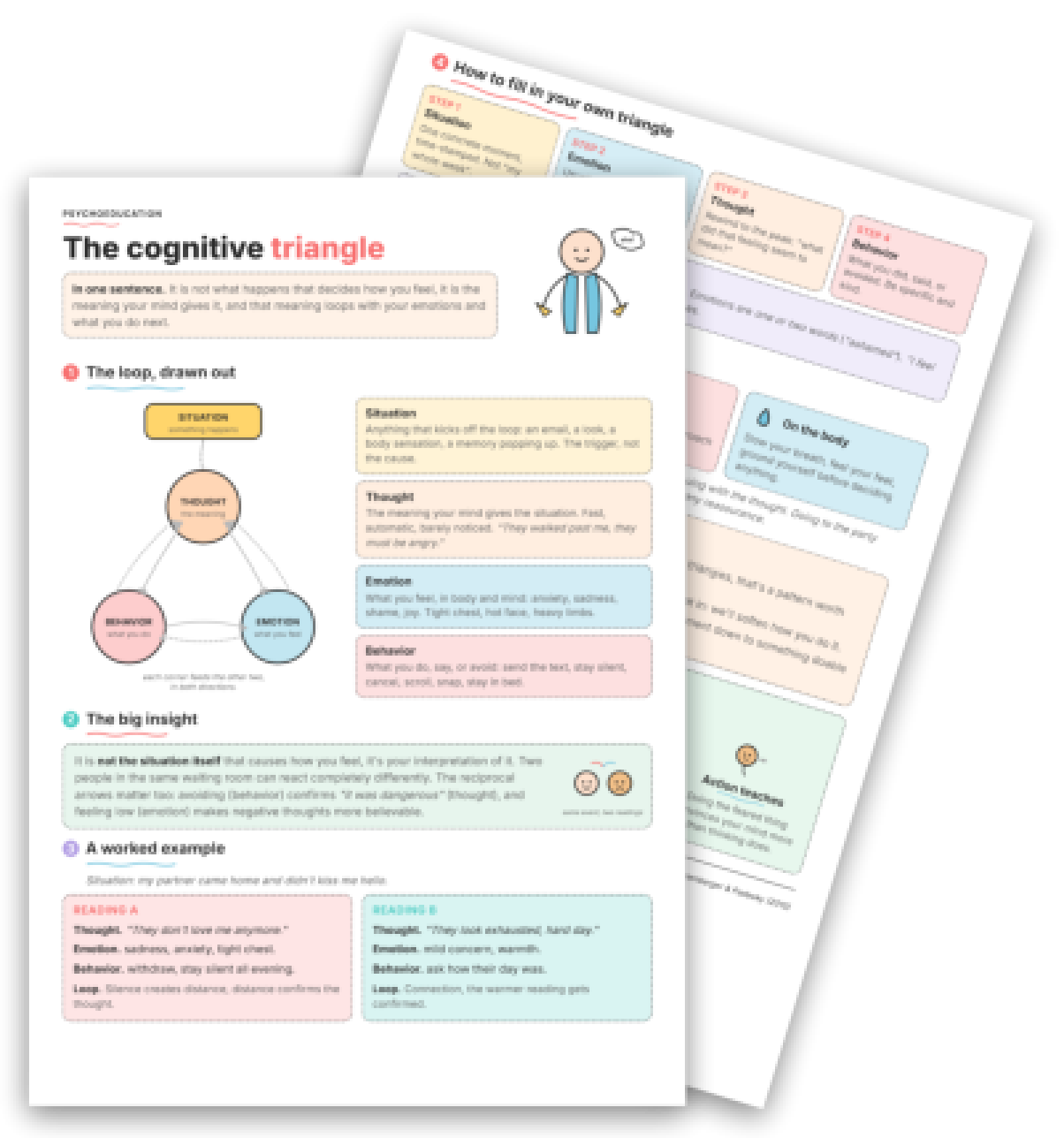
A printable visual support clinicians use in session to explain the thought-emotion-behavior loop concretely, build shared vocabulary, and give patients a reference they can return to between appointments.
Clinical vignettes
Mapping a Withdrawal Cycle
Reframing an Anxiety Spike
Clinical picture. T., a man in his mid-twenties, was referred following a first panic attack at work and subsequent health anxiety. The clinician used the cognitive triangle as a psychoeducational tool to examine one specific episode: a sudden awareness of his heartbeat during a meeting. T. had interpreted the sensation as "something is wrong with my heart," which triggered acute anxiety and an urge to leave the room. The worksheet helped him distinguish the situation (a neutral body sensation) from the meaning his mind assigned it, and to trace how leaving early had reinforced the belief that the situation was dangerous. He did not report full symptom relief, but described feeling "less at the mercy of it" once the loop was drawn out explicitly.
Explaining the thought-emotion-behavior loop verbally is something most CBT clinicians do in the first or second session, and most patients nod, then walk out with a fuzzy understanding that dissolves before the next appointment. This cognitive triangle PDF worksheet gives that explanation a visual anchor: a printable support to use directly in session to make the loop concrete, accelerate psychoeducation, and leave patients with a reference they can actually find again at home.
Use this resource with your patients
Handout, exercises and materials ready to use, right inside SessionFuel.
Why the Cognitive Triangle Resists Verbal Explanation
The loop is conceptually simple, but patients consistently conflate thoughts and emotions, treating "I feel like nobody likes me" as a feeling rather than an automatic thought. They also miss the bidirectionality: that avoiding (behavior) circles back to confirm "it was dangerous" (thought), which makes the emotion more intense at the next exposure. Saying "each corner feeds the other two" out loud rarely produces genuine uptake. The abstract becomes the abstract.
There is a subtler clinical difficulty, too. Patients who are highly ruminative, or who present with prominent cognitive distortions, tend to intellectualize the model without locating themselves inside it. They understand the triangle in principle but cannot apply it to a specific, time-stamped moment. Without a worked example and a structured filling protocol, the concept stays theoretical, and theoretical tools do not travel well into the week.
The ABC model from REBT covers overlapping ground, but the triangle's three-corner layout, situation, thought, emotion, behavior, maps more directly onto Beck's original formulation and lands faster with patients unfamiliar with CBT structure.
What the Fiche Contains: A Visual Map of the Loop
The printable unfolds across five numbered panels. Panel 1 renders the loop as an actual diagram: Situation, Thought, Emotion, Behavior, with explicit bidirectional arrows and the caption "each corner feeds the other two, in both directions." Showing this to a patient mid-session is faster than sketching it on a notepad, and the arrows make the feedback mechanism visible in a way that a verbal explanation rarely achieves.
Panel 2 defines each corner precisely, including the critical distinction that a situation is "the trigger, not the cause," and that thoughts are "fast, automatic, barely noticed." This wording is precise enough to open a conversation about automatic thought patterns without over-complicating the introduction.
Panel 3 provides a worked example: a partner who arrives home without a greeting, contrasted across two readings. Reading A spirals into withdrawal and confirmed distance; Reading B leads to warmth and connection. The "same event, two readings" structure demonstrates interpretive bias concretely, without requiring you to construct an example on the fly.
Panel 4 walks through a four-step self-monitoring protocol: time-stamp one concrete situation, name the emotion first (usually the easiest entry point), rewind to the peak to identify the thought, then specify the behavior. The fiche includes one clinician-ready clarification: "Thoughts are sentences you can write down. Emotions are one or two words." That single line cuts several minutes from any session spent unpacking confused self-referential cognitions, including the classic "I feel like a failure" framing.
Panel 5 maps three intervention handles: challenging the thought, doing the behavioral opposite (directly relevant to work on avoidance reduction), and somatic grounding before deciding anything. The note that "changing behavior often shifts thoughts faster than arguing with the thought" is worth reading aloud as a standalone psychoeducation point.
> Key takeaway: The fiche is a visual support that facilitates the explanation of the cognitive triangle in session, not a questionnaire patients complete alone. The diagram, the worked example, and the four-step protocol work because patients can see the loop rather than only hear it described.
750+ clinical tools
A library built with and for clinicians, ready to use in session and extend between appointments.
Access all the toolsWhen and How to Introduce the Fiche
The fiche fits naturally after the initial anamnesis, typically in the second or third session, once you have identified at least one recurrent situation-thought-emotion sequence in the patient's presentation. For patients with generalized anxiety disorder, social anxiety, or depression who are new to CBT, it serves as the foundational psychoeducation step before any cognitive restructuring work begins. It also integrates cleanly into a longitudinal case formulation as the shared map you and the patient return to throughout treatment.
A natural introduction: "I'd like to show you a diagram that maps how thoughts, emotions, and behaviors connect, it makes the next few sessions much clearer." Go through Panel 3 together, applying it to a real moment the patient raised. Do not hand the fiche to the patient and ask them to complete it alone; the in-session walkthrough is where its clinical value lies.
Debrief by asking which corner was easiest to identify (usually emotion) and which was hardest (usually thought, confused with feeling). That difficulty, surfaced by the fiche, directly sets up the next conversation about cognitive distortions and catching automatic thoughts as structured homework.
For patients with significant perfectionism or harsh self-monitoring, Panel 5 of the fiche pre-empts a common resistance: "If filling the triangle feels like self-judgment instead of curiosity, bring that in." Reading that line together models the collaborative stance of the alliance from the outset. The fiche does not replace the case formulation; it anchors psychoeducation at the right moment, creates shared vocabulary, and gives patients a concrete reference every subsequent session can build on.
Use it with your patients
Share this tool in the mobile app and follow the work between sessions.
Sources
- Beck, A. T., Rush, A. J., Shaw, B. F., Emery, G. (1979). Cognitive Therapy of Depression. Guilford Press.
- Beck, J. S. (2021). Cognitive Behavior Therapy: Basics and Beyond (3rd ed.). Guilford Press.
Your session continues in your patients' pocket
Use with a patientYour resources, available everywhere
The handouts, exercises, programs and audios above: you choose which ones to make available to your patients, in the mobile app dedicated to them.
And far more than a library
The app goes well beyond resources, to support your patients every day:
Related categories
Explore other clinical resources by category.

Anxiety
Clinical hub for anxiety disorders: CBT and ACT worksheets, psychoeducation sheets, and exercises for assessment and treatment across the anxiety spectrum.

Mood
Evidence-based worksheets and clinical tools for mood disorders: CBT, ACT, and positive psychology resources for psychologists and therapists.

Emotions
Clinical resources on emotion regulation: worksheets, coping tools, CBT, REBT, and ACT exercises for therapists working across diagnoses and age groups.

Cognition
Printable cognitive therapy worksheets and clinical tools for therapists: CBT, ACT, schema work, defusion, distortions, and belief restructuring.

Understand
Clinical hub for the therapeutic aim 'Understand': worksheets and tools to build patient insight across CBT, ACT, schema therapy and more.

Build awareness
Clinical worksheets and tools to build awareness in therapy: cognitive distortions, schemas, emotions, ACT and CBT resources for practitioners.