
Clinical picture. A., a woman in her late thirties, presented with persistent low mood and recurrent thoughts that a single critical remark from her manager confirmed she was professionally incompetent. During the session, the clinician introduced the Cognitive Distortions Reference Sheet and invited her to read through the twelve patterns quietly. A. paused at labelling and mental filter, recognising both in her own account without prompting. She noted that putting a name to the process felt less like self-criticism and more like observing a mechanism. Over the following week she began jotting down hot thoughts and matching them to the sheet before the next appointment, which gave the clinician concrete material to work with.
HandoutAnxietyMood & depressionSelf & identityThoughts & cognitionEmotions & stressPersonalityUnderstandBuild awarenessRestructureCBT
Cognitive Distortions: PDF Worksheet, Tools and Exercises for Clinical Practice
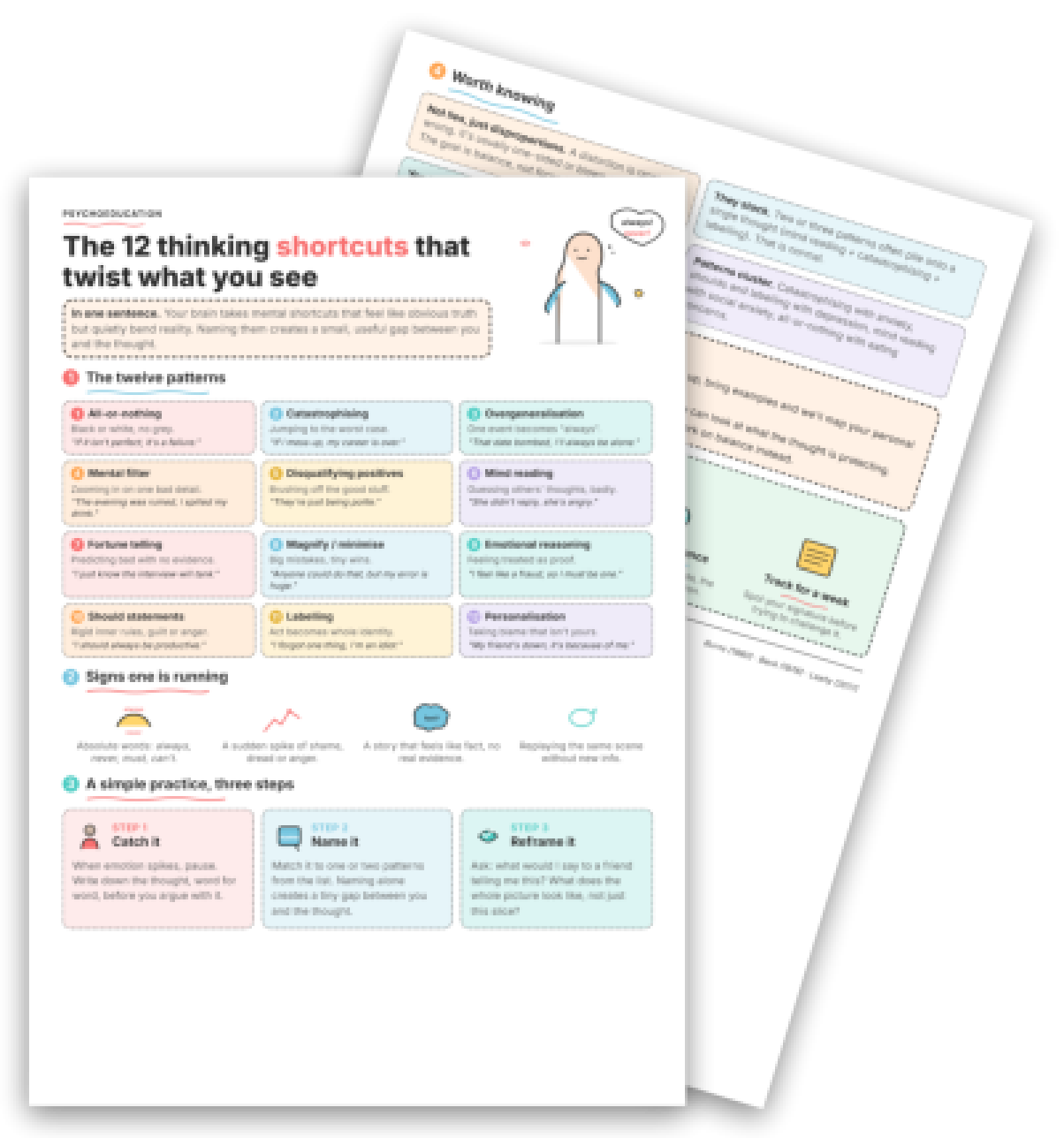
A visual reference sheet covering all twelve cognitive distortion patterns, with recognition cues and a three-step reframing practice, designed to support in-session psychoeducation.
Clinical vignettes
Naming the Pattern, Not the Person
Psychoeducation Before Formal Restructuring
Clinical picture. T., a man in his mid-twenties, had recently started cognitive-behavioural therapy for health anxiety marked by catastrophic interpretations of physical sensations. The clinician offered the reference sheet early in treatment, framing it as a map rather than a corrective tool, to lower any sense of being told his thinking was wrong. T. identified fortune telling and emotional reasoning as patterns he recognised, commenting that he had always assumed the anxious feeling itself was evidence of danger. This shift in framing reduced his initial resistance and supported engagement with the thought records introduced in the following session. Progress remained gradual, consistent with the complexity of health-focused cognitions.
Verbal psychoeducation on cognitive distortions rarely produces lasting uptake. The patient nods, session ends, and the taxonomy disappears by the following week. This PDF worksheet on cognitive distortions gives you a visual reference to work through all twelve patterns together in session, leaving the patient with a concrete taxonomy they can consult between appointments.
Use this resource with your patients
Handout, exercises and materials ready to use, right inside SessionFuel.
Why distortions resist verbal explanation alone
The problem isn't the patient's insight capacity; it's the modality. A single oral walkthrough gives the patient no stable reference point. Distortions also blur into one another without a clear visual grid: all-or-nothing thinking and overgeneralisation, catastrophising and fortune telling, tend to collapse into a vague sense of "negative thinking" that the patient can't operationalise between sessions.
Beck's foundational model was clear on this: recognition is the prerequisite for restructuring, and recognition requires repeated, anchored exposure to the category system, not a single explanation. The fiche addresses two clinical realities at once: the patient who forgets which pattern is which between sessions, and the patient whose emotional arousal level, at the very moment a distortion is running hardest, makes verbal instruction slide off without leaving a trace.
What the fiche contains: a visual taxonomy of twelve patterns
The sheet opens with a one-sentence framing that sets the defusion rationale before the patient even reads the list: "Naming them creates a small, useful gap between you and the thought." You can quote that line directly when handing the sheet over, it does some of the therapeutic work for you.
Panel 1 presents all twelve patterns in a numbered visual grid: all-or-nothing thinking, catastrophising, overgeneralisation, mental filter, disqualifying positives, mind reading, fortune telling, magnify/minimise, emotional reasoning, should statements, labelling, and personalisation. Each entry carries a one-line descriptor and a verbatim example thought ("If it isn't perfect, it's a failure"; "I feel like a fraud, so I must be one"). The visual format lets you point to specific patterns during psychoeducation rather than reciting a list from memory, and the patient can scan the grid independently between sessions.
Panel 2, "Signs one is running," names four recognition cues: absolute language (always, never, must, can't), a sudden spike of shame, dread or anger, a story that feels like fact with no real evidence, and replaying the same scene without new information. This section functions as a between-session self-monitoring guide, with no form to fill in.
Panel 3 sequences a three-step micro-practice: catch the thought (pause, write it word for word before arguing with it), name the pattern (match it to the grid), and reframe (ask what the whole picture looks like, not just this slice). The catch step articulates naturally with the automatic thought identification work that often precedes this fiche in a CBT sequence, and the reframe step pairs well with structured automatic thought restructuring exercises assigned as homework.
Panel 4, "Worth knowing," carries four clinically precise nuances: distortions are disproportions rather than outright lies; they stack, with two or three patterns frequently piling onto a single thought; each patient develops a personal signature of two or three recurring favourites; and patterns cluster by presentation (catastrophising with anxiety, shoulds and labelling with depression, mind reading with social anxiety, all-or-nothing with eating concerns). That clustering note maps directly onto cognitive case formulation and gives you language to frame the personalisation work ahead.
> Key point: The fiche is a visual support that facilitates the explanation of cognitive distortions during the session itself. It is not a self-administered questionnaire. Its clinical value comes from working through it together, so the patient has a shared vocabulary and a portable reference to take away.
Clinical library
750+ clinical tools
A library built with and for clinicians, ready to use in session and extend between appointments.
Access all the toolsSeveral resource types
Psychoeducation handouts
Understand at a glance
Interactive exercises
To do and fill in
Interactive programs
A structured path
Audios
Meditation and relaxation
Psychometric tests
Automatic scoring
When and how to introduce the fiche
The fiche fits naturally into early-to-mid psychoeducation, typically from the second or third session once you have a working cognitive formulation. It is particularly useful for patients presenting with generalised anxiety, perfectionism, or low self-esteem, where the distortion vocabulary accelerates pattern recognition considerably faster than oral description.
A direct, non-pathologising introduction works well: "I want to show you a map of the most common thinking shortcuts that generate distress. We'll use it to work out which ones show up most in your situation." Scan the grid together in session, pausing at any pattern the patient immediately recognises. That recognition moment, often marked by a visible shift in posture or a dry laugh, is clinically significant: it is the beginning of the defusion the fiche's framing promises.
Debrief the following session by asking which patterns came up during the week. The sheet's "To discuss in session" prompts support exactly this: if the same two or three patterns keep appearing, you can begin mapping the patient's personal signature. If naming a distortion feels easy but the emotional charge stays heavy, that is a signal to move toward the schema or core belief level, using something like the tracing thought origins to core beliefs exercise or the catching your thoughts practice as a bridge.
One limit worth noting: for patients in early stabilisation, or those prone to using insight as a vehicle for self-criticism, the taxonomy can function as a new catalogue for self-attack rather than defusion. Introduce it once a working alliance is solid, and frame it explicitly as a tool for curiosity, not diagnosis.
The fiche does not replace the CBT cognitive model conversation or the REBT ABC model work further downstream. It earns its place as the initial shared reference, the map the patient keeps returning to across the entire restructuring phase.
Use it with your patients
Share this tool in the mobile app and follow the work between sessions.
Sources
- Beck, A. T., Rush, A. J., Shaw, B. F., Emery, G. (1979). Cognitive Therapy of Depression. Guilford Press.
- Burns, D. D. (1980). Feeling Good: The New Mood Therapy. William Morrow.
- Burns, D. D. (1989). The Feeling Good Handbook. HarperCollins.
- Beck, J. S. (2021). Cognitive Behavior Therapy: Basics and Beyond. Guilford Press.
- Ozdel, K., Taymur, I., Guriz, S. O., Tulaci, R. G., Kuru, E., Turkcapar, M. H. (2014). Measuring Cognitive Errors Using the Cognitive Distortions Scale (CDS): Psychometric Properties in Clinical and Non-Clinical Samples. PLOS ONE.
Patient mobile app
Your session continues in your patients' pocket
Use with a patientYour resources, available everywhere
The handouts, exercises, programs and audios above: you choose which ones to make available to your patients, in the mobile app dedicated to them.
Psychoeducation handoutsInteractive exercisesInteractive programsAudiosPsychometric tests
And far more than a library
The app goes well beyond resources, to support your patients every day:
Standardized tests
Therapy journal
Gamification
Wellbeing challenges
Introspection prompts
Therapist homework
Related categories
Explore other clinical resources by category.

Anxiety
Clinical hub for anxiety disorders: CBT and ACT worksheets, psychoeducation sheets, and exercises for assessment and treatment across the anxiety spectrum.

Mood
Evidence-based worksheets and clinical tools for mood disorders: CBT, ACT, and positive psychology resources for psychologists and therapists.

Identity
Clinical resources for self-identity work in therapy: CBT, ACT, schema tools for clinicians addressing self-concept, core beliefs, and identity disruption.

Emotions
Clinical resources on emotion regulation: worksheets, coping tools, CBT, REBT, and ACT exercises for therapists working across diagnoses and age groups.

Cognition
Printable cognitive therapy worksheets and clinical tools for therapists: CBT, ACT, schema work, defusion, distortions, and belief restructuring.

Understand
Clinical hub for the therapeutic aim 'Understand': worksheets and tools to build patient insight across CBT, ACT, schema therapy and more.