
Clinical picture. T., a 38-year-old secondary school teacher, presented with chronic fatigue, jaw tension, and poor sleep, attributing her difficulties to a demanding new head of department. During a third session, the clinician introduced the GAD psychoeducation worksheet and asked her to complete the six self-appraisal questions aloud. T. paused at question two, the empty-day worry item, noting that she felt unsettled even during school holidays when no obvious stressor was present. She also endorsed the substitute test, acknowledging that whenever a specific concern resolved, a new one took its place within hours. The clinician did not offer a diagnosis but reflected that her pattern of worry appeared to run across many unrelated topics simultaneously, and recommended a formal assessment using a validated measure before the next appointment.
Generalized Anxiety Disorder (GAD): PDF Worksheet, Tools and Exercises
A structured visual worksheet, clinical tools, and exercises to help clinicians explain GAD's shifting worry process to patients and open a grounded clinical conversation.
Clinical vignettes
Worksheet Reframes Longstanding Tension
Somatic Focus Shifts to Worry Pattern
Clinical picture. M., a 45-year-old logistics coordinator, was referred by his general practitioner for recurrent tension headaches and what he described as difficulty switching off after work. He had not previously considered anxiety as a framework for his experience, associating anxiety instead with panic attacks. The clinician walked through the worksheet section on body and mind companions, which prompted M. to recognise persistent neck stiffness and restlessness he had dismissed as occupational strain. When the spiral diagram was reviewed, he identified a sequence from the previous week in which a minor delivery delay had, within minutes, expanded into catastrophic thoughts about contract loss and financial ruin. This recognition opened a productive conversation about the migrating quality of his worry and the value of a structured psychological assessment.
GAD is one of the most routinely missed presentations in consultation, not because patients conceal it, but because they mis-attribute it. A patient who opens with fatigue, chronic neck tension, and disrupted sleep rarely frames the picture as "I worry constantly about everything." This fiche PDF gives you a concrete visual support to redirect that conversation in session, from somatic complaints toward the shifting, multi-domain worry process underlying them.
Use this resource with your patients
Handout, exercises and materials ready to use, right inside SessionFuel.
Why GAD Resists Oral Explanation in Session
The central clinical difficulty is not recognition on your side; it is the concept of the worry-engine on the patient's side. Patients with GAD rarely experience their worry as globally excessive. Each individual concern feels proportionate to its context. When you explain verbally that GAD involves free-floating, topic-migrating anxiety that persists regardless of what resolves, most patients respond with some version of "but I'm worried about real things." The metacognitive dimension, and the defining absence of a single identifiable stressor, are notoriously hard to convey without a grounding frame.
Differential confusion compounds this. A patient whose worry clusters around health may have partially self-diagnosed health anxiety; one whose main complaints are irritability and poor sleep may have normalized the picture as burnout. Patients who have lived with diffuse worry since adolescence frequently mistake chronicity for personality, what the fiche calls the personality trap: "I've always been a worrier, that's just me." An oral explanation alone rarely dislodges that framing.
What the Fiche Contains: A Visual Support for Explaining GAD
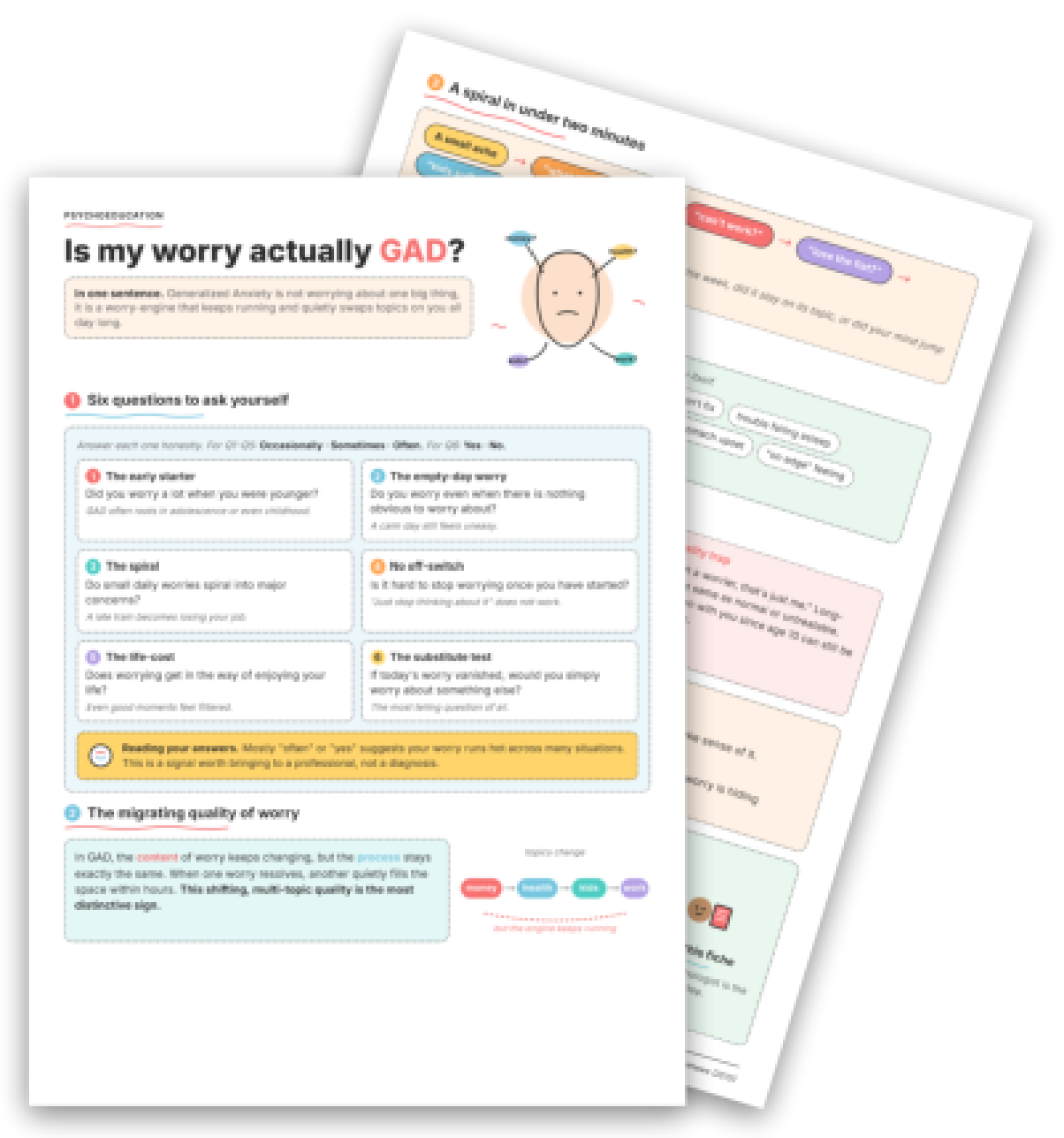
The fiche opens with a single-sentence clinical metaphor that does the work five minutes of verbal description often cannot: "a worry-engine that keeps running and quietly swaps topics on you all day long." That line is worth reading aloud with the patient before moving further.
The main tool is a six-question self-assessment, each question targeting a distinct feature of GAD:
- The early starter: developmental onset, given that GAD often roots in adolescence or childhood
- The empty-day worry: anxiety that persists even when circumstances are calm
- The spiral: small concerns escalating rapidly (a late train becomes job loss)
- The no off-switch: failed voluntary thought suppression, directly relevant to the metacognitive model
- The life-cost: impairment across positive as well as negative situations
- The substitute test: "If today's worry vanished, would you simply worry about something else?" described in the fiche as "the most telling question of all"
Patients respond on a three-point scale (Occasionally / Sometimes / Often) for Q1-5, and Yes/No for Q6. The visual layout makes the pattern across answers legible at a glance, which is something an oral exchange rarely achieves.
Beyond the questionnaire, three further panels carry important clinical weight. The migrating quality panel shows graphically that topics change while the underlying process does not, a key insight for patients stuck on content rather than process. The two-minute spiral sequence (a physical twinge escalating to catastrophic job and housing loss) pairs well with your work on decatastrophizing and on mapping anxiety physical sensations. The body and mind companions panel lists ten somatic and behavioral markers (tense jaw, fatigue sleep does not fix, waking through the night, "braced on waking") that help patients connect the physical presentation to the worry process. Finally, a differential panel clearly distinguishes GAD from social anxiety, health anxiety, OCD, and PTSD, so you can use it live to name what is not present, a move that often strengthens alliance.
> Key point: The fiche is a visual support that facilitates the explanation of GAD in session; it is not a self-administered questionnaire. The clinician guides the patient through the panels, which leaves the patient with a concrete, named reference to take home.
750+ clinical tools
A library built with and for clinicians, ready to use in session and extend between appointments.
Access all the toolsWhen and How to Propose the Fiche
The fiche fits naturally in the psychoeducation phase, typically sessions two or three, after the initial anamnesis has surfaced the worry pattern but before formulation of case is complete. It is particularly well-suited to patients who:
- present primarily with somatic complaints and have not yet connected these to chronic worry
- have normalised long-standing anxiety as a personality trait
- show the reassurance-seeking loop without recognising it as anxiety-driven
- are ambivalent about whether their experience warrants clinical attention
A low-framing introduction keeps the tone collaborative: "There's a one-page tool I sometimes use to look at how worry works for different people. I'd like to go through it with you and see which parts fit." This avoids labelling the patient before they have self-identified with the description.
Debrief by starting with Q6, the substitute test, since it is the item most likely to produce a genuine moment of recognition. From there, connect the body symptoms panel to what the patient has already reported, and use the differential section to explicitly rule out frameworks that do not apply. For patients who will benefit from deeper work on the intolerance of uncertainty that underlies GAD's engine, the Intolerance of Uncertainty psychoeducation program and the structured exercise on intolerance of uncertainty in anxiety extend the conversation naturally. For ongoing monitoring, the Anxiety Check-In tracks changes session by session, and the worry and attentional capture exercise gives the patient a between-session tool immediately after the psychoeducation phase.
One limit worth noting: the fiche is explicitly framed as a recognition tool, not a diagnostic instrument. The closing panel states this clearly, and you will want to reinforce that framing verbally so the patient does not leave with a self-diagnosis in hand.
The fiche does not replace the clinical formulation; it makes one abstract feature of GAD, the process rather than the content of worry, concrete enough for the patient to hold onto between sessions.
Use it with your patients
Share this tool in the mobile app and follow the work between sessions.
Sources
- Wells, A. (1995). Meta-cognition and worry: A cognitive model of generalized anxiety disorder. Behavioural and Cognitive Psychotherapy.
- Robichaud, M., Koerner, N., Dugas, M. J. (2019). Cognitive Behavioral Treatment for Generalized Anxiety Disorder: From Science to Practice. Routledge.
- National Institute for Health and Care Excellence (NICE) (2011). Generalised anxiety disorder and panic disorder in adults: management (CG113).
Your session continues in your patients' pocket
Use with a patientYour resources, available everywhere
The handouts, exercises, programs and audios above: you choose which ones to make available to your patients, in the mobile app dedicated to them.
And far more than a library
The app goes well beyond resources, to support your patients every day:
Related categories
Explore other clinical resources by category.
Anxiety
Clinical hub for anxiety disorders: CBT and ACT worksheets, psychoeducation sheets, and exercises for assessment and treatment across the anxiety spectrum.

Understand
Clinical hub for the therapeutic aim 'Understand': worksheets and tools to build patient insight across CBT, ACT, schema therapy and more.

CBT
CBT worksheets, cognitive restructuring exercises & behavioral tools for clinicians. Evidence-based resources for every phase of cognitive behavioral therapy.

Trauma
Clinical hub on trauma and PTSD: assessment, differential diagnosis, treatment phases, and printable resources for practitioners. 155 chars.

Mood
Evidence-based worksheets and clinical tools for mood disorders: CBT, ACT, and positive psychology resources for psychologists and therapists.

Identity
Clinical resources for self-identity work in therapy: CBT, ACT, schema tools for clinicians addressing self-concept, core beliefs, and identity disruption.