
Clinical picture. R., a woman in her early forties, was referred by her GP for persistent sleep difficulties and what her referral letter described as generalised anxiety. In the initial assessment session, she mentioned almost in passing that she had been assaulted by a colleague several years earlier and had never spoken about it clinically. The clinician introduced the informational sheet as a shared reading exercise, inviting R. to go through the six sign clusters and note which resonated. She identified hyperarousal, avoidance of crowded workplaces, and recurrent intrusive imagery, all active in the past month, alongside pervasive self-blame. Naming the pattern as a probable trauma response rather than a character flaw visibly shifted her posture; she agreed to return for a structured trauma-focused assessment the following week.
PTSD: PDF Worksheet, Tools and Exercises for Clinical Practice
A printable PDF checklist to support PTSD psychoeducation in session, helping patients organise their symptom picture and move past misdiagnosis before deeper trauma work begins.
Clinical vignettes
Old Trauma, Mislabelled as Anxiety
Recent Road Accident, Threshold Unclear to Patient
Clinical picture. M., a man in his late twenties, attended a single-session consultation six weeks after a serious road traffic collision in which he had not been physically injured. He reported feeling "fine mostly" but described difficulty driving on motorways, startling at tyre sounds, emotional flatness with his partner, and nightly replays of the impact. He was uncertain whether his reactions were proportionate or clinically relevant. The clinician used the worksheet's gating question and time anchor to structure a brief review together, and M. counted five of the six sign clusters present over the past month. The threshold criterion gave him a concrete frame for understanding why a referral was warranted rather than a sign he was "making a fuss"; he left with a GP letter and a follow-up appointment scheduled.
Getting a patient to recognise their own PTSD picture in session is harder than it sounds: the word alone triggers defensiveness, and verbal explanations of symptom clusters tend to blur together without a visual anchor. This fiche PDF gives you a structured psychoeducation sheet you can walk through together, turning what risks becoming a clinical monologue into a shared mapping exercise.
Use this resource with your patients
Handout, exercises and materials ready to use, right inside SessionFuel.
Why PTSD Resists Verbal Explanation in Session
The problem isn't theoretical. Many patients arrive with a long trail of misdiagnoses, and the fiche names this directly: symptoms are "often mislabelled as 'just anxiety', 'just stress', or depression." When the trauma engine goes unidentified, treatment targets the wrong mechanism. Psychoeducation on PTSD in isolation corrects that, but only if the patient can actually organise what they're experiencing into a coherent picture.
Verbal explanations tend to produce surface recognition at best. Intrusion, avoidance, hyperarousal, numbing, self-blame, and sudden emotional flares don't feel like a single syndrome from the inside; they feel like chaos. A visual layout that names and separates each cluster does what an oral summary cannot: it gives the patient a map they can hold, point to, and take home.
There's also a temporal confusion worth addressing explicitly in session. PTSD is frequently understood as something that starts immediately after the event. In practice, you'll often be working with people whose symptoms emerged, or persisted, months or years later. Differential work with presentations resembling generalised anxiety, depression, or OCD depends on this distinction being clear to the patient, not only to you.
What the Fiche Contains
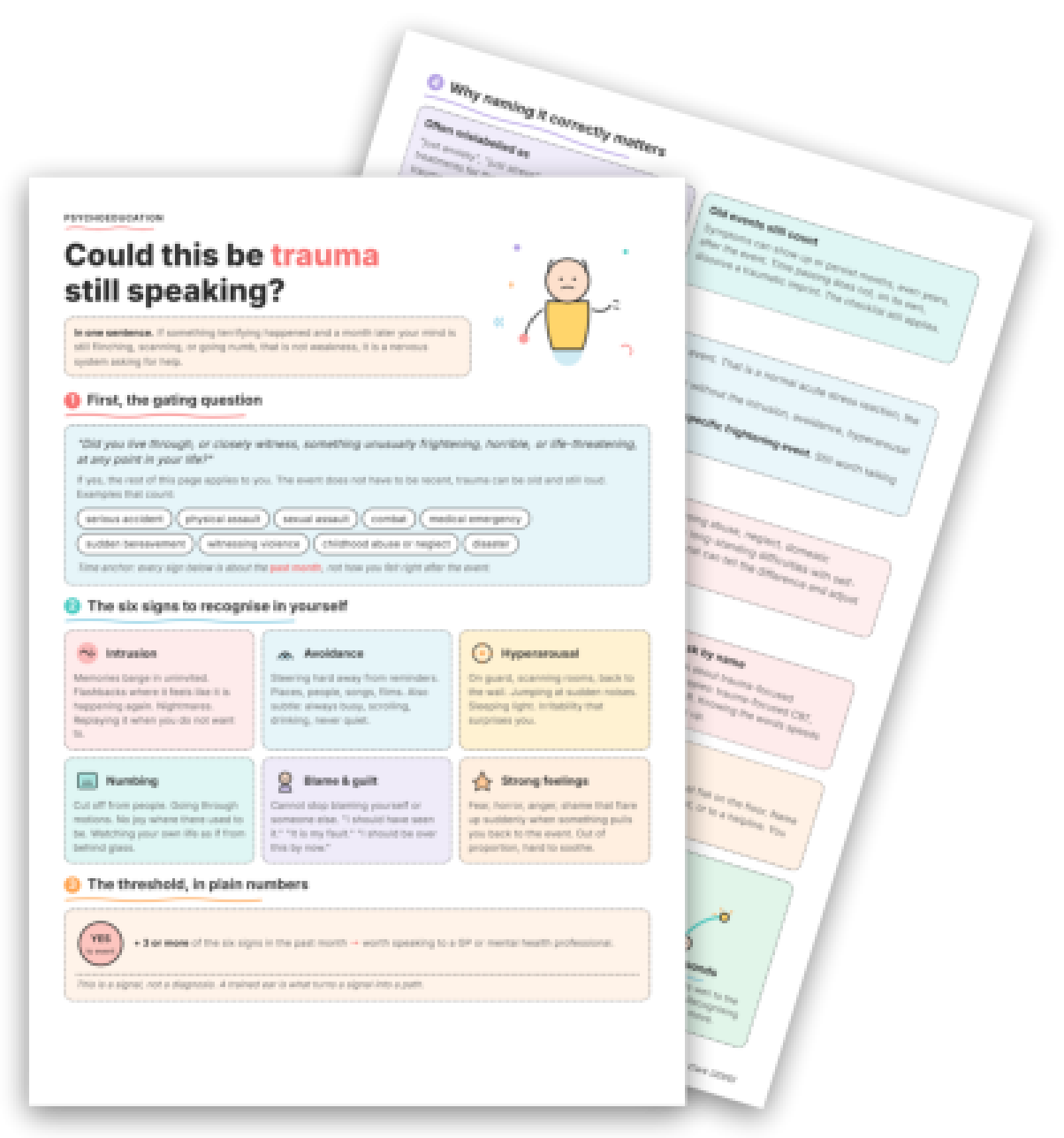
The sheet is structured across seven sections, each serving a specific clinical function.
A gating question opens the page: "Did you live through, or closely witness, something unusually frightening, horrible, or life-threatening, at any point in your life?" This anchors the conversation before any symptom is named. The accompanying list of qualifying events, assault, bereavement, childhood abuse, medical emergency, combat, disaster, among others, normalises a wide range of presentations without pathologising any of them.
The core of the fiche is six named symptom clusters: Intrusion, Avoidance, Hyperarousal, Numbing, Blame and guilt, and Strong feelings. Each is described in plain, behaviorally anchored language. Avoidance, for instance, explicitly includes the subtle end of the spectrum: "always busy, scrolling, drinking, never quiet." That level of specificity reaches patients who would never recognise évitement expérientiel in clinical vocabulary.
A threshold panel follows: event plus three or more signs in the past month is the prompt to seek professional input. Importantly, the fiche also names what PTSD is NOT, separating acute stress reactions and grief-adjacent sadness from the diagnostic picture. A dedicated note on complex trauma covers presentations shaped by repeated or childhood adversity, a dimension that often co-occurs with difficulties you may already be addressing through shame-focused work, guilt and responsibility exercises, or emotion regulation psychoeducation.
A grounding reminder closes the page, offering a 5-4-3-2-1 sensory anchor for patients who feel destabilised by reading it, directly aligned with present-moment grounding techniques you may already use in session.
> Key point: This fiche is a visual support you use with the patient, not a self-administered screening instrument. Its value lies in the shared mapping it enables: both clinician and patient leave the exchange with a common vocabulary before the deeper clinical work begins.
750+ clinical tools
A library built with and for clinicians, ready to use in session and extend between appointments.
Access all the toolsWhen and How to Propose the Fiche
This sheet fits best in early assessment, once the therapeutic alliance supports a frank conversation about the presenting history. A natural introduction: "I'd like to go through a short overview of how trauma can show up, so we can look together at which parts resonate with you." That framing keeps the exercise collaborative rather than diagnostic in tone.
It's particularly well-placed when a patient arrives with a pre-existing label that may be masking an underlying traumatic aetiology: burnout, panic disorder, health anxiety, or treatment-resistant depression are common entry points. Walking through the six clusters together often produces a recognition that reorients the case formulation.
For complex trauma presentations, treat the fiche as a first orientation only. The C-PTSD note is deliberately brief; it signals to the patient that their experience may be wider than the six core signs, pointing toward trauma-informed assessment without overloading an early session.
After using it, ask which clusters land most strongly, and invite the patient to bring one concrete example of each to the next appointment. Pair the debrief with adaptive coping work or an initial exposure hierarchy when the treatment plan is moving toward trauma-focused CBT or EMDR.
The fiche doesn't replace clinical formulation; it makes the opening of that formulation more legible, for the patient and for you.
Use it with your patients
Share this tool in the mobile app and follow the work between sessions.
Sources
- American Psychiatric Association (2013). Diagnostic and Statistical Manual of Mental Disorders (5th ed.). American Psychiatric Publishing.
- Weathers, F. W., Litz, B. T., Keane, T. M., Palmieri, P. A., Marx, B. P., & Schnurr, P. P. (2013). PTSD Checklist for DSM-5 (PCL-5). National Center for PTSD, U.S. Department of Veterans Affairs.
- National Institute for Health and Care Excellence (NICE) (2018). Post-traumatic stress disorder (NICE Guideline NG116). NICE.
- National Center for PTSD, U.S. Department of Veterans Affairs (2016). Using the PTSD Checklist for DSM-5 (PCL-5). U.S. Department of Veterans Affairs.
Your session continues in your patients' pocket
Use with a patientYour resources, available everywhere
The handouts, exercises, programs and audios above: you choose which ones to make available to your patients, in the mobile app dedicated to them.
And far more than a library
The app goes well beyond resources, to support your patients every day:
Related categories
Explore other clinical resources by category.

Trauma
Clinical hub on trauma and PTSD: assessment, differential diagnosis, treatment phases, and printable resources for practitioners. 155 chars.

Understand
Clinical hub for the therapeutic aim 'Understand': worksheets and tools to build patient insight across CBT, ACT, schema therapy and more.

CBT
CBT worksheets, cognitive restructuring exercises & behavioral tools for clinicians. Evidence-based resources for every phase of cognitive behavioral therapy.
Anxiety
Clinical hub for anxiety disorders: CBT and ACT worksheets, psychoeducation sheets, and exercises for assessment and treatment across the anxiety spectrum.

Mood
Evidence-based worksheets and clinical tools for mood disorders: CBT, ACT, and positive psychology resources for psychologists and therapists.

Identity
Clinical resources for self-identity work in therapy: CBT, ACT, schema tools for clinicians addressing self-concept, core beliefs, and identity disruption.