
Clinical picture. M., a 38-year-old secondary school teacher, was referred after requesting a third cardiology opinion within four months following two unremarkable ECGs and a normal echocardiogram. He described spending two to three hours each evening researching palpitations online and waking at night to check his pulse manually. During session, the clinician introduced the informational worksheet on health anxiety, walking through the healthy-attention versus health-anxiety comparison column by column. M. recognized his own pattern immediately in the "reassurance fades within hours" row, noting that his cardiologist's words felt convincing at the appointment and hollow by the following morning. This shared recognition opened a productive conversation about the reassurance loop and provided a concrete rationale for why further investigations were unlikely to bring lasting relief.
Health Anxiety: PDF Worksheet, Tools and Exercises for Clinical Practice
A printable PDF fiche with structured tools and exercises to explain health anxiety clearly in session, from the reassurance loop to daily behavioural patterns.
Clinical vignettes
Reassurance Seeking After Normal Cardiac Workup
Headache Worry Disproportionate to Findings
Clinical picture. L., a 52-year-old administrative manager, presented with persistent worry about a brain tumour following a normal MRI scan six weeks prior. She reported Googling headache symptoms daily and had begun avoiding physical exertion for fear of worsening an undetected lesion. The clinician used the worksheet's five structured questions as a brief self-assessment, and L. endorsed the rightmost response option on four of the five items, including doubt returning after medical reassurance and health thoughts occupying most of her waking day. The clinician was careful to frame this not as a diagnosis but as a signal worth exploring further, consistent with the worksheet's own language. L. agreed to trial a two-week self-monitoring log tracking the time cost of health-focused checking behaviour as a first concrete step.
Patients presenting with health anxiety rarely arrive labelling it that way. They come convinced something has been missed medically, and the first clinical challenge is naming what is happening without triggering defensiveness or fracturing the alliance. This fiche PDF gives you a concrete, non-stigmatising visual support to open exactly that conversation.
Use this resource with your patients
Handout, exercises and materials ready to use, right inside SessionFuel.
Why Health Anxiety Resists Oral Explanation in Session
The central difficulty is that reassurance, the natural clinical reflex, actively maintains the disorder. Telling a patient their tests came back clear does nothing to interrupt the reassurance loop; it produces temporary calm, then returns them to baseline worry within hours. Patients understand this intellectually once you name it, but rarely feel the mechanism until they can see it laid out.
A second obstacle is the boundary between appropriate health vigilance and illness anxiety proper. Without a visual reference, explaining this gradient verbally tends to produce either over-identification ("I do all of that") or dismissal ("but my symptoms are real"). The fiche sidesteps this by placing both profiles side by side, making the distinction legible rather than something to be argued.
Inside the Fiche: A Visual Support for Health Anxiety
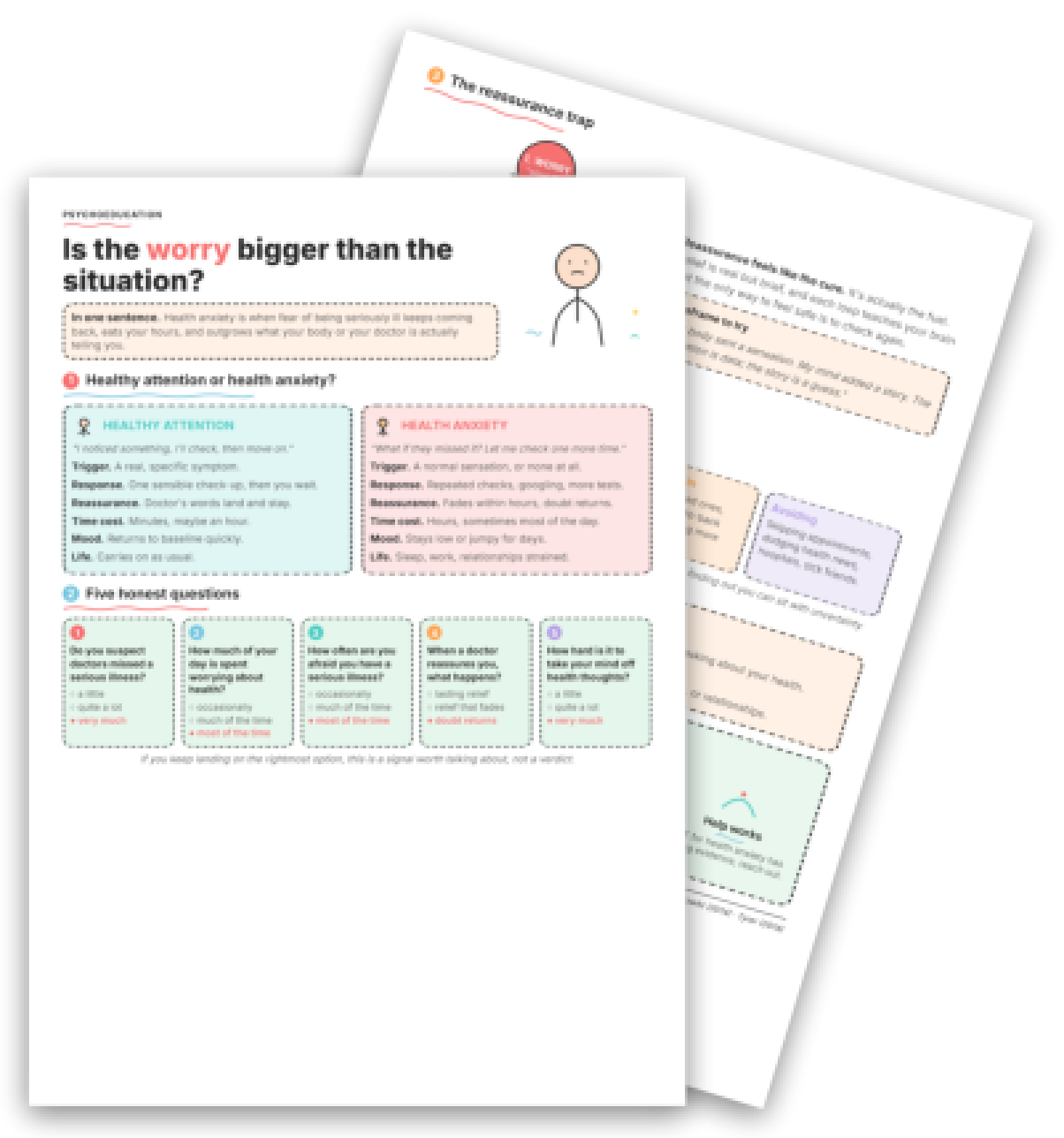
The sheet is structured across four visual panels, grounded in the work of Salkovskis, Abramowitz, and Tyrer.
Panel 1 presents a parallel comparison of Healthy Attention and Health Anxiety across six dimensions: trigger, response, reassurance, time cost, mood, and impact on daily life. The contrast is immediate. A patient who reads "doctor's words land and stay" opposite "doubt returns" can locate themselves without you having to press the point.
Panel 2 contains five self-report items covering frequency of worry, suspicion of missed diagnosis, and difficulty disengaging from health-related cognitions. The fiche frames these carefully: "If you keep landing on the rightmost option, this is a signal worth talking about, not a verdict." This wording protects the alliance at precisely the moment a patient is most likely to feel labelled.
Panel 3 is a cycle diagram illustrating the reassurance trap: worry triggers checking, checking produces brief calm, doubt returns, and the loop restarts stronger. The fiche states it plainly: "Reassurance feels like the cure. It's actually the fuel." Having this on paper lets you point to the mechanism rather than argue it, which is particularly useful with intellectualising patients or those presenting with marked intolerance of uncertainty.
Panel 4 maps the four behavioural expressions: body-checking, googling, repeated reassurance-seeking, and avoidance. The observation that "checking and avoiding look opposite, but they do the same job" is often the most surprising moment in the session, and the one most worth debriefing. It connects naturally to broader work on adaptive vs maladaptive coping and prepares the ground for building an exposure hierarchy when that step is indicated.
> Key point: The fiche is a visual support that facilitates explanation in session, not a self-administered questionnaire. Use it as a shared reference you hold with the patient, then leave it with them as a concrete between-session anchor.
750+ clinical tools
A library built with and for clinicians, ready to use in session and extend between appointments.
Access all the toolsWhen and How to Introduce It in Your Practice
The fiche fits best in the second or third session, once the presenting complaint is mapped and the alliance is established. It is not an intake tool. For patients who arrive after multiple inconclusive medical consultations, framing it as "a way of looking at the difference between normal health vigilance and something more persistent" avoids the word "anxiety" when that framing is still unwelcome.
Profiles for whom it is particularly useful:
- Patients with comorbid OCD features, where the checking rituals and doubt cycle overlap significantly with health anxiety's maintenance model
- Those presenting death anxiety alongside somatic preoccupation
- Patients whose worry escalated after a genuine medical event, who need help distinguishing residual vigilance from a self-sustaining anxiety loop
The fiche bridges efficiently into decatastrophizing work, automatic thought restructuring, and mapping anxiety's physical sensations. In the debrief, the reassurance trap diagram consistently generates the richest clinical material: ask the patient where in the cycle they recognise themselves most readily. The "To discuss in session" prompts at the bottom of the fiche can serve directly as follow-up session anchors across subsequent appointments.
The fiche does not replace a full case formulation or the exposure-based protocol that CBT for health anxiety requires. It gives both parties a shared vocabulary and a concrete reference point to return to when the reassurance pull intensifies.
Use it with your patients
Share this tool in the mobile app and follow the work between sessions.
Sources
- Salkovskis, P. M., Rimes, K. A., Warwick, H. M. C., Clark, D. M. (2002). The Health Anxiety Inventory: development and validation of scales for the measurement of health anxiety and hypochondriasis. Psychological Medicine.
- Abramowitz, J. S., Braddock, A. E. (2008). Psychological Treatment of Health Anxiety and Hypochondriasis: A Biopsychosocial Approach. Hogrefe.
- Abramowitz, J. S., Braddock, A. E. (2011). Hypochondriasis and Health Anxiety. Hogrefe.
Your session continues in your patients' pocket
Use with a patientYour resources, available everywhere
The handouts, exercises, programs and audios above: you choose which ones to make available to your patients, in the mobile app dedicated to them.
And far more than a library
The app goes well beyond resources, to support your patients every day:
Related categories
Explore other clinical resources by category.

Anxiety
Clinical hub for anxiety disorders: CBT and ACT worksheets, psychoeducation sheets, and exercises for assessment and treatment across the anxiety spectrum.

Understand
Clinical hub for the therapeutic aim 'Understand': worksheets and tools to build patient insight across CBT, ACT, schema therapy and more.

CBT
CBT worksheets, cognitive restructuring exercises & behavioral tools for clinicians. Evidence-based resources for every phase of cognitive behavioral therapy.

Trauma
Clinical hub on trauma and PTSD: assessment, differential diagnosis, treatment phases, and printable resources for practitioners. 155 chars.

Mood
Evidence-based worksheets and clinical tools for mood disorders: CBT, ACT, and positive psychology resources for psychologists and therapists.

Identity
Clinical resources for self-identity work in therapy: CBT, ACT, schema tools for clinicians addressing self-concept, core beliefs, and identity disruption.