
Clinical picture. M., a 38-year-old secondary school teacher, presented after her GP referred her for persistent fatigue and sleep difficulties. She described herself as "a worrier by nature" and initially attributed her difficulties to a demanding workload. During the second session, the clinician introduced the GAD DSM-5 criteria sheet as a shared reference point, walking through the ordinary-worry versus GAD-worry distinction column by column. M. paused at the criterion describing worry that survives resolution and migrates to a new topic, saying it was the first time something had captured what she actually experienced rather than what she assumed stress was supposed to look like. By the end of the session she could identify that her pattern had been present, most days, across at least four life domains, for close to two years, which opened a more precise conversation about treatment options.
GAD DSM-5 Criteria: PDF Worksheet, Tools and Exercises for Clinical Practice
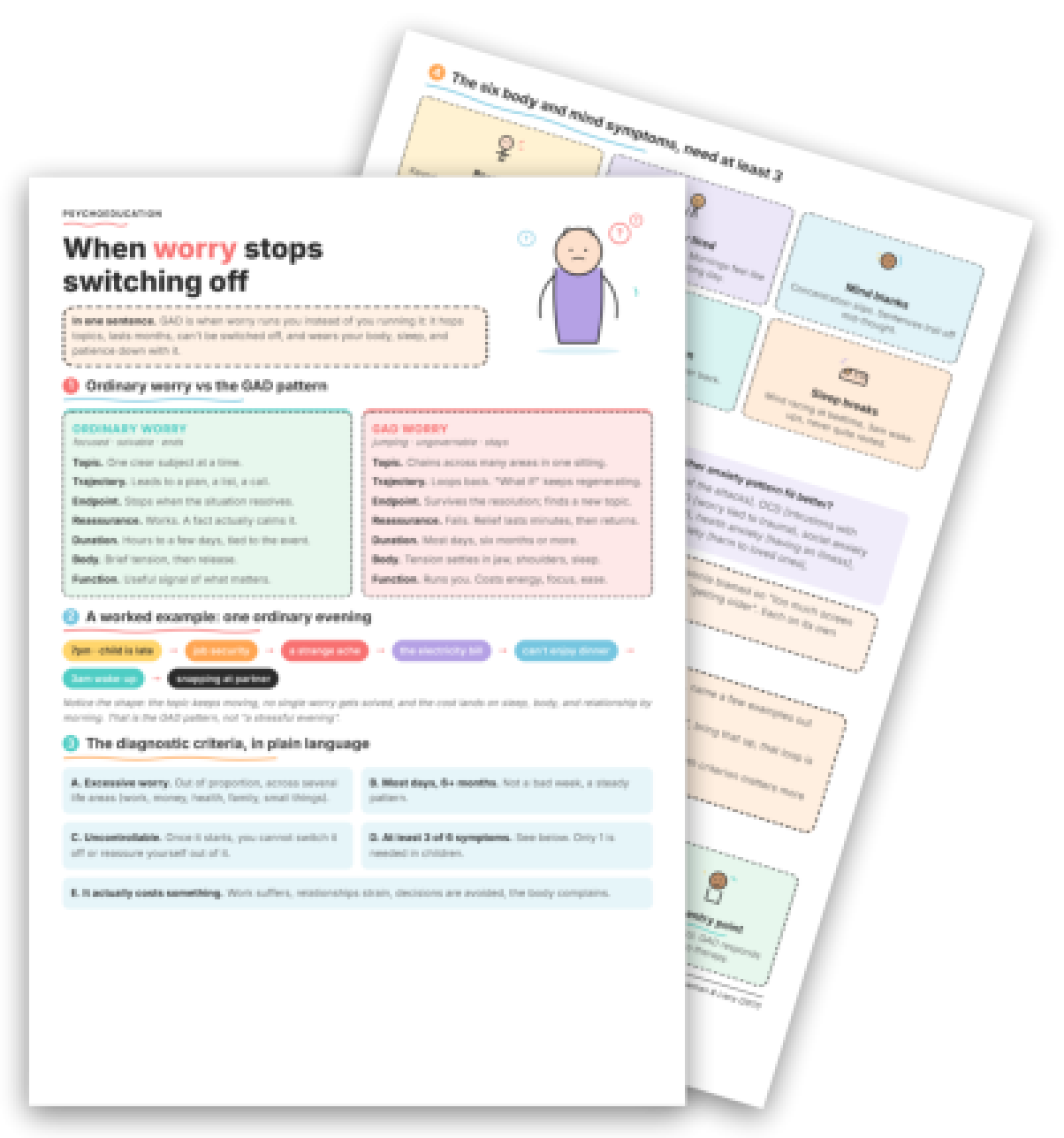
A visual PDF worksheet presenting the DSM-5 GAD criteria in plain language, with a side-by-side worry comparison, a worked evening example, and ready-to-use session prompts.
Clinical vignettes
Naming the Pattern, Not Just the Stress
When Reassurance Seeking Clarifies the Diagnosis
Clinical picture. K., a 52-year-old self-employed contractor, attended an initial assessment reporting anxiety about his business finances. As history-taking proceeded, the clinician noted that reassurance from his accountant consistently failed to reduce his worry for more than a short time, and that health, his adult children, and minor household matters were equally prominent concerns. The clinician used the informational sheet to explain criterion C, the uncontrollability feature, framing it as a characteristic of the worry process rather than a reflection of the seriousness of any single topic. K. recognised the looping quality the sheet described and stopped minimising his presentation as mere "overthinking about money." This reframe supported engagement with a structured treatment plan and reduced his resistance to monitoring exercises that had seemed irrelevant to him before.
Most patients arriving with GAD have spent years being told, and telling themselves, that they are "just a worrier." Getting them to see the clinical picture requires more than naming the DSM criteria aloud. This fiche PDF provides a structured visual support to make that shift happen in session, efficiently, without pathologising language.
Use this resource with your patients
Handout, exercises and materials ready to use, right inside SessionFuel.
Why GAD Is Hard to Explain at the Bedside
The diagnostic criteria for GAD are deceptively familiar-sounding to patients. "Excessive worry" is easy to dismiss ("I worry because things are genuinely difficult"), the six-month threshold is hard to self-assess retrospectively, and the uncontrollability criterion (criterion C) is the one most likely to go unrecognised. Patients often describe their worry as a rational response to an uncertain world, not as an automatic process that runs independently of actual threat.
The other common obstacle: symptom fragmentation. Irritability gets attributed to fatigue, jaw tension to "bad posture," sleep disruption to screen time. Each symptom looks ordinary in isolation. The pattern, across six months and multiple life domains, is what clinicians see and patients don't.
An oral explanation of criteria A through E rarely closes that gap. Presented in sequence, the criteria sound like a checklist being read at the patient. A visual layout that holds all the dimensions simultaneously allows something different: the patient can see the gestalt, not just the list.
What the Fiche Contains, and Why the Visual Format Matters
The fiche opens with a side-by-side comparison contrasting ordinary worry with the GAD pattern across seven dimensions: topic focus, trajectory, endpoint, response to reassurance, duration, somatic profile, and function. The plain-language labels are sharp enough to be clinically precise: "Reassurance. Works. A fact actually calms it." versus "Reassurance. Fails. Relief lasts minutes, then returns." That second line, shown visually next to the first, lands differently than saying it aloud. It is also directly actionable for the reassurance-seeking work that follows in treatment.
A worked evening example traces one episode across time: a child running late at 7pm cascades to job security, a physical ache, the electricity bill, an interrupted dinner, a 3am wake-up, and irritability with a partner by morning. The caption calls this explicitly "the GAD pattern, not 'a stressful evening'". That reframe, shown as a linear chain, gives patients a language for what they have been living, without a diagnostic verdict landing first.
The fiche then presents the five diagnostic criteria (A through E) in plain language, followed by a labelled panel of the six somatic and cognitive symptoms (restlessness, fatigue, concentration difficulty, irritability, muscle tension, sleep disruption), with the requirement that at least three be present. A separate section covers differential considerations: physical causes to rule out (thyroid, caffeine, cardiac), and the overlapping presentations worth distinguishing (OCD, panic disorder, PTSD, social anxiety, health anxiety).
Finally, a "To discuss in session" panel provides three ready-made prompts oriented toward the patient's own experience of worry hopping, failed reassurance, and duration, useful for anchoring the psychoeducation in what the patient has already described.
> Key point: the fiche is a visual support that facilitates the explanation of GAD in session, not a self-administered questionnaire. The clinician works through it with the patient; the patient leaves with a concrete reference point.
750+ clinical tools
A library built with and for clinicians, ready to use in session and extend between appointments.
Access all the toolsWhen and How to Introduce It in Session
The fiche works best once an initial anamnesis has surfaced at least one of the three core features: multi-domain worry, uncontrollability, or the six-month chronicity. Introducing it before any rapport is established risks making the encounter feel like a diagnostic intake; introducing it after a few sessions means it meets a patient who already has partial language for their experience.
A low-labelling framing: "I'd like to show you something that maps out what we've been talking about. It's not a verdict, more a way of seeing the shape of it together." For patients who struggle with uncertainty or whose worry covers health-related concerns, the rule-out section on the fiche can itself be reassuring: medical causes are named as things to check, not as threats.
Debrief by anchoring to the worked example: "Does the evening scenario in the fiche look familiar?" That question opens the door to the patient's own chains of worry without requiring them to self-diagnose first. From there, the path into intolerance of uncertainty work, worry-specific exercises, or a full GAD-focused psychoeducation program is clearer because a shared vocabulary has been established.
The fiche does not replace the cognitive-behavioral model of GAD; it makes the first explanation of that model stick.
Use it with your patients
Share this tool in the mobile app and follow the work between sessions.
Sources
- American Psychiatric Association (2013). Diagnostic and Statistical Manual of Mental Disorders, Fifth Edition (DSM-5). American Psychiatric Publishing.
- Locke, A. B., Kirst, N., Shultz, C. G. (2015). Diagnosis and Management of Generalized Anxiety Disorder and Panic Disorder in Adults. American Family Physician.
- National Institute of Mental Health (NIMH). Generalized Anxiety Disorder. National Institute of Mental Health.
- Wells, A. (1995). Metacognition and Worry: A Cognitive Model of Generalised Anxiety Disorder. Behavioural and Cognitive Psychotherapy.
Your session continues in your patients' pocket
Use with a patientYour resources, available everywhere
The handouts, exercises, programs and audios above: you choose which ones to make available to your patients, in the mobile app dedicated to them.
And far more than a library
The app goes well beyond resources, to support your patients every day:
Related categories
Explore other clinical resources by category.

Anxiety
Clinical hub for anxiety disorders: CBT and ACT worksheets, psychoeducation sheets, and exercises for assessment and treatment across the anxiety spectrum.

Understand
Clinical hub for the therapeutic aim 'Understand': worksheets and tools to build patient insight across CBT, ACT, schema therapy and more.

CBT
CBT worksheets, cognitive restructuring exercises & behavioral tools for clinicians. Evidence-based resources for every phase of cognitive behavioral therapy.

Integrative
Integrative therapy clinical resources: worksheets, psychoeducation programs, and exercises for eclectic, multimodal practice across orientations.

Trauma
Clinical hub on trauma and PTSD: assessment, differential diagnosis, treatment phases, and printable resources for practitioners. 155 chars.

Mood
Evidence-based worksheets and clinical tools for mood disorders: CBT, ACT, and positive psychology resources for psychologists and therapists.