
Clinical picture. T., a 34-year-old software developer, was referred after a prolonged period of remote work had expanded into a near-total withdrawal from professional and social settings. He described himself as "just an introvert" and had never considered a psychiatric formulation. During the intake, the clinician used the three-category framework from the psychoeducation sheet to map T.'s avoided situations: he had declined two promotions requiring presentations, stopped answering the phone from unknown numbers, and consistently left team lunches before the food arrived. Walking T. through the distinction between introversion as preference and social anxiety as a fear that incurs ongoing life costs shifted his understanding enough that he agreed to a full diagnostic assessment. A provisional diagnosis of Social Anxiety Disorder was subsequently established, and structured treatment was initiated.
Recognizing Social Anxiety Disorder: PDF Worksheet, Tools and Exercises
A printable PDF fiche with tools and exercises to help clinicians explain social anxiety disorder clearly in session, from symptom recognition to safety behaviours.
Clinical vignettes
Avoidance Mistaken for Introversion
Body Symptoms as a Secondary Trigger
Clinical picture. M., a 27-year-old postgraduate student, presented reporting "panic attacks" in seminars, though closer questioning revealed no discrete panic episodes outside social observation contexts. She described a well-established pattern: anticipating that she might blush during a discussion, then blushing in response to that anticipation, then becoming preoccupied with whether classmates had noticed, and replaying the sequence for the remainder of the day. The clinician introduced the iceberg model from the informational sheet, naming the secondary-trigger mechanism explicitly: the physical symptom becomes its own feared stimulus. M. recognised the pattern immediately and noted she had begun wearing high-necked clothing year-round and positioning herself near seminar room doors. This recognition was used as a basis for collaborative case conceptualisation before commencing cognitive-behavioural work.
Patients with social anxiety disorder rarely walk into the first session naming a fear of negative evaluation. They come in saying "I blush too much", describing a career they chose for how little public exposure it required, or reporting exhaustion from years of scripting every conversation in advance. Getting from that presentation to a shared clinical understanding of social anxiety disorder is one of the more reliably effortful pieces of early psychoeducation. This fiche PDF is designed as a visual support the clinician can use directly in session to make that shift faster and more durable.
Use this resource with your patients
Handout, exercises and materials ready to use, right inside SessionFuel.
Why Social Anxiety Disorder Is Difficult to Explain at the Verbal Level
Several mechanisms compound each other here. First, patients who have organised their lives around avoidance often no longer experience their fear as excessive; the avoidance has worked well enough that the fear can feel like plain common sense. The fiche names this directly: "After years of avoiding, the fear can feel like simple truth ('of course they'll judge me, I'm boring')." Pointing to that sentence together is often more efficient than several minutes of Socratic questioning.
Second, the somatic entry point creates a consistent clinical trap. The patient identifies blushing, trembling, or a racing heart as the primary problem, missing the metacognitive layer: the fear that those symptoms will themselves be seen and judged. This makes the disorder look, on the surface, closer to a panic-type presentation or a health anxiety pattern than to a social fear. A plain verbal explanation of the iceberg structure rarely lands on first pass.
Third, distinguishing social anxiety from introversion or shyness is something many patients have tried to do on their own, usually concluding they are simply shy. The verbal correction ("no, shyness fades with familiarity, social anxiety stays") is easy to say and hard to retain without a visual anchor.
What the Fiche Contains: Six Panels That Do the Explaining Visually
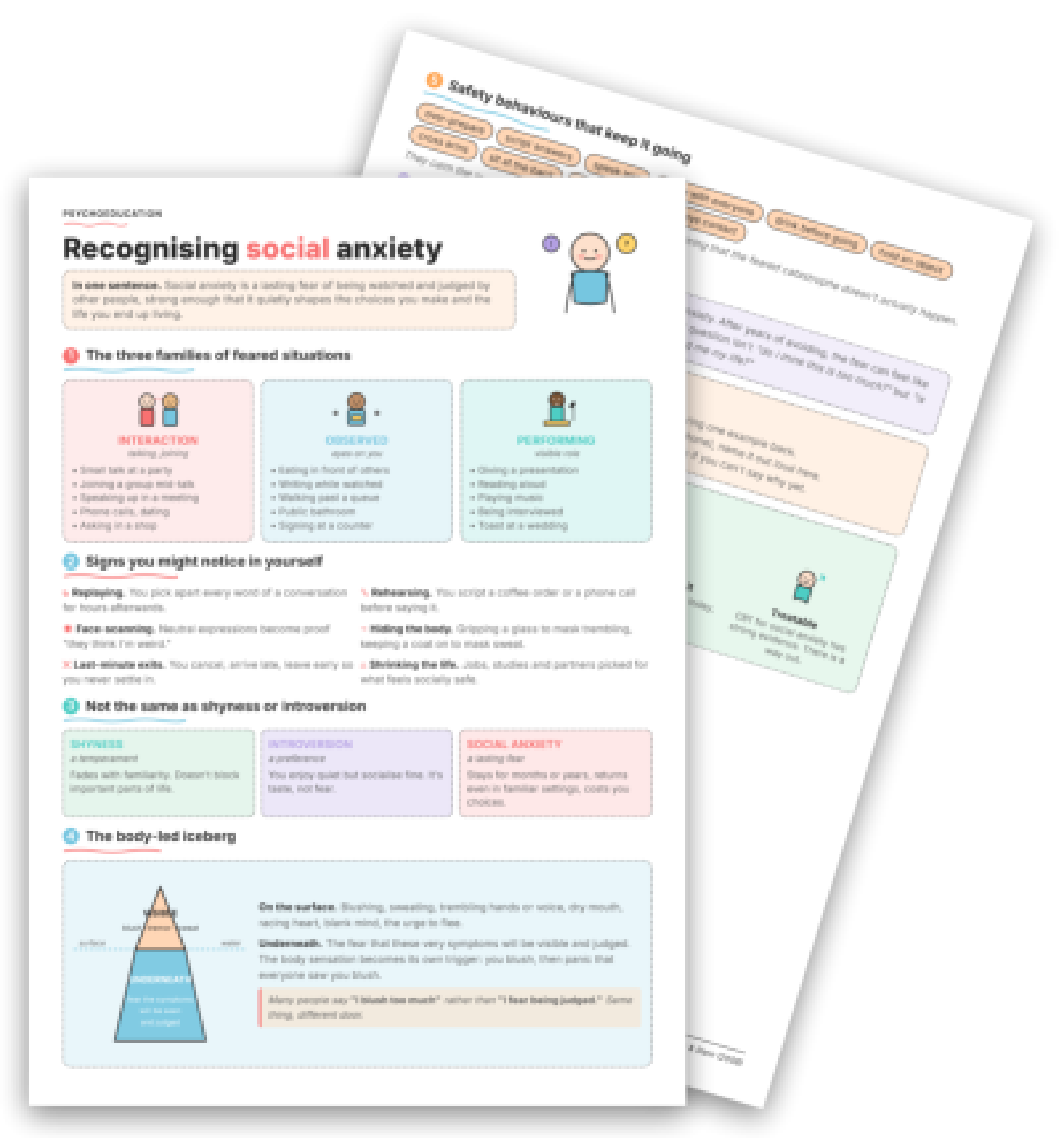
The fiche is organised into six numbered panels, each targeting a distinct piece of the psychoeducation.
- Panel 1 maps the three families of feared situations: interaction situations (small talk, phone calls, asking in a shop), observed situations (eating in front of others, signing at a counter), and performance situations (presentations, reading aloud, a toast at a wedding). Laying this taxonomy out visually helps the patient locate themselves precisely, rather than just agreeing with a general description.
- Panel 2 lists six behavioural signs with specific labels: replaying, rehearsing, face-scanning, hiding the body, last-minute exits, and shrinking the life. The precision of "jobs, studies and partners picked for what feels socially safe" frequently produces recognition that an oral description of avoidance does not.
- Panel 3 gives a side-by-side comparison of shyness, introversion, and social anxiety, the clearest version of that distinction patients tend to encounter. Clinicians working with the Clark and Wells model will find the panel consistent with the self-focused attentional processing framework.
- Panel 4 renders the body-led iceberg: visible surface symptoms above the waterline, and the fear-of-being-seen-to-have-symptoms beneath it. The visual format shows the second-order fear in a way that the oral explanation routinely fails to convey.
- Panel 5 lists safety behaviours (scripting answers, holding an object, arriving late, staying on the phone), directly paired with the maintenance rationale drawn from the Salkovskis model: "They calm the moment, but they stop you from ever discovering that the feared catastrophe doesn't actually happen." This sets up the work on changing avoidance patterns and eventual graded exposure without requiring the clinician to introduce those concepts cold.
- Panel 6 addresses a diagnostic subtlety patients often use to dismiss themselves: the absence of perceived excessiveness. It reframes the diagnostic question from "do I think this is too much?" to "is this fear out of proportion, and is it costing me my life?"
The fiche closes with three "To discuss in session" prompts, structured as open invitations: bringing a replaying episode, naming a safety behaviour, and raising body symptoms even without words for them yet.
> To retain: this fiche is a visual support for explaining social anxiety disorder during the session, not a self-administered checklist. Its value is in the shared looking: the patient and clinician examining the panels together builds a common vocabulary that holds across the work.
750+ clinical tools
A library built with and for clinicians, ready to use in session and extend between appointments.
Access all the toolsWhen and How to Propose the Fiche in Practice
The fiche fits naturally in the first two to three sessions, once the initial anamnèse has surfaced the social domain as a concern. It works particularly well with patients whose presentation is somatic or who actively resist the label ("I'm not anxious, I'm just shy"), because the comparison panel in particular offers the patient a chance to locate themselves rather than being categorised.
A low-stakes introduction: "I'd like to show you a diagram that maps out how this kind of difficulty tends to work. We'll look at it together and you can tell me what fits your experience and what doesn't." That framing positions the fiche as a collaborative tool, consistent with the alliance-building work of early sessions.
For debrief, the three "To discuss in session" prompts can structure the conversation immediately: which family of feared situations resonates most, and which safety behaviours the patient already recognises in themselves. Patients who identify heavily with Panel 6 (the absence of perceived excessiveness) often need that point revisited later, when building an exposure hierarchy first surfaces resistance.
For patients who need to go further between sessions, the Social Anxiety Psychoeducation program and the Exploring Social Anxiety worksheet extend the work autonomously. The Fear of Appearing Anxious exposure list and tools on adaptive versus maladaptive coping pair naturally with the safety behaviour panel as the formulation deepens. If assertiveness deficits have already emerged, assertiveness tools and exercises offer a practical complement later in the care plan.
The fiche does not replace the Clark and Wells model for case formulation work; it opens the door to it at a pace the patient can follow.
Use it with your patients
Share this tool in the mobile app and follow the work between sessions.
Sources
- National Institute for Health and Care Excellence (NICE) (2013). Social anxiety disorder: recognition, assessment and treatment (CG159). NICE.
- Clark, D. M., Wells, A. (1995). A cognitive model of social phobia. In R. G. Heimberg, M. R. Liebowitz, D. A. Hope, F. R. Schneier (Eds.), Social Phobia: Diagnosis, Assessment, and Treatment (pp. 69-93). Guilford Press.
- Heimberg, R. G., Liebowitz, M. R., Hope, D. A., Schneier, F. R. (1995). Social Phobia: Diagnosis, Assessment, and Treatment. Guilford Press.
- Heimberg, R. G., Becker, R. E. (2002). Cognitive Behavioral Group Therapy for Social Phobia: Basic Mechanisms and Clinical Strategies. Guilford Press.
- American Psychiatric Association (APA) (2013). Diagnostic and Statistical Manual of Mental Disorders, Fifth Edition (DSM-5). American Psychiatric Publishing.
Your session continues in your patients' pocket
Use with a patientYour resources, available everywhere
The handouts, exercises, programs and audios above: you choose which ones to make available to your patients, in the mobile app dedicated to them.
And far more than a library
The app goes well beyond resources, to support your patients every day:
Related categories
Explore other clinical resources by category.
Anxiety
Clinical hub for anxiety disorders: CBT and ACT worksheets, psychoeducation sheets, and exercises for assessment and treatment across the anxiety spectrum.

Understand
Clinical hub for the therapeutic aim 'Understand': worksheets and tools to build patient insight across CBT, ACT, schema therapy and more.

CBT
CBT worksheets, cognitive restructuring exercises & behavioral tools for clinicians. Evidence-based resources for every phase of cognitive behavioral therapy.

Trauma
Clinical hub on trauma and PTSD: assessment, differential diagnosis, treatment phases, and printable resources for practitioners. 155 chars.

Mood
Evidence-based worksheets and clinical tools for mood disorders: CBT, ACT, and positive psychology resources for psychologists and therapists.

Identity
Clinical resources for self-identity work in therapy: CBT, ACT, schema tools for clinicians addressing self-concept, core beliefs, and identity disruption.