
Clinical picture. A. is a 34-year-old primary school teacher presenting with contamination-related OCD; her handwashing sequences last between 20 and 45 minutes each morning and leave her skin visibly excoriated. During a scheduled session, the clinician introduced the structured exercise, beginning with question 1: A. named handwashing as the compulsion she most wanted to address, describing it as the only thing that temporarily quieted the fear of transmitting illness to her pupils. Working through questions 3 and 4, she recognised that the behaviour ended not when she felt clean but when physical pain or time pressure forced her to stop, a pattern she had never articulated before. For question 5, she and the clinician agreed on a concrete stopping criterion: three complete soap-and-rinse cycles, each lasting no more than 20 seconds, measured on a visible kitchen timer. At the following session A. reported having adhered to the criterion on four of seven mornings, a modest but clinically meaningful shift in locus of control.
OCD Compulsions: A Structured Exercise on Stopping Criteria
Help patients with OCD identify their compulsive pattern, its maintaining drivers, and a precise measurable criterion to end the ritual.
Clinical vignettes
Handwashing Ritual: Finding a Stopping Rule
Reassurance-Seeking Loop: Setting a Countable Limit
Clinical picture. M., a 28-year-old postgraduate student, presented with harm-related OCD characterised by repeated reassurance-seeking: he texted family members an average of 15 to 30 times per evening to confirm that no accident had occurred after he left home. The clinician used the guided exercise to help M. trace the function of the behaviour (question 3), which he described as seeking a feeling of certainty that never fully arrived, only a brief reduction in tension before the next doubt surfaced. Question 4 revealed that the texts stopped only when family members stopped replying, meaning an external agent, not M. himself, was currently setting the boundary. Through question 5, M. identified a stopping criterion he considered genuinely measurable: a maximum of two reassurance texts per evening, sent within a defined 10-minute window after arriving home. Over the following two weeks M. used the criterion as a reference point during high-anxiety evenings, reporting that naming the rule aloud to himself reduced the compulsion to escalate on three separate occasions.
When Words Alone Are Not Enough
Patients with OCD rarely lack insight into their rituals. They can describe them, name them, feel embarrassed by them. What they cannot easily do is see, from the outside, what function the compulsion serves and, above all, where it is supposed to stop. That last point is critical. Without a precise stopping criterion, the ritual expands to fill whatever time and attention are available. Verbal explanation in the consulting room rarely fixes this. The patient agrees, goes home, and runs the ritual for forty minutes because nothing inside them signals "now it is done."
This exercise, which complements the Automatic Behaviors psychoeducation program and the Recognizing OCD fiche, puts that problem in writing, in the patient's own words, before the next session.
Use this resource with your patients
Handout, exercises and materials ready to use, right inside SessionFuel.
What the Exercise Contains
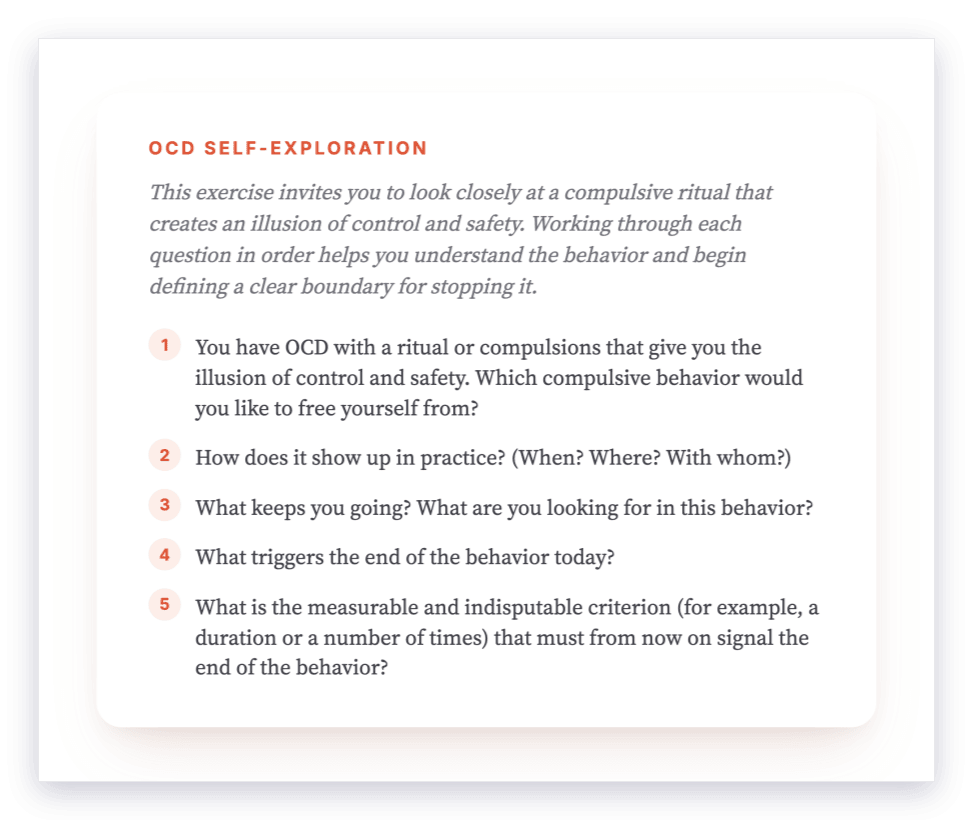
The five questions move in a deliberate sequence. The first asks the patient to name the specific compulsive behavior they want to break free from. Many patients live inside the ritual and have never articulated it as an object they could examine from the outside. Naming it is already a distancing move.
The second question maps the compulsion in context: when, where, and with whom it occurs. This situational anchoring mirrors the trigger-mapping logic in identifying emotional triggers and gives you the contextual data needed to plan graded work.
The third question goes to the heart of the maintaining loop: what keeps the patient going, what are they searching for? This is where the illusion of control and safety becomes explicit. Patients often discover, in writing, that they are chasing a felt sense of security that the ritual promises but never fully delivers, a dynamic examined in the Psychological Safety Crutches fiche and in work on safety behaviors.
The fourth question shifts focus to the present stopping mechanism: what ends the ritual today? For most patients the answer is uncomfortable. They stop when exhaustion wins, or when anxiety drops below a threshold they cannot name.
The fifth question is the therapeutic core. The patient must define a measurable, indisputable stopping criterion, expressed as a duration or a fixed number of repetitions. This is the move from felt sense to behavioral contract, and it is the one most patients cannot make spontaneously without having worked through questions one to four first.
This image is a static preview listing the exercise questions only. The full guided experience, complete with patient-facing instructions and space to write answers, is completed by the patient on their own in the app and is not visible here.
This exercise is available to patients through the mobile application that is the dedicated patient-side interface of SessionFuel. The clinician assigns it as homework, and the patient completes it directly on their phone, on their own, between two consultations.
750+ clinical tools
A library built with and for clinicians, ready to use in session and extend between appointments.
Access all the toolsUse it with your patients
Share this tool in the mobile app and follow the work between sessions.
How to Integrate It as Between-Session Practice
This exercise suits patients who have already received basic psychoeducation about OCD, for instance through the Intolerance of Uncertainty worksheet or work on the cycle of avoidance that underpins compulsive patterns. It is not designed as a first contact with the diagnosis.
Introduce it toward the end of a session in which you have discussed the compulsive loop. Frame question five explicitly before the patient leaves: their task is to arrive at the next consultation with a number or a duration written down. That concrete expectation focuses their reflection between sessions.
When they bring the completed exercise back, the most productive entry point is usually question five, working backwards. If their criterion remains vague, questions three and four reveal why. If it is precise, questions one and two give you the situational detail needed to calibrate exposure work and sequence steps on a fear hierarchy.
This exercise pairs naturally with the OCD Compulsion Progress Review, which the patient can complete weekly once a stopping criterion is established, and with the Permissive Thinking fiche for patients whose rituals are partly driven by internal permission-giving. Patients who also show broader control-seeking patterns or who rely on reassurance-seeking alongside their compulsions may benefit from running those exercises in parallel.
Key takeaway: The clinical value of this exercise sits in question five. The four questions before it are not preamble; they are the scaffolding that makes a genuine, measurable stopping criterion possible for the first time.
Your session continues in your patients' pocket
Use with a patientYour resources, available everywhere
The handouts, exercises, programs and audios above: you choose which ones to make available to your patients, in the mobile app dedicated to them.
And far more than a library
The app goes well beyond resources, to support your patients every day:
Related categories
Explore other clinical resources by category.

Anxiety
Clinical hub for anxiety disorders: CBT and ACT worksheets, psychoeducation sheets, and exercises for assessment and treatment across the anxiety spectrum.

Emotions
Clinical resources on emotion regulation: worksheets, coping tools, CBT, REBT, and ACT exercises for therapists working across diagnoses and age groups.

Behaviours
Clinical hub for behaviors in therapy: worksheets and tools for coping, eating disorders, CBT formulation, and maladaptive behavioral patterns.

Cognition
Printable cognitive therapy worksheets and clinical tools for therapists: CBT, ACT, schema work, defusion, distortions, and belief restructuring.

Build awareness
Clinical worksheets and tools to build awareness in therapy: cognitive distortions, schemas, emotions, ACT and CBT resources for practitioners.

CBT
CBT worksheets, cognitive restructuring exercises & behavioral tools for clinicians. Evidence-based resources for every phase of cognitive behavioral therapy.