
Clinical picture. A woman in her late thirties, referred to here as M., presents with longstanding health anxiety and a specific fear of fainting in public spaces; she has progressively limited her shopping to one nearby supermarket visited only with her partner. During a session reviewing the safety behaviors psychoeducation sheet, the clinician invites M. to map her own loop: trigger (supermarket aisle), prediction ("I will collapse"), safety behavior (gripping the trolley tightly and keeping her partner within arm's reach), and relief. M. identifies, with some surprise, that she has never actually tested whether the aisle is safe without the grip, and that her world has contracted to the radius of one person's availability. The clinician notes, without overstating the point, that the next step would be to examine what happens when the trick is gradually removed, starting in a low-demand context.
Safety Behaviors: PDF Worksheet, Tools and Exercises for Clinical Practice
A printable PDF fiche, clinical tools, and structured exercises to explain how safety behaviors maintain fear and guide patients through dropping them gradually.
Clinical vignettes
Gripping the Trolley, Shrinking the World
Rehearsing Every Sentence Before Speaking
Clinical picture. A man in his mid-twenties, referred to here as J., attends for social anxiety; he describes spending up to forty minutes rehearsing what he will say before any work meeting, yet consistently leaves meetings feeling he sounded stilted and unconvincing. Using the psychoeducation sheet in session, the clinician walks through the four behavior families and J. recognizes his rehearsal as a mental act safety behavior: it is designed to prevent humiliation but produces the wooden delivery he most wants to avoid. He is struck by the framing that each rehearsal session is, in effect, a vote confirming that unscripted speech is dangerous. A brief behavioral experiment is proposed for the following week, attending one short meeting with no prior rehearsal, to gather actual data rather than rely on the trick.
Most patients understand, intellectually, that avoidance keeps anxiety alive. What they cannot see is how the water bottle, the pre-planned seat near the exit, or the silent body-scan during a meeting all operate through the same mechanism. This fiche PDF gives you a visual support to make that recognition concrete, in session, with very little overhead.
Use this resource with your patients
Handout, exercises and materials ready to use, right inside SessionFuel.
Why Safety Behaviors Resist Explanation in Session
The Salkovskisian logic is clean: the safety behavior prevents the catastrophe from being tested, so the threat belief is never disconfirmed. Patients credit the trick with their survival rather than the situation with being safe. Stated aloud, this is understood and immediately forgotten.
Three obstacles recur in practice. First, subtle behaviors, gripping a supermarket trolley, mentally rehearsing every sentence before speaking, carrying a medication "just in case", do not feel like avoidance to the patient; they feel like sensible precautions. Second, the four behavioral families (avoidance, escape, subtle tricks, and mental acts) span such different topographies that a patient presenting with health anxiety and compulsive symptom-checking genuinely fails to recognize themselves in the same category as someone who leaves parties early. Third, the paradox that the behavior actively produces the feared outcome (pinned arms increase sweating; rehearsed speech sounds robotic) is counterintuitive enough that a single verbal explanation rarely installs it. The patient needs to see the loop laid out, not just hear it described.
What the Fiche Contains: A Visual Map of the Maintenance Cycle
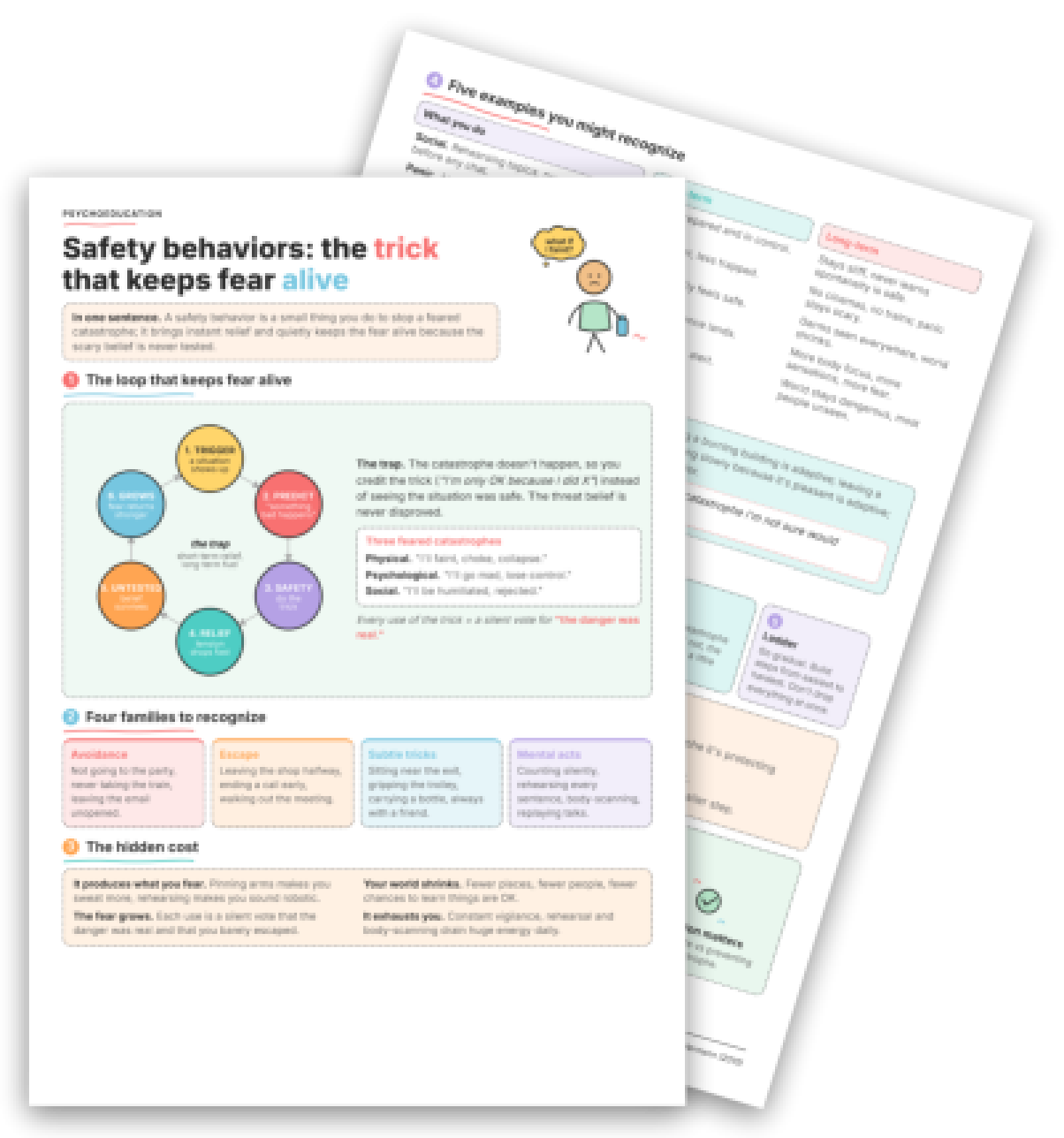
The fiche is structured across six numbered panels. Panel 1 renders the six-step maintenance loop as a visual circuit: trigger, prediction, safety behavior, relief, untested belief, and growing fear. The trap is labeled plainly: "short-term relief, long-term fuel." This diagram does what oral explanation cannot, it shows the patient that relief is the bait, not evidence of real danger. You can point to it, trace the arrows, and return to it whenever a new behavior surfaces across sessions.
Panel 2 maps the four families to recognize, with clinical examples drawn from panic, social anxiety, contamination OCD, and PTSD. This taxonomy is directly usable in case formulation and pairs naturally with tools like the Clark & Wells model of social anxiety or the cycle of avoidance. Panel 3 details the hidden costs: the behavior produces what the patient fears, shrinks the patient's world, reinforces the sense of narrow escape, and depletes attentional resources through constant vigilance.
Panel 5 addresses the clinically delicate question of intention, the one axis that distinguishes adaptive coping from a safety behavior. The fiche phrases it as a test question: "Am I doing this to engage with life, or to prevent a catastrophe I'm not sure would happen?" This framing opens useful dialogue without labeling the behavior as pathological before the alliance is solid.
Panel 6 presents the five-step dropping sequence, spot, name, test, collect, ladder, which maps directly onto graded exposure planning. It complements building an exposure hierarchy and the habituation rationale you are likely already using.
> Key point: The fiche is a visual support that facilitates your in-session explanation of safety behaviors. It is not a questionnaire the patient completes alone, it is a reference you work through together, then leave with them as a concrete anchor between sessions.
750+ clinical tools
A library built with and for clinicians, ready to use in session and extend between appointments.
Access all the toolsWhen and How to Propose the Fiche
The optimal moment is once the formulation is sufficiently shared that the patient can place their own behaviors inside the model. For presentations involving panic disorder, social anxiety, OCD checking, or health anxiety, this is often the second or third session. For more complex presentations with long-standing avoidance patterns, the kind mapped by the automatic behaviors psychoeducation program, wait until the patient has enough psychological safety to tolerate the implication that their coping strategies have been sustaining the problem.
A low-pathologizing introduction: "I want to show you a diagram that describes something almost everyone with anxiety does, without realizing it. We'll look at it together and you can tell me if any of it rings a bell." The panel on intention is particularly worth pausing on when a patient pushes back with "but it really does help me." This is not resistance, it is accurate, and the fiche acknowledges it: short-term relief is real. The cost is what accumulates over time.
For patients already working on reassurance-seeking patterns or avoidance reduction, the fiche anchors both threads under one explanatory framework and accelerates the move to graded exposure. One contraindication worth noting: in acute phases of OCD or severe health anxiety, introducing the maintenance loop too early can trigger rumination about the behaviors themselves. In those cases, defer to symptom stabilization before using the fiche.
The fiche does not replace the therapeutic frame; it makes the explanation sharper and leaves the patient with a reference they can consult between sessions.
Use it with your patients
Share this tool in the mobile app and follow the work between sessions.
Sources
- Salkovskis, P. M. (1991). The Importance of Behaviour in the Maintenance of Anxiety and Panic: A Cognitive Account. Behavioural and Cognitive Psychotherapy.
- Clark, D. M., Wells, A. (1995). A Cognitive Model of Social Phobia. Guilford Press.
Your session continues in your patients' pocket
Use with a patientYour resources, available everywhere
The handouts, exercises, programs and audios above: you choose which ones to make available to your patients, in the mobile app dedicated to them.
And far more than a library
The app goes well beyond resources, to support your patients every day:
Related categories
Explore other clinical resources by category.

Anxiety
Clinical hub for anxiety disorders: CBT and ACT worksheets, psychoeducation sheets, and exercises for assessment and treatment across the anxiety spectrum.

Trauma
Clinical hub on trauma and PTSD: assessment, differential diagnosis, treatment phases, and printable resources for practitioners. 155 chars.

Behaviours
Clinical hub for behaviors in therapy: worksheets and tools for coping, eating disorders, CBT formulation, and maladaptive behavioral patterns.

Understand
Clinical hub for the therapeutic aim 'Understand': worksheets and tools to build patient insight across CBT, ACT, schema therapy and more.

Build awareness
Clinical worksheets and tools to build awareness in therapy: cognitive distortions, schemas, emotions, ACT and CBT resources for practitioners.

CBT
CBT worksheets, cognitive restructuring exercises & behavioral tools for clinicians. Evidence-based resources for every phase of cognitive behavioral therapy.