
Clinical picture. M., a man in his early forties, presented with a longstanding fear of lifts that had begun to limit his work attendance after his employer relocated to a sixth-floor office. He reported taking the stairs without exception and carrying a bottle of water and anxiolytic medication whenever he entered the building, though he rarely took the medication. In session, the clinician introduced the four-petal model and invited M. to map his own maintaining behaviours; he quickly identified the water bottle and the medication as safety habits he had not previously recognised as part of the avoidance pattern. He agreed to a graded experiment in the following week, entering the lift once without either object, which produced mild discomfort but disconfirmed his prediction that he would panic uncontrollably.
What Keeps Fears and Phobias Going: PDF Worksheet, Tools and Exercises
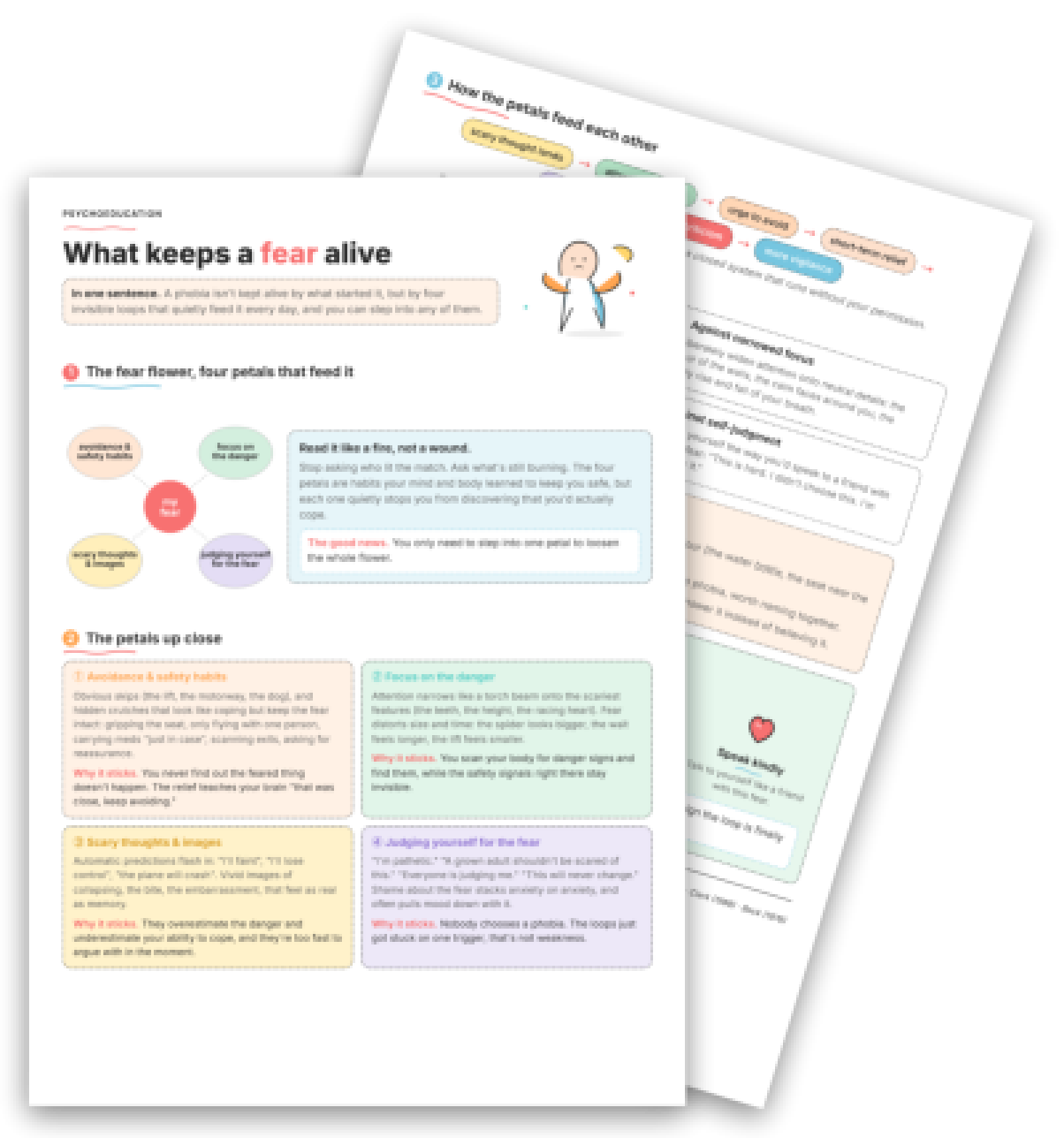
A visual psychoeducation tool presenting the four-petal maintenance model of phobia, designed to shift the clinical conversation from origins to sustaining loops.
Clinical vignettes
Lift Avoidance and the Safety Habit Loop
Self-Judgment Compounding a Dog Fear
Clinical picture. R., a woman in her late thirties, sought help for a fear of dogs that she described as embarrassing given her rural upbringing and professional confidence in other domains. She reported spending considerable mental energy criticising herself after each avoidance episode, telling herself she was weak and that the fear would never shift. The clinician used the informational sheet to reframe self-judgment as a fourth maintaining loop rather than an accurate self-assessment, separating it from the original fear. R. noted that her shame had been amplifying her anticipatory anxiety before social situations involving dogs, sometimes more than the dogs themselves. Naming this petal as a distinct target gave her a concrete entry point that felt less exposing than immediate behavioural experiments, and she agreed to work on the self-critical thoughts as a first step.
When patients with specific phobia come to session, they almost always want to talk about where the fear came from. Redirecting that conversation toward what keeps the fear running today is one of the more friction-prone moments in CBT formulation work. This fiche PDF makes that pivot concrete, visual, and fast.
Use this resource with your patients
Handout, exercises and materials ready to use, right inside SessionFuel.
Why the maintenance model is hard to convey verbally
Most patients have an implicit wound model of their phobia: something happened, they were marked by it, and the mark needs erasing. Asking them to shift to a perpetuating-factors frame at the oral level tends to produce polite nodding, not genuine reorientation. The four maintenance mechanisms, taken together as a system, are simply too abstract to hold in working memory while listening to a therapist speak.
There is also the safety-behaviour blind spot. Patients rarely identify their compulsive crutches as part of the problem. Gripping a seat, scanning exits, carrying medication "just in case," flying only with one companion: none of this feels like a maintaining factor. It feels like coping. That distinction is exactly what a visual support can crystallise in a way that ten minutes of Socratic dialogue sometimes cannot. The Psychological Safety Crutches sheet is a useful companion here, but the fear flower gives patients the overarching model first.
Inside the fiche: a visual support for phobia maintenance
The fiche PDF organises the maintenance model around a central flower diagram: "my fear" sits at the core, surrounded by four petals: avoidance and safety habits, focus on the danger, scary thoughts and images, and judging yourself for the fear. The layout does something a whiteboard sketch rarely achieves: it shows the four loops simultaneously, so the patient can see at a glance that they are facing a closed system, not a linear chain.
A brief explanatory sentence sets the clinical frame immediately: "Stop asking who lit the match. Ask what's still burning." That single line reorients the work without pathologising the patient or dismissing their history.
Section two unpacks each petal in plain language. The avoidance petal makes the reinforcement logic explicit: "The relief teaches your brain 'that was close, keep avoiding.'" The danger-focus petal ties selective attention to perceptual distortion, a mechanism well described in the Clark and Wells model of social anxiety and fully applicable here. The fiche's coverage of selective attention narrowing in phobia maps directly onto what you would discuss using the Clark & Wells social anxiety framework in a more complex presentation.
Section three provides a vicious-cycle chain: scary thought, narrowed attention, urge to avoid, short-term relief, fear unchanged, self-criticism, more vigilance. The horizontal flow makes the closed-loop nature of the maintenance system visible in a way that verbal description cannot replicate. Section four pairs one practical lever with each petal, including the prediction-testing instruction ("Write the prediction down before the situation, then check what actually happened"), which maps directly onto a behavioural experiment protocol. A "To discuss in session" block at the bottom prompts the patient to flag safety behaviours they had not noticed, the moment of post-avoidance relief, and the "I'm weak for having this" narrative, all of which are high-value clinical entry points.
> Key takeaway: The fear flower is a visual support that facilitates the explanation of phobia maintenance in session. It is not a self-assessment questionnaire. The clinician uses it to anchor the formulation conversation, establish a shared vocabulary, and leave the patient with a concrete reference between sessions.
750+ clinical tools
A library built with and for clinicians, ready to use in session and extend between appointments.
Access all the toolsWhen and how to introduce it
The fiche fits naturally in the psychoeducation phase, typically sessions two to four once the initial assessment is complete and the therapeutic alliance is established. It works across specific phobia, health anxiety, and any presentation where avoidance cycles and safety behaviours are central maintaining factors.
A low-inference introduction: "Before we start building a hierarchy of situations to practise, I'd like to show you a diagram that maps exactly what's been keeping the fear in place. It will help us decide where to step in first." Present the fiche, point to the petal that seems most dominant for this patient, and ask which loop they recognise most in themselves. The debrief question about the prediction-checking step naturally opens the door to building a personal exposure list and planning graded exposure work.
One practical limit: patients with high shame around the phobia may initially fixate on the self-judgment petal and use it to re-enter the "I'm pathetic" loop. Name that risk explicitly before handing the sheet over. The fiche addresses shame directly ("Nobody chooses a phobia"), but the clinician's framing of that sentence carries more weight than the printed words alone.
The fiche does not replace the formulation and it does not replace exposure. What it does is make the logic of habituation through approach legible before the first step up the hierarchy has been taken.
Use it with your patients
Share this tool in the mobile app and follow the work between sessions.
Sources
- Salkovskis, P. M. (1991). The importance of behaviour in the maintenance of anxiety and panic: A cognitive account. Behavioural and Cognitive Psychotherapy.
- Clark, D. M., & Wells, A. (1995). A cognitive model of social phobia. In R. G. Heimberg, M. R. Liebowitz, D. A. Hope, & F. R. Schneier (Eds.), Social Phobia: Diagnosis, Assessment, and Treatment. Guilford Press.
- Rachman, S. (2020). Anxiety (4th ed.). Routledge.
Your session continues in your patients' pocket
Use with a patientYour resources, available everywhere
The handouts, exercises, programs and audios above: you choose which ones to make available to your patients, in the mobile app dedicated to them.
And far more than a library
The app goes well beyond resources, to support your patients every day:
Related categories
Explore other clinical resources by category.

Anxiety
Clinical hub for anxiety disorders: CBT and ACT worksheets, psychoeducation sheets, and exercises for assessment and treatment across the anxiety spectrum.

Understand
Clinical hub for the therapeutic aim 'Understand': worksheets and tools to build patient insight across CBT, ACT, schema therapy and more.

Build awareness
Clinical worksheets and tools to build awareness in therapy: cognitive distortions, schemas, emotions, ACT and CBT resources for practitioners.

CBT
CBT worksheets, cognitive restructuring exercises & behavioral tools for clinicians. Evidence-based resources for every phase of cognitive behavioral therapy.

Trauma
Clinical hub on trauma and PTSD: assessment, differential diagnosis, treatment phases, and printable resources for practitioners. 155 chars.

Mood
Evidence-based worksheets and clinical tools for mood disorders: CBT, ACT, and positive psychology resources for psychologists and therapists.