
Clinical picture. M., a woman in her early 40s, presented with panic disorder and a longstanding pattern of leaving supermarkets the moment she noticed her heart rate rise, which she interpreted as a sign of imminent collapse. During a session focused on psychoeducation, the clinician walked through the fear curve using the informational sheet, pointing out the escape-relief loop and how each exit had reinforced her brain's prediction that staying would be catastrophic. M. was initially skeptical that anxiety could plateau and self-resolve without any action on her part. The clinician invited her to recall a past episode in which she had been unable to leave, such as being stuck in traffic, and M. identified that fear had indeed subsided after roughly ten minutes without anything terrible occurring. This reframe shifted her stated rationale for avoidance from "escaping keeps me safe" to "I have never actually waited to find out what happens."
Habituation: PDF Worksheet, Tools and Exercises for Clinical Practice
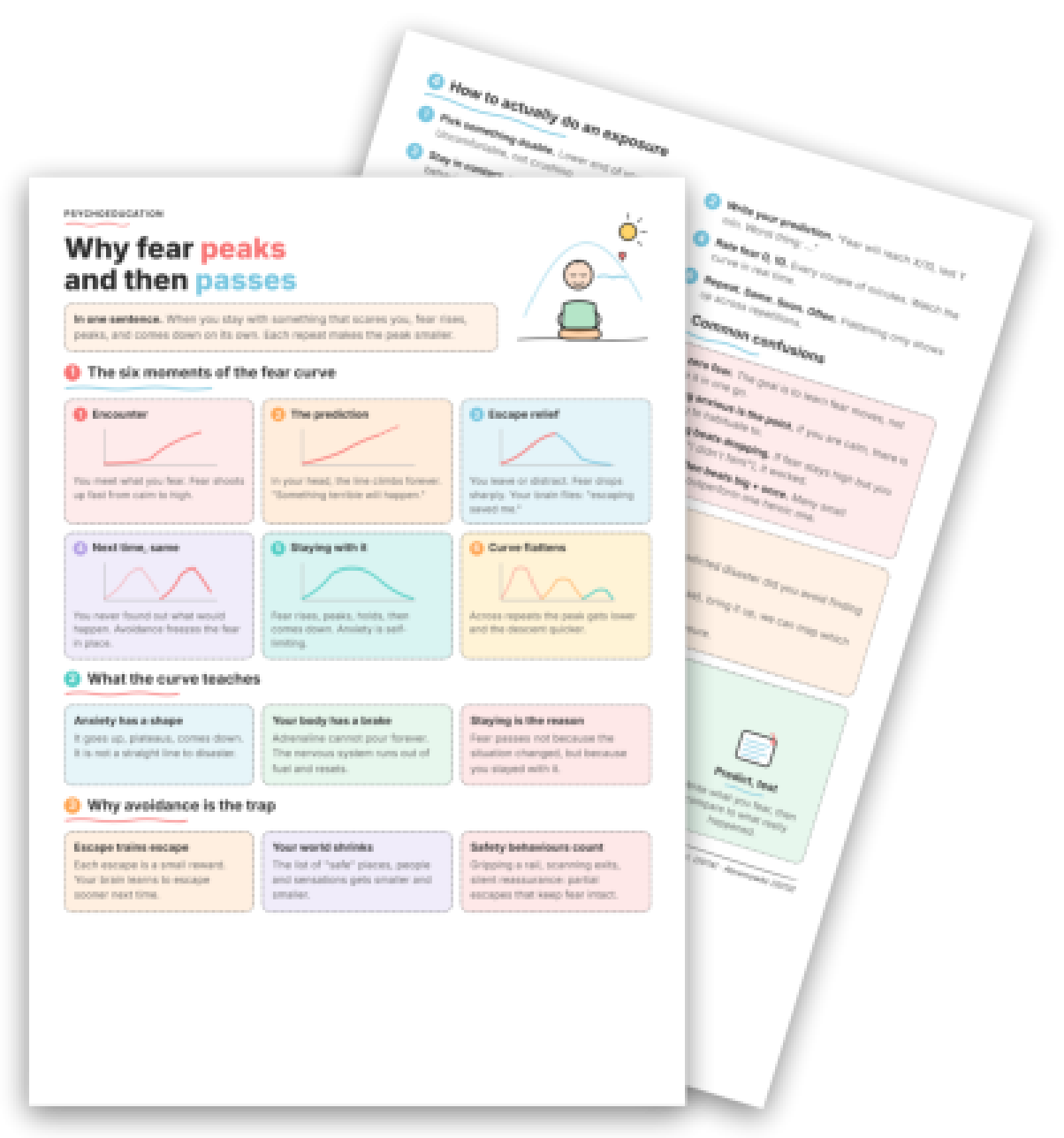
A visual PDF worksheet, practical tools and exercises to explain the fear curve and exposure rationale clearly in session, with a concrete take-home reference.
Clinical vignettes
Fear Curve Revisited in Panic Disorder
Habituation Curve During Social Exposure
Clinical picture. T., a man in his late 20s, met criteria for social anxiety disorder and reported canceling professional presentations at the last moment, which had begun to affect his employment. The clinician introduced the habituation handout to illustrate why repeated cancellation was maintaining rather than managing his fear, drawing attention to the mechanism by which avoidance prevents any new learning. T. agreed to a behavioral experiment: he would deliver a short prepared statement to two colleagues and rate his fear every two minutes on a 0-to-10 scale, recording the numbers on the worksheet. His peak rating of 8 dropped to a 4 within twelve minutes without any escape or reassurance seeking. Reviewing the real-time data afterward, T. noted that the curve matched the diagram almost exactly, which he described as making the anxiety feel less arbitrary and more manageable.
Patients seeking exposure-based treatment often articulate the rationale fluently and then abort the exposure at peak anxiety anyway. The problem is rarely comprehension; it is the absence of a visceral, portable image of what the fear curve actually does. This PDF worksheet on habituation gives you a visual anchor to work from in session and sends the patient home with something concrete enough to pull out at the moment escape becomes tempting.
Use this resource with your patients
Handout, exercises and materials ready to use, right inside SessionFuel.
Why Habituation Resists Verbal Explanation
The central obstacle is not intellectual. Most patients, even those with limited psychoeducation, can repeat back the phrase "anxiety goes up and comes down." What they cannot do, mid-exposure, is hold that knowledge against the pull of an autonomic alarm signal insisting otherwise.
The catastrophic prediction bias at play here, well described in the cognitive models of Salkovskis and Clark, is precisely that the patient's private mental graph shows anxiety climbing forever. Nothing in oral psychoeducation corrects that image; it needs to be replaced by an actual image. Every escape also reinforces what the fiche calls "escaping saved me", solidifying the cycle of avoidance before the next session even begins.
Safety behaviours compound this. A patient gripping a rail, staying on the phone, or rehearsing a reassuring phrase has technically "stayed" in the situation while functionally escaping it, which is exactly why progress stalls in ways that can puzzle both patient and clinician.
What the Fiche Contains: A Visual Support for the Explanation
The PDF worksheet maps the entire habituation arc across six labelled moments of the fear curve: Encounter, Prediction, Escape relief, Next time same, Staying with it, and Curve flattens. Seeing these six beats laid out sequentially does something a spoken explanation cannot: it externalises the patient's private predictive graph and places a corrective shape beside it.
Three supporting sections then give clinical depth to the curve:
- What the curve teaches: anxiety has a shape; the body has a brake ("Adrenaline cannot pour forever"); staying is the operative mechanism, not a change in the external situation.
- Why avoidance is the trap: the fiche distinguishes full escape from safety behaviours and partial escape, naming gripping, scanning exits, and silent reassurance explicitly.
- How to actually do an exposure: a numbered six-step protocol covering item selection, writing a prediction, dropping safety behaviours, rating fear every few minutes, and staying until the curve descends.
A "Phrases to borrow" panel gives patients portable self-talk ("My body cannot keep this up forever", "Lower peak, faster recovery. That is the prize."), and a Common confusions section addresses the three most frequent misunderstandings: the goal is not zero fear; feeling anxious during exposure is correct, not a sign of failure; and many small exposures outperform a single heroic one.
Particularly useful for session debriefing is the "To discuss in session" block, which prompts patients to bring in specific escape episodes and identify which safety behaviours to target first.
> Key point: the fiche is a visual support that facilitates the explanation of habituation in session; it replaces neither the case formulation nor the therapist's guidance, but it makes the fear-curve argument tangible and leaves the patient with a reference to consult at the exact moment they feel like leaving.
750+ clinical tools
A library built with and for clinicians, ready to use in session and extend between appointments.
Access all the toolsWhen and How to Propose It
The worksheet fits naturally at the point where you are moving from formulation to active exposure work, typically after the exposure hierarchy has been built and before the first planned exposure attempt. For patients with OCD, social anxiety, panic disorder, or health anxiety, the timing is almost identical: just before the first planned step on the graded exposure list.
Introduce it without pathologising: "I want to show you something that explains what your nervous system is actually doing during an exposure, so the curve makes sense before you're inside it." Walk through the six-panel sequence together in session rather than assigning it to read independently; the conversation that emerges around panel 3 (Escape relief) and panel 4 (Next time same) often surfaces the avoidance logic the patient has never articulated.
After a first exposure attempt, the post-exposure self-report pairs naturally with this fiche: the patient can compare what their fear rating actually did against the curve they were shown.
One limit to flag: for patients in early stabilisation or those for whom psychoeducation activates significant anticipatory dread, delay this worksheet until the therapeutic alliance is solid enough to hold the anxiety the exposure discussion itself will trigger. The fiche is a precision tool, most effective when the patient is ready to move toward rather than away from the feared stimulus.
Use it with your patients
Share this tool in the mobile app and follow the work between sessions.
Sources
- Wolpe, J. (1958). Psychotherapy by Reciprocal Inhibition. Stanford University Press.
- Barlow, D. H. (2002). Anxiety and Its Disorders: The Nature and Treatment of Anxiety and Panic (2nd ed.). Guilford Press.
Your session continues in your patients' pocket
Use with a patientYour resources, available everywhere
The handouts, exercises, programs and audios above: you choose which ones to make available to your patients, in the mobile app dedicated to them.
And far more than a library
The app goes well beyond resources, to support your patients every day:
Related categories
Explore other clinical resources by category.

Anxiety
Clinical hub for anxiety disorders: CBT and ACT worksheets, psychoeducation sheets, and exercises for assessment and treatment across the anxiety spectrum.

Understand
Clinical hub for the therapeutic aim 'Understand': worksheets and tools to build patient insight across CBT, ACT, schema therapy and more.

Exposure
Exposure therapy clinical resources for practitioners: worksheets, hierarchies, and psychoeducation tools for anxiety, PTSD, OCD, and avoidance-based presentations.

CBT
CBT worksheets, cognitive restructuring exercises & behavioral tools for clinicians. Evidence-based resources for every phase of cognitive behavioral therapy.

Trauma
Clinical hub on trauma and PTSD: assessment, differential diagnosis, treatment phases, and printable resources for practitioners. 155 chars.

Mood
Evidence-based worksheets and clinical tools for mood disorders: CBT, ACT, and positive psychology resources for psychologists and therapists.