
Clinical picture. A man in his late thirties, referred to here as R., presented with panic attacks and progressive driving avoidance following a road traffic collision eighteen months prior. He reported no conscious fear of driving in dry conditions, yet reliably experienced tachycardia, diaphoresis, and an urge to pull over whenever rain began on the windscreen. In the third session the clinician introduced the classical conditioning psychoeducation sheet, walking R. through the US-UR-CS-CR framework and the worked example of John, which R. recognised as closely parallel to his own account. He was visibly less self-critical once he understood the reaction as ordinary associative learning rather than a sign of weakness. This reframe opened a productive conversation about the avoidance trap and his readiness to consider graded exposure to rain sounds as a starting point.
Classical Conditioning: PDF Worksheet, Tools and Exercises
A printable PDF fiche, clinical tools, and exercises to explain the conditioning mechanism clearly in session and support exposure-based work.
Clinical vignettes
Rain as a Panic Cue After Collision
Conditioned Fear Response to a Supervisor's Tone
Clinical picture. A woman in her mid-forties, referred to here as D., sought help for what she described as "freezing up" at work whenever her line manager used a particular flat, clipped tone of voice, even when the content of the message was entirely neutral. History-taking revealed a childhood marked by a parent whose anger was reliably preceded by that same vocal quality, meaning the tone had long functioned as a conditioned stimulus predicting threat. The clinician used the conditioning psychoeducation sheet to map the original pairing alongside the current conditioned response, which D. found clarifying rather than distressing. She noted that naming the mechanism helped her observe the freeze response with some distance rather than interpreting it as evidence that she was "about to be in trouble." Subsequent sessions built on this foundation to address avoidance behaviours and begin reducing the conditioned association through planned exposure in low-stakes situations.
Most patients arriving for anxiety, PTSD, or phobia work have no conceptual framework for why a smell, a sound, or a particular junction on the motorway now triggers a full alarm response. Without that framework, the rationale for exposure-based interventions falls flat. This fiche PDF on classical conditioning gives you a ready-made visual scaffold to close that gap in a single session.
Use this resource with your patients
Handout, exercises and materials ready to use, right inside SessionFuel.
Why Classical Conditioning Is So Hard to Explain Verbally
The Pavlovian model is deceptively simple to state and genuinely difficult to metabolise in the consulting room. Patients hear "your brain made an association" and nod, but the nod rarely means they have grasped the mechanism well enough to tolerate graded exposure work or to understand why dropping avoidance behaviours is the only route forward.
Two things reliably get lost without a visual anchor. First, the directionality of the three-stage sequence (before / during / after) is abstract when spoken. Second, the avoidance trap, the paradox that short-term relief actively consolidates the conditioned fear, is counterintuitive enough that patients need to see the loop, not just hear it described. The fiche addresses both.
What the Fiche Contains: A Visual Explanation Engine
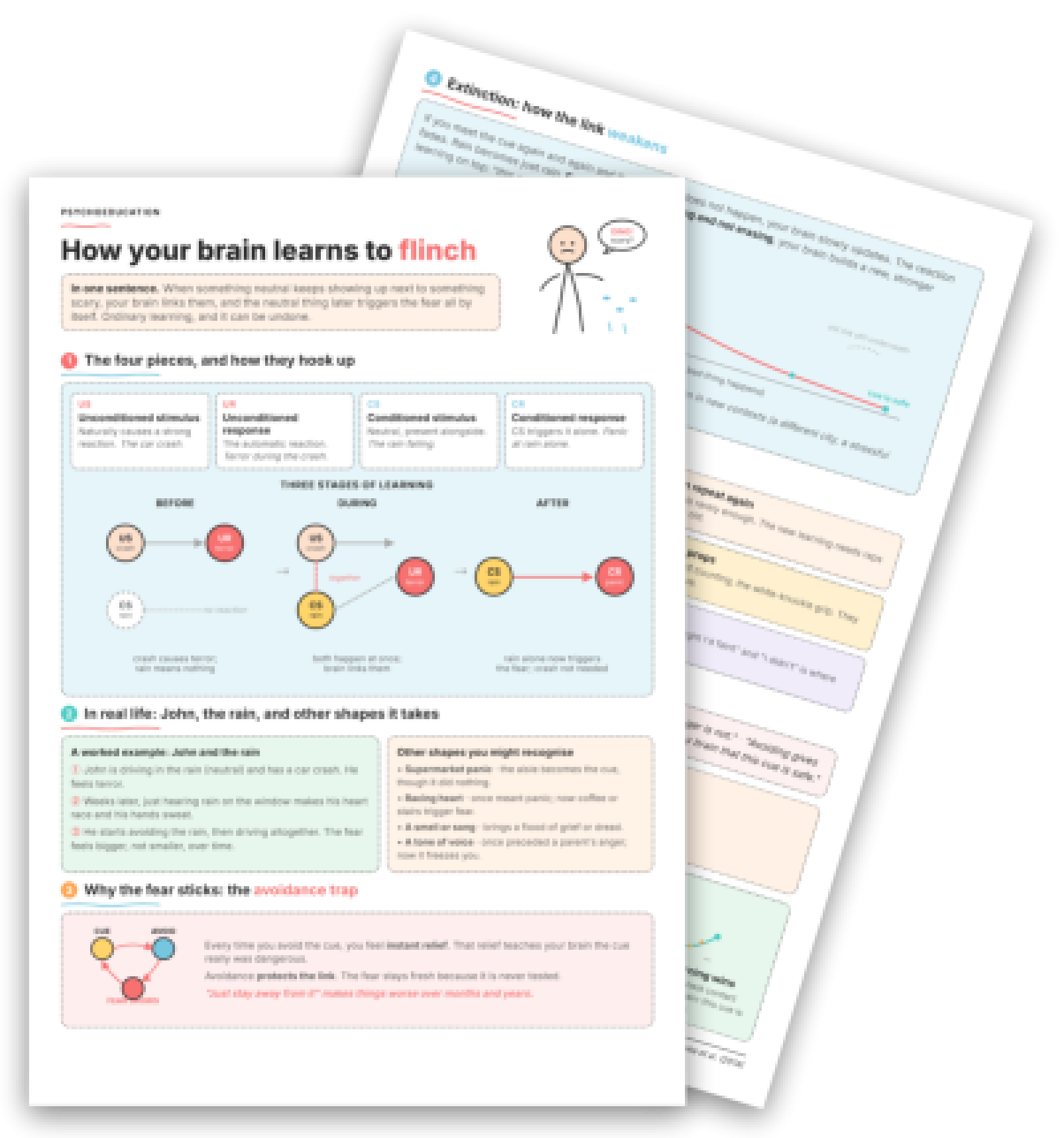
The fiche is structured across six numbered panels, designed to be walked through with the patient during the session rather than handed over as reading.
- Panel 1 defines the four building blocks, labelled US, UR, CS, and CR, with concrete referents for each (the car crash, the terror, the rain, the panic).
- Panel 2 lays out the three-stage learning sequence, "before / during / after", as a horizontal flow diagram. The before/after contrast makes the conditioning process visible in a way that verbal explanation alone cannot match.
- Panel 3 uses John's driving vignette, then lists four other conditioned patterns patients commonly recognise: supermarket panic, racing heart triggered by coffee or stairs, grief cued by a song, and the freeze response to a certain tone of voice.
- Panel 4 diagrams the avoidance trap: "Every time you avoid the cue, you feel instant relief. That relief teaches your brain the cue really was dangerous." Seeing the loop (cue, avoid, fear grows) drawn as a cycle tends to land differently than the spoken version.
- Panel 5 introduces extinction with a simple fear-reduction curve and explicitly frames fear returning in new contexts as "the old link still underneath" rather than a setback, a reframe that is clinically important to establish before exposure therapy begins.
- Panel 6 translates the model into five concrete practice principles: face the cue in doses, repeat, vary contexts, drop safety behaviours, and track the gap between prediction and outcome.
> Key point: The fiche is a visual support for in-session explanation, not a self-help handout. Its diagrams do the work that a verbal explanation of the US-CS-CR chain rarely achieves on its own. The patient leaves with a concrete reference they can consult between appointments.
The closing "To discuss in session" checklist on the fiche is worth reading aloud together: it specifies exactly when the patient should flag cue-specific reactions, avoidance spread, or fear returning after a good period.
750+ clinical tools
A library built with and for clinicians, ready to use in session and extend between appointments.
Access all the toolsWhen and How to Introduce the Fiche
Timing. The fiche fits naturally in the early-to-mid psychoeducation phase, once the clinical presentation is clear and before you formalise an exposure hierarchy. For PTSD presentations, it pairs well with autonomic nervous system psychoeducation. For panic disorder, introduce it alongside your explanation of interoceptive conditioning before moving to the panic attack psychoeducation program.
Profiles. Particularly useful for patients who intellectualise their symptoms without understanding their origin, for those who resist exposure on the grounds that "it doesn't make sense that the supermarket could scare me", and for anyone whose avoidance has silently narrowed their daily world. The fear psychoeducation program and the anxiety psychoeducation program provide a broader psychoeducation frame if you need more depth across multiple sessions.
Introduction wording. A low-stigma framing: "I'd like to show you a diagram that explains exactly how your brain learned to respond this way. It's ordinary learning, the same mechanism that makes you feel hungry when you smell bread. Understanding it usually makes the treatment plan feel more logical."
Debrief. After walking through the panels, ask which example resonated most and whether they can identify their own CS. The gap between "I thought I'd faint" and "I didn't", as the fiche phrases it, is where you will later anchor post-exposure learning with a tool like the graded exposure self-report.
The fiche does not replace the clinical formulation or the exposure work; it makes the rationale for both legible, and gives the patient a precise vocabulary to report back on between sessions.
Use it with your patients
Share this tool in the mobile app and follow the work between sessions.
Sources
- Pavlov, I. P. (1927). Conditioned Reflexes: An Investigation of the Physiological Activity of the Cerebral Cortex. Oxford University Press.
Your session continues in your patients' pocket
Use with a patientYour resources, available everywhere
The handouts, exercises, programs and audios above: you choose which ones to make available to your patients, in the mobile app dedicated to them.
And far more than a library
The app goes well beyond resources, to support your patients every day:
Related categories
Explore other clinical resources by category.

Anxiety
Clinical hub for anxiety disorders: CBT and ACT worksheets, psychoeducation sheets, and exercises for assessment and treatment across the anxiety spectrum.

Trauma
Clinical hub on trauma and PTSD: assessment, differential diagnosis, treatment phases, and printable resources for practitioners. 155 chars.

Understand
Clinical hub for the therapeutic aim 'Understand': worksheets and tools to build patient insight across CBT, ACT, schema therapy and more.

Exposure
Exposure therapy clinical resources for practitioners: worksheets, hierarchies, and psychoeducation tools for anxiety, PTSD, OCD, and avoidance-based presentations.

CBT
CBT worksheets, cognitive restructuring exercises & behavioral tools for clinicians. Evidence-based resources for every phase of cognitive behavioral therapy.

Mood
Evidence-based worksheets and clinical tools for mood disorders: CBT, ACT, and positive psychology resources for psychologists and therapists.