
Clinical picture. M., a 34-year-old logistics coordinator, presented following three panic attacks in as many weeks, each culminating in an emergency department visit where no cardiac pathology was identified. He described a rapid escalation from mild chest tightness to a conviction that he was dying, typically reaching peak intensity within four minutes. In the first lesson of the psychoeducation program, M. completed the symptom checklist and rated his last attack at 9 out of 10 on the anxiety scale; he also recognised, through the multiple-choice prompt on cognitions, that the thought "I am having a heart attack" had been present in all three episodes. When the clinician reviewed his lesson responses at the following session, the completed prompts provided a concrete basis for discussing how catastrophic interpretation amplifies physical sensations rather than reflecting genuine medical danger. M. reported that simply naming the vicious cycle had reduced his sense of helplessness, though he remained sceptical about his ability to interrupt it in the moment.
Panic Attacks: A Step-by-Step Psychoeducation Program
A structured 4-lesson clinical program helping patients understand the panic cycle and build concrete skills to manage attacks autonomously.
Clinical vignettes
Reframing the Vicious Cycle
Addressing Hypervigilance Between Episodes
Clinical picture. A., a 28-year-old graduate student, sought consultation after a first panic attack during an oral examination; she had since developed a pattern of monitoring her heartbeat and breathing throughout the day. Working through the early lessons of the program independently, she identified muscle tension and shifts in her breathing rhythm as the bodily sensations that most reliably triggered anticipatory anxiety. The step on hypervigilance led her to note, in her written response, that she checked her pulse approximately fifteen times per day and avoided caffeine entirely out of fear of provoking another attack. At the next session the clinician used A.'s own entries to introduce the concept of interoceptive sensitisation, framing her vigilance not as prudence but as a maintenance factor. A. remained uncertain about relinquishing her checking behaviours, which opened a productive discussion about the tension between short-term reassurance and longer-term habituation.
Use this resource with your patients
Handout, exercises and materials ready to use, right inside SessionFuel.
The clinical challenge: what words alone rarely accomplish
Panic attacks sit at an awkward intersection for clinicians. Patients usually arrive having already been told, by a GP, an emergency physician, or a previous therapist, that what they experienced was not dangerous. They nodded. Then the next attack hit and felt just as catastrophic. Verbal reassurance rarely dislodges the felt sense of dying, because the body is screaming louder than any rational explanation can reach.
What makes this doubly hard to convey is the layered nature of the problem: the fight-or-flight physiology, the catastrophic misinterpretation loop, the hypervigilance toward body sensations, and the avoidance behaviours that quietly maintain the disorder. A single spoken explanation during a consultation cannot track all of those threads simultaneously. Something structured and returnable-to is needed.

750+ clinical tools
A library built with and for clinicians, ready to use in session and extend between appointments.
Access all the toolsWhat the program contains
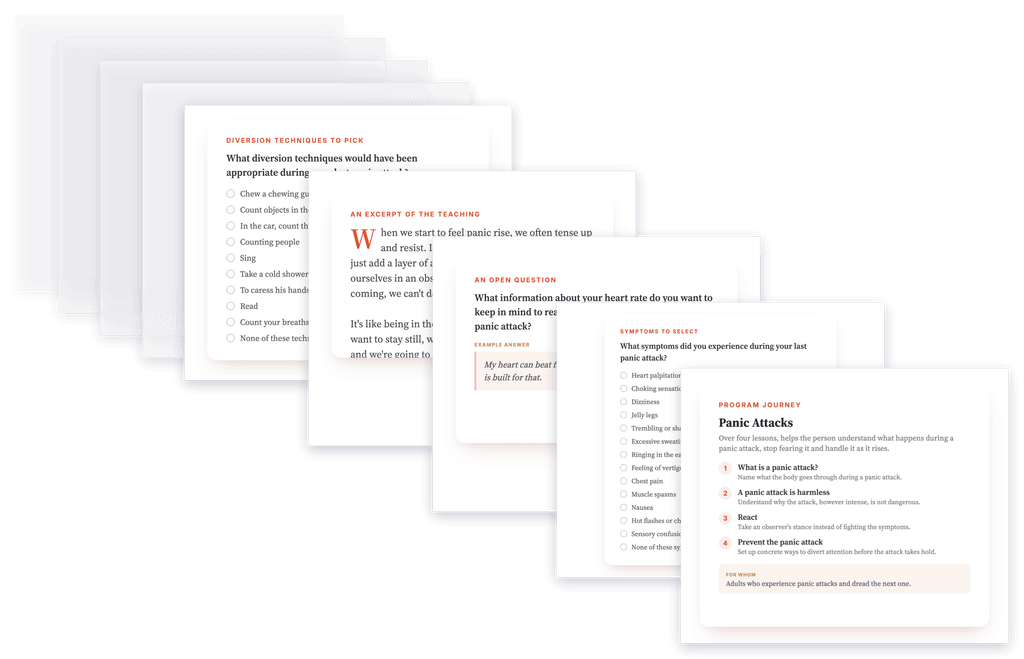
This four-lesson curriculum gives patients a step-by-step arc they work through between appointments, building genuine understanding and skill across each stage.
Lesson 1 unpacks the mechanics of a panic attack: where the symptoms come from, how the anxiety scale works (0 to 10), the vicious cycle between physical sensations and alarming thoughts, and the role of hypervigilance toward innocuous body signals. Patients do not just read; they answer targeted multiple-choice questions about their own symptom history and write short prompted reflections, such as rating the peak intensity of their last attack and naming what their body achieved recently.
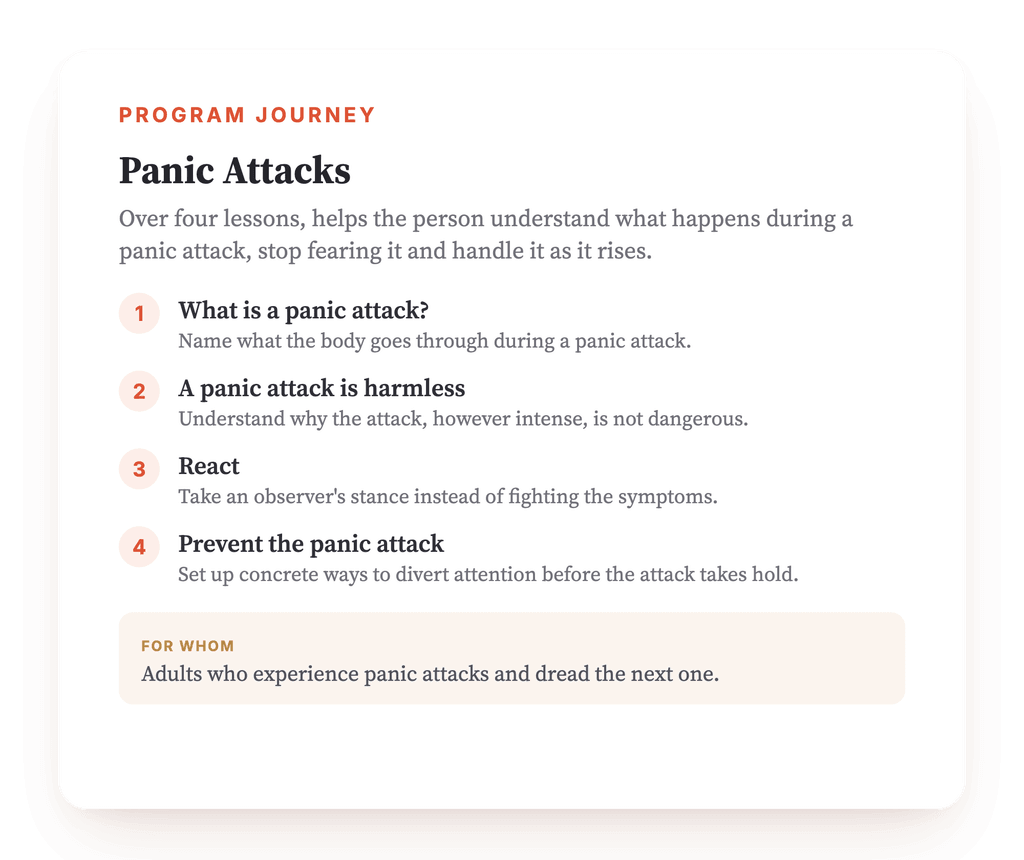
Lesson 2 addresses the most clinically stubborn belief: that the attack is dangerous. It walks through, precisely and physiologically, why patients will not have a cardiac arrest, will not stop breathing, and will not lose control of their mind or fall. Each explanation ends with a personal prompt asking the patient to formulate, in their own words, the reassurance they want to carry into the next attack.
Lesson 3 shifts from understanding to action. It introduces acceptance of symptoms as an observer stance, deep breathing as an active regulation tool, and personalised positive affirmations chosen from a structured list, building a concrete response toolkit rather than a vague intention to "stay calm."
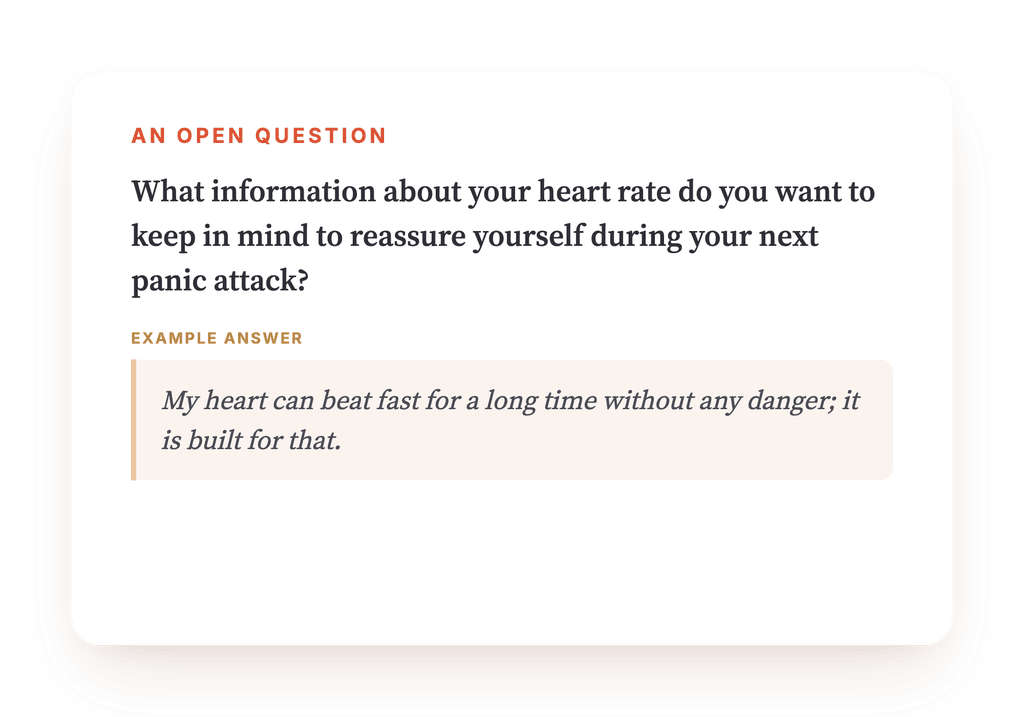
Lesson 4 focuses on early recognition and prevention: analysing the sequence of a past attack, practising distraction and grounding techniques (including sensory anchoring and present-moment focus), and two more surprising levers, channelled anger and immediate pleasurable activity, as incompatible-response strategies.
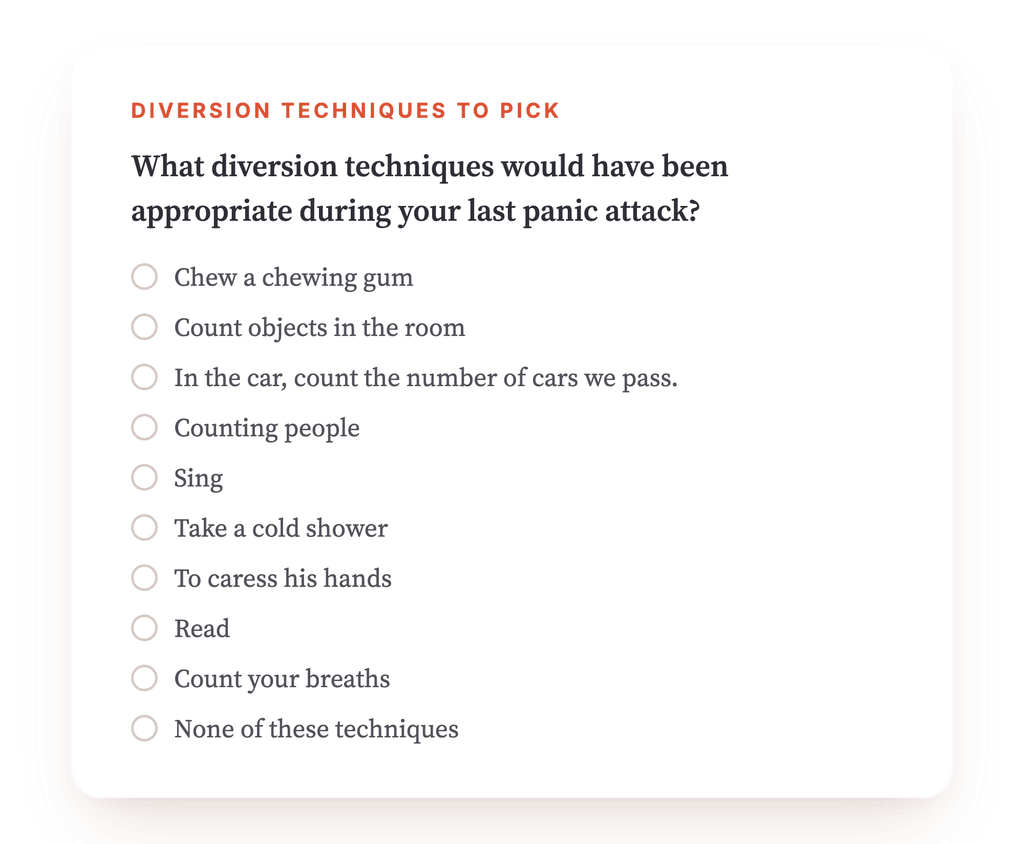
The preview images embedded here show the program overview and a couple of sample cards. These aperçus show only a fraction of the program; the complete curriculum contains many more lessons, steps, guided prompts, and multiple-choice questions than what appears in those illustrations.
This program is available to patients through the mobile application that is the dedicated patient-side interface of SessionFuel: once you assign the program to a patient within SessionFuel, they receive it directly on their phone and complete each lesson on their own, at their own pace.
Use it with your patients
Share this tool in the mobile app and follow the work between sessions.
How to integrate it as between-session homework
Key insight: The clinical value of this program is not in what happens during the consultation, but in the structured autonomous work the patient does between appointments, returning with personal data you can actually use.
This program suits patients who have experienced one or more panic attacks, whether or not they meet full criteria for panic disorder. It is equally useful early in treatment, to build a shared vocabulary and psychoeducational foundation, and mid-treatment, alongside exposure work or graded fear hierarchy construction.
Introduce it simply: explain that you are assigning structured reading and reflection tasks to complete between your meetings, that the patient will work through it step by step on their phone, and that each lesson ends with written responses they can bring back.
At the next appointment, those responses become clinical material. The patient's own description of their last attack's peak, the affirmations they selected, the diversion techniques they flagged as feasible: all of it arrives pre-organised, saving time and deepening the conversation. You can then connect the program's content to related work, such as the CBT model of panic, the physiology of body-stress responses, relaxation technique practice, or intolerance of uncertainty work for patients whose anticipatory anxiety drives the cycle.
For patients who also struggle with agoraphobia or broader anxiety and limiting beliefs, this program pairs naturally as a first step that anchors everything else in concrete somatic understanding.
Your session continues in your patients' pocket
Use with a patientYour resources, available everywhere
The handouts, exercises, programs and audios above: you choose which ones to make available to your patients, in the mobile app dedicated to them.
And far more than a library
The app goes well beyond resources, to support your patients every day:
Related categories
Explore other clinical resources by category.

Anxiety
Clinical hub for anxiety disorders: CBT and ACT worksheets, psychoeducation sheets, and exercises for assessment and treatment across the anxiety spectrum.

Emotions
Clinical resources on emotion regulation: worksheets, coping tools, CBT, REBT, and ACT exercises for therapists working across diagnoses and age groups.

CBT
CBT worksheets, cognitive restructuring exercises & behavioral tools for clinicians. Evidence-based resources for every phase of cognitive behavioral therapy.

Trauma
Clinical hub on trauma and PTSD: assessment, differential diagnosis, treatment phases, and printable resources for practitioners. 155 chars.

Mood
Evidence-based worksheets and clinical tools for mood disorders: CBT, ACT, and positive psychology resources for psychologists and therapists.

Identity
Clinical resources for self-identity work in therapy: CBT, ACT, schema tools for clinicians addressing self-concept, core beliefs, and identity disruption.