
Clinical picture. M., a 34-year-old account manager, presented with generalised anxiety characterised by persistent reassurance-seeking and difficulty tolerating unplanned social situations. During the intake review, he described checking guest lists before any professional event and frequently declining invitations when information about the activity was unavailable. His clinician introduced the psychoeducation program on uncertainty tolerance, and M. completed Lesson 1 between sessions, working through the structured prompts on control-seeking and avoidance. At the following appointment he spontaneously connected a childhood belief about predictability being equivalent to safety with his current reassurance rituals. No dramatic shift occurred, though he identified two low-stakes situations where he could deliberately withhold information-seeking as a first behavioural experiment.
Intolerance of Uncertainty: A 4-Lesson Psychoeducation Program
A structured autonomous program helping patients understand, reframe, and gradually embrace uncertainty as a source of possibility rather than threat.

Clinical vignettes
Naming the Avoidance Behind Control-Seeking
Reframing the Future as Open, Not Threatening
Clinical picture. A., a 28-year-old graduate student, met criteria for a generalised anxiety disorder with prominent intolerance of uncertainty about her professional trajectory. She described rumination organised almost entirely around future scenarios, consistently imagining the worst plausible outcome for each open situation. Her clinician proposed the multi-lesson uncertainty program as between-session work, and A. completed the Lesson 1 multiple-choice questions on her relationship to the future, selecting "I always imagine the worst" and "I see every possible obstacle." Reviewing her responses together, the clinician noted that A. had never distinguished between a genuinely threatening future event and a simply unknown one. Over subsequent lessons A. began to articulate, with modest but measurable consistency, that unfamiliarity and danger are not synonymous.
Use this resource with your patients
Handout, exercises and materials ready to use, right inside SessionFuel.
What makes uncertainty so hard to work with clinically
Intolerance of uncertainty sits at the heart of generalized anxiety, OCD, perfectionism, and avoidance patterns of all kinds, yet it is one of the concepts that resists a purely verbal explanation. You can describe the loop in session, but the patient who needs reassurance right now tends to experience the explanation as yet another attempt to master the unknown. What actually needs to shift is the patient's lived relationship with the future, not just their intellectual understanding of why uncertainty is unavoidable.
Two clinical obstacles compound this. First, the avoidance and rule-governed behavior maintaining the intolerance are often invisible to the patient: the research before any social event, the subtle checking, the rigid inner rules that feel protective rather than costly. The Intolerance of Uncertainty: PDF Worksheet, Tools and Exercises and the companion Intolerance of Uncertainty: PDF Worksheet, Tools and Exercises for GAD can make the loop legible in session, but translating that insight into sustained behavioral change requires structured, repeated work over time. Second, the reframe itself, moving from uncertainty as threat to uncertainty as the precondition for everything meaningful, is genuinely counterintuitive and needs to be built step by step, not delivered in a single conversation.
750+ clinical tools
A library built with and for clinicians, ready to use in session and extend between appointments.
Access all the toolsWhat the program contains
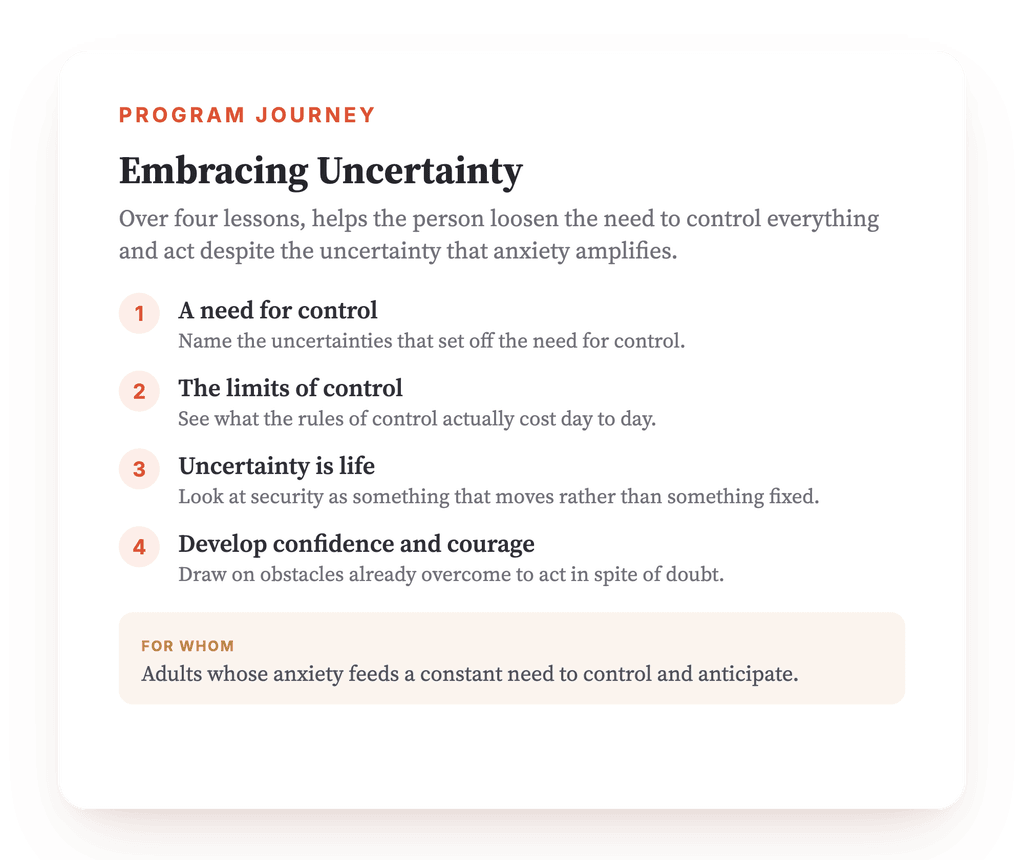
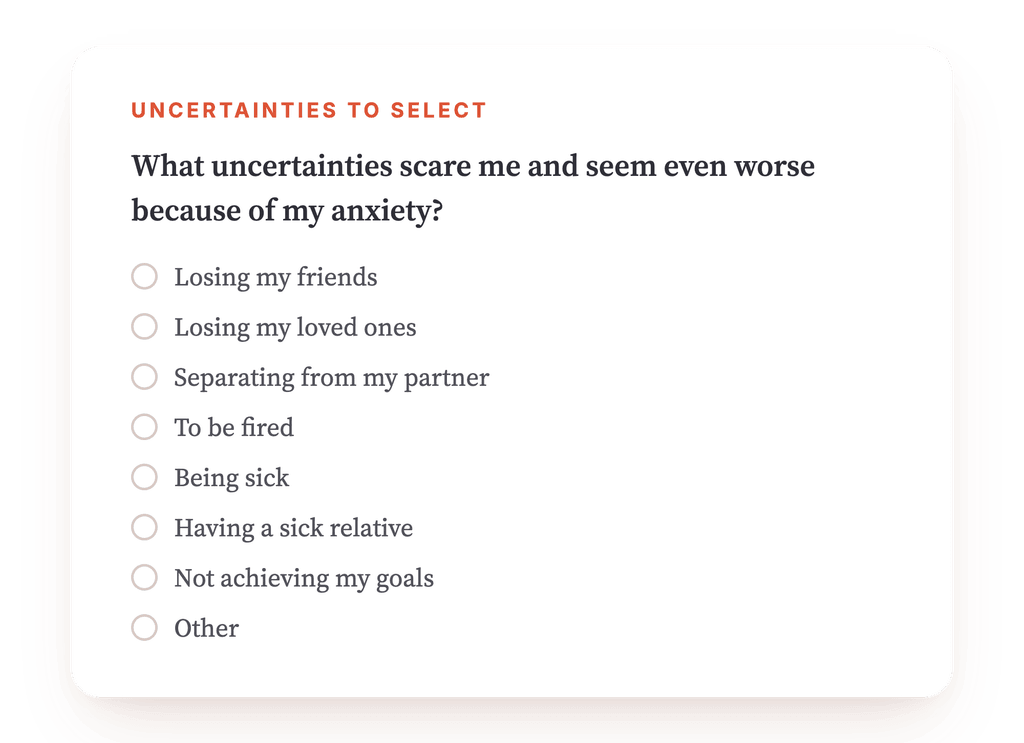
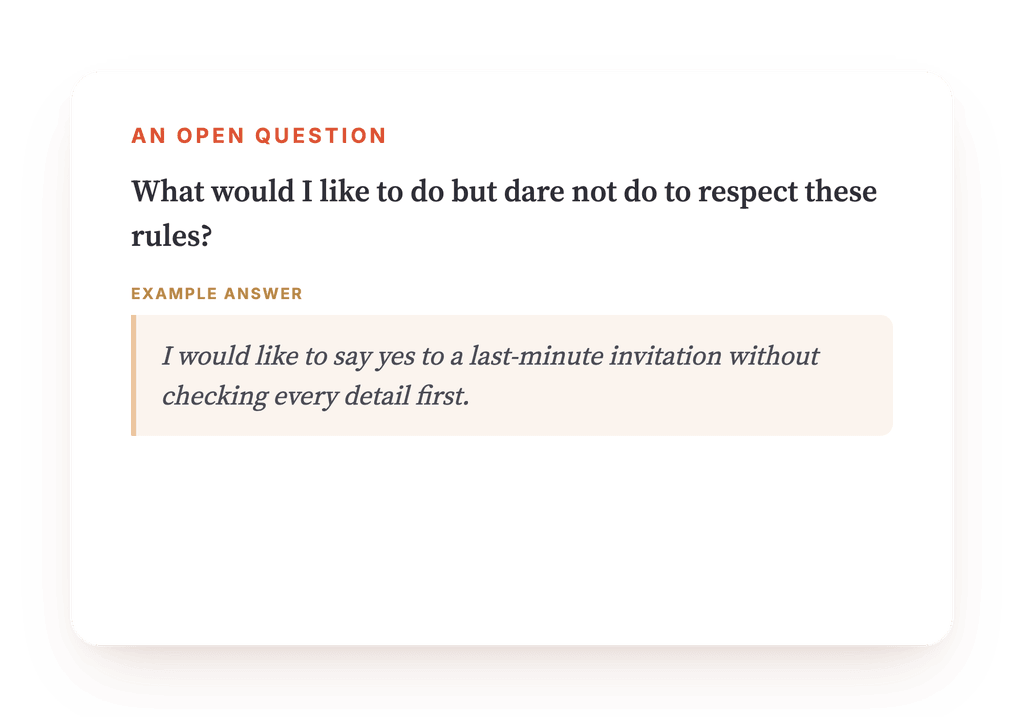
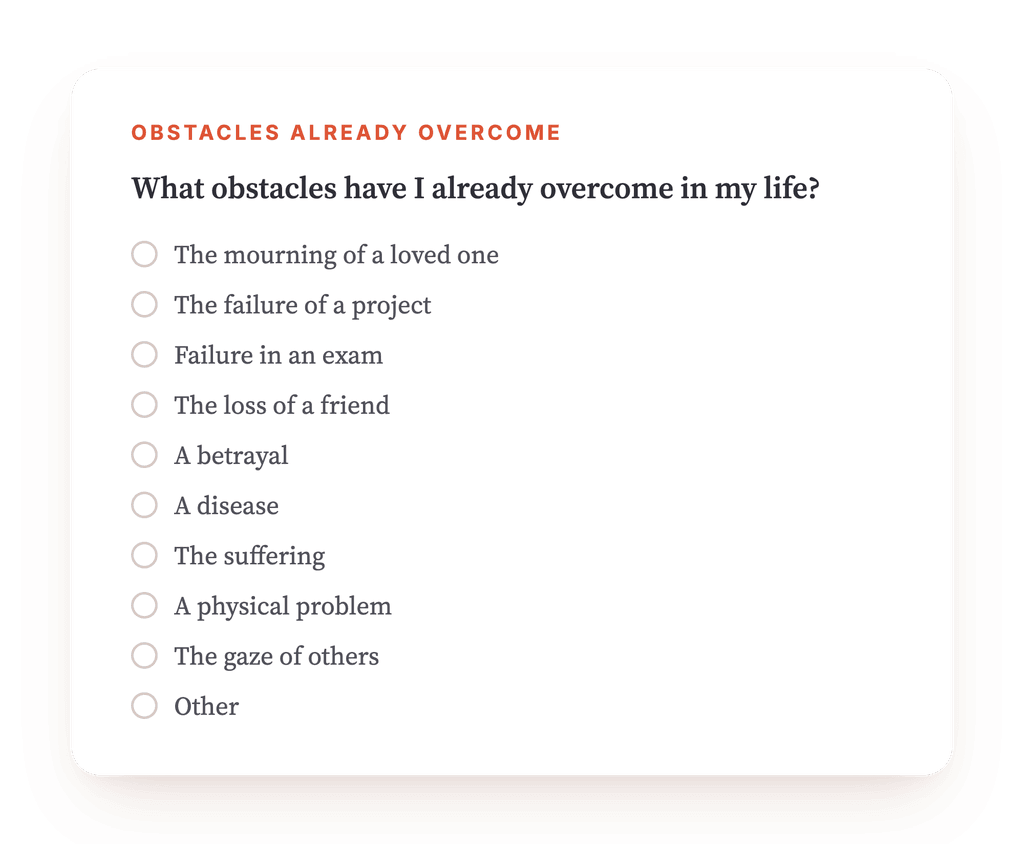
Appréhender l'incertitude is a four-lesson autonomous psychoeducation curriculum. The preview images embedded below give a glimpse of the program's overview map and a couple of sample cards, but these aperçus ne montrent qu'une fraction du programme: the complete curriculum contains many more lessons, steps, psychoeducation texts, multiple-choice reflections, and open-ended written prompts than what is visible here.
Lesson 1 (A need for control) opens by mapping the patient's specific fear landscape: which uncertainties feel most threatening, what emotions arise in the face of the unknown, and how compensatory beliefs and avoidance behaviors are constructed to manage that threat. Lesson 2 (The limits of control) goes deeper into the self-imposed rules and loss fears that narrow a patient's life, including failure anxiety and the things they dare not attempt. Together, these two lessons make the maintenance cycle concrete and personally owned, rather than abstract.
Lesson 3 (L'incertitude, c'est la vie) pivots the frame: uncertainty is reconsidered as the engine of motivation, curiosity, and possibility. Patients explore what remains open and generative in their lives right now and are invited to identify domains where greater curiosity is possible. Lesson 4 (Develop confidence and courage) consolidates the shift by anchoring resilience evidence, personal resources, and intuition, helping the patient build genuine confidence in their capacity to face the unknown rather than seeking to eliminate it.
Throughout, structured multiple-choice questions make reflection accessible, while open-ended written prompts generate material that is directly usable in the therapeutic relationship.
This program is available to patients through the mobile application that is the dedicated patient-side interface of SessionFuel: the clinician assigns it from their SessionFuel account, and the patient then works through each lesson autonomously on their phone, between appointments.
Use it with your patients
Share this tool in the mobile app and follow the work between sessions.
How to integrate it as between-session work
This program is well suited to patients presenting with generalized anxiety, health anxiety, perfectionism, or rigid avoidance patterns, particularly those who have already named the intolerance of uncertainty loop in session and are ready to work with it concretely. It also fits patients whose cycle of avoidance is maintained by reassurance-seeking or safety behaviors, and those for whom catastrophizing or worry dominates.
Introduce the program after at least one session devoted to the concept: pair it with the Intolerance of Uncertainty: PDF Worksheet, Tools and Exercises or the What If...? Reframing Catastrophic Worry: PDF Worksheet, Tools and Exercises as an in-session primer. Assign one or two lessons as homework between consultations, asking the patient to complete the steps on their own and note what surprised or challenged them.
Key insight: The written prompts, especially the patient's responses about past resilience and untried possibilities, become direct clinical material at the next session. Use them to identify maintained avoidance, update the formulation, and reinforce emerging confidence in their own coping resources.
At the return appointment, open with the patient's written responses rather than a general check-in. Responses to prompts about rules they dare not break (Lesson 2) often reveal schema-level beliefs worth targeting with tools such as Developing a Growth Mindset: PDF Worksheet, Tools and Exercises, the "Should" Statements: PDF Worksheet, Tools and Exercises, or the Comfort, Stretch and Panic Zones: PDF Worksheet, Tools and Exercises. Responses from Lesson 4 on personal resources connect naturally to Resilience: A Structured Psychoeducation Program for Clinicians or the Protective Factors: PDF Worksheet, Tools and Exercises.
For patients whose uncertainty intolerance overlaps with psychological inflexibility, the program pairs well with the Psychological Flexibility: PDF Worksheet, Tools and Exercises and Active Acceptance: PDF Worksheet, Tools and Exercises for ACT Practice as complementary in-session psychoeducation supports.
Your session continues in your patients' pocket
Use with a patientYour resources, available everywhere
The handouts, exercises, programs and audios above: you choose which ones to make available to your patients, in the mobile app dedicated to them.
And far more than a library
The app goes well beyond resources, to support your patients every day:
Related categories
Explore other clinical resources by category.

Anxiety
Clinical hub for anxiety disorders: CBT and ACT worksheets, psychoeducation sheets, and exercises for assessment and treatment across the anxiety spectrum.

Emotions
Clinical resources on emotion regulation: worksheets, coping tools, CBT, REBT, and ACT exercises for therapists working across diagnoses and age groups.

Cognition
Printable cognitive therapy worksheets and clinical tools for therapists: CBT, ACT, schema work, defusion, distortions, and belief restructuring.

Understand
Clinical hub for the therapeutic aim 'Understand': worksheets and tools to build patient insight across CBT, ACT, schema therapy and more.

Restructure
Clinical hub for cognitive restructuring worksheets: distortion identification, belief disputation, ABC model, and schema work for evidence-based practice.

ACT
Clinical hub for Acceptance and Commitment Therapy (ACT): worksheets, exercises, programs and audio resources for practitioners using the ACT model.