
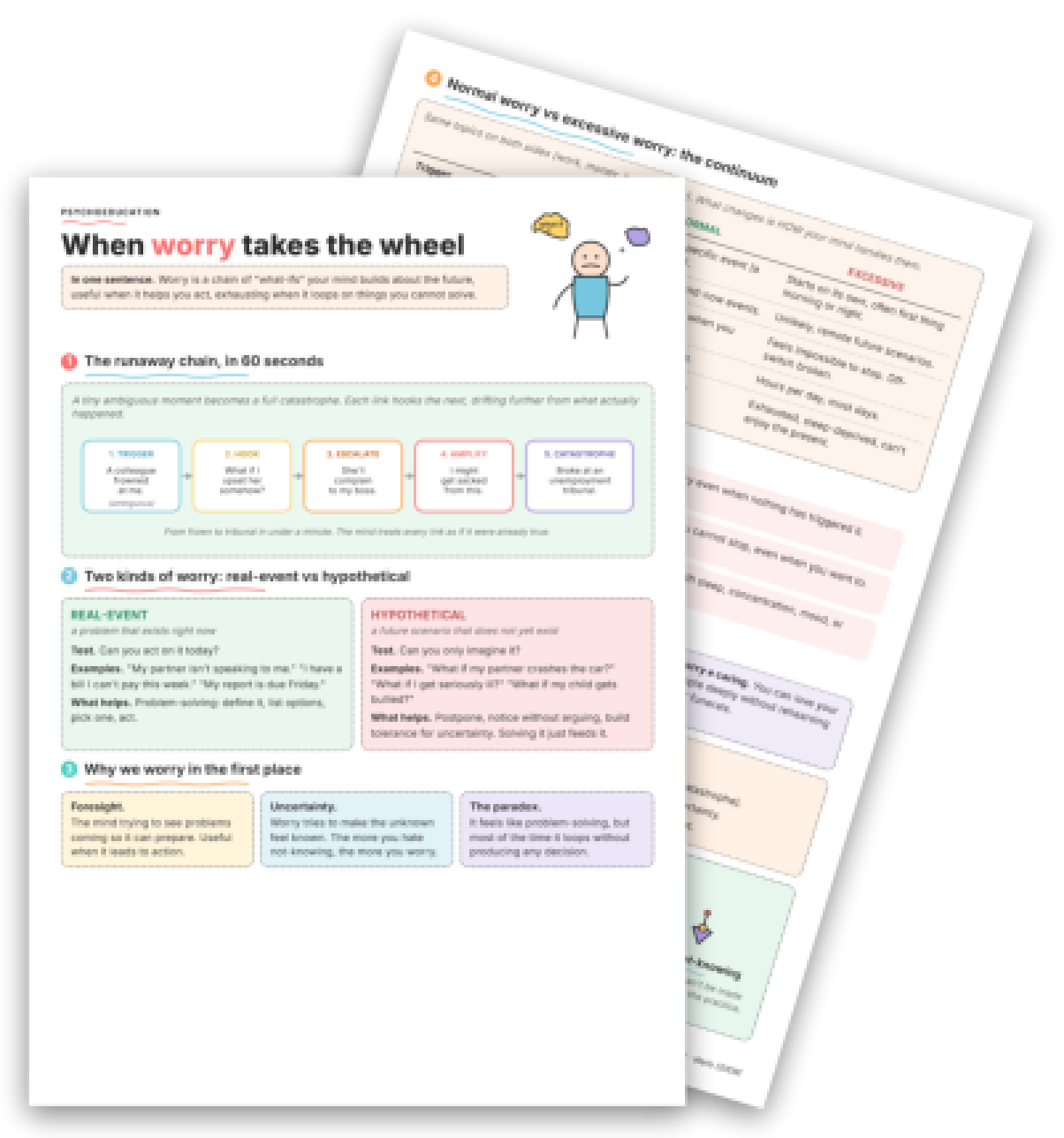
Clinical picture. M., a 34-year-old teacher, presented with sleep difficulties and persistent tension she described as "my brain just won't stop." She reported that a single ambiguous email from a parent could occupy her mind for hours before bed. The clinician introduced the psychoeducation sheet on worry, walking through the runaway-chain diagram together and asking M. to map a recent episode onto the five links. She recognised, with some surprise, how quickly her mind had moved from a mildly critical word to imagining a formal complaint, and noted that she had treated each step as if it were already happening. This naming exercise gave her a shared vocabulary to use in subsequent sessions when flagging the onset of a chain.
What Is Worry? PDF Worksheet, Tools and Exercises for Clinical Practice
A visual psychoeducation worksheet helping clinicians explain the worry chain, the real-event vs hypothetical distinction, and the normal-to-excessive continuum in session.
Clinical vignettes
Naming the Chain in Session
Sorting Real-Event from Hypothetical
Clinical picture. R., a 47-year-old accountant with generalised anxiety, came to session listing several worries he felt equally urgent: an overdue invoice from a supplier, and the recurring thought that his wife might develop a serious illness. The clinician used the informational sheet to introduce the real-event versus hypothetical distinction, asking R. to apply the test "Can you act on this today?" to each item on his list. R. placed the invoice in the real-event column and, with some reluctance, acknowledged that his wife's health was currently fine and that no action was available to him. He left with a small between-session task: when a worry arose, to sort it before attempting to resolve it, a step that reduced the time he spent trying to problem-solve scenarios that had no concrete solution.
Patients who present with excessive worry will almost always tell you they understand what worry is. They don't. What they understand is that they worry; what they systematically miss is the structural mechanics that keep it running. Explaining it verbally tends to produce polite agreement without genuine insight. This PDF worksheet is a visual support that makes the internal architecture of worry concrete and shareable during the session itself.
Use this resource with your patients
Handout, exercises and materials ready to use, right inside SessionFuel.
Why Worry Resists Oral Explanation
The clinical problem is that worry mimics useful cognition. It feels like foresight. It feels like preparation. For many patients, it feels like care, as in "I worry because I love them." Dismantling that equation verbally, without a shared map, rarely lands.
A second resistance is the paradox of worry: it presents as problem-solving while producing no decision and no action. Patients often push back when you name this, not out of defensiveness, but because the loop is genuinely hard to see from the inside. The loop needs to be shown, not described.
A third difficulty, particularly relevant for GAD formulation work, is the real-event vs hypothetical distinction. Patients collapse these two categories, applying the same strategy (rumination, reassurance-seeking) to both, including to scenarios that cannot, by definition, be solved. Without a concrete sorting tool, the distinction stays abstract.
What the Fiche Contains, and Why the Visual Format Matters
The worksheet opens with a one-sentence definition grounding the whole session: "Worry is a chain of 'what-ifs' your mind builds about the future, useful when it helps you act, exhausting when it loops on things you cannot solve." That framing is immediately usable as a shared vocabulary with the patient.
Section 1 maps the five-link catastrophe chain as a visual sequence: Trigger (a colleague frowned), Hook ("What if I upset her?"), Escalate ("She'll complain to my boss"), Amplify ("I might get sacked"), Catastrophe ("Broke at an unemployment tribunal"). The layout shows, in a way words cannot, how each thought is treated as established fact before the next link is added. This is the kind of mechanism that takes five minutes to describe and five seconds to grasp on a diagram.
Section 2 presents two worry types side by side: real-event worries (a problem that exists now, actionable today) versus hypothetical worries (a future scenario, imagined only). Each type carries a simple test question and a corresponding intervention, problem-solving for real-event, postponement and uncertainty tolerance for hypothetical. For patients stuck in intolerance of uncertainty loops, this distinction is the beginning of the clinical work, not just psychoeducation.
Section 4 displays a five-dimension comparison table: trigger, likelihood, controllability, duration, and functional impact, contrasting normal worry and excessive worry across each axis. The same topics appear on both sides of the continuum, which is exactly the point. It normalises without minimising, a balance that is genuinely hard to strike verbally.
Section 6 names three counter-intuitive principles the patient is unlikely to have heard: more worry does not equal more prepared, suppression is less effective than sorting, and worry is not the same as caring. These are the reframes that benefit from being printed and taken home.
The worksheet closes with a "To discuss in session" block, giving the patient three concrete anchors for the next appointment: a recent example of the chain replaying, their ratio of hypothetical to real-event worries, and which sign from the "line has been crossed" checklist applies to them.
> Key point: This worksheet is a visual support the clinician uses to explain worry's structure during the session, not a questionnaire the patient fills out alone. It provides a shared reference, a common vocabulary, and something concrete the patient leaves with.
Clinical library
750+ clinical tools
A library built with and for clinicians, ready to use in session and extend between appointments.
Access all the toolsSeveral resource types
Psychoeducation handouts
Understand at a glance
Interactive exercises
To do and fill in
Interactive programs
A structured path
Audios
Meditation and relaxation
Psychometric tests
Automatic scoring
When and How to Introduce It
This worksheet fits naturally in early psychoeducation sessions, once the presenting complaint has been mapped but before structured intervention begins. It works well alongside an anxiety psychoeducation program or as a standalone primer for GAD, health anxiety, and presentations where catastrophizing is a central maintaining process.
A low-pressure introduction: "I want to show you a diagram that describes what worry actually does at the level of individual thoughts, you may find it matches your experience pretty closely." That framing avoids pathologising and positions the fiche as a neutral explanatory tool.
After presenting the chain, spend two to three minutes on the real-event vs hypothetical test together, using an actual worry the patient brought that day. Once they can sort their own material, the uncertainty-tolerance work that follows has a clear rationale. For patients who identify with the "line has been crossed" checklist, the What If...? Reframing Catastrophic Worry worksheet and the Managing Worry attentional awareness exercise are natural next-step complements.
One limit worth noting: for patients in acute distress or with significant comorbid depression, the conceptual density of the fiche can feel overwhelming in a first encounter. In those cases, start with Section 1 only, and return to the continuum table when the alliance is more established. The worksheet does not replace the clinical frame; it makes the explanation cleaner and leaves the patient with something solid to return to between sessions.
Use it with your patients
Share this tool in the mobile app and follow the work between sessions.
Sources
- Dugas, M. J., Freeston, M. H., & Ladouceur, R. (1997). Intolerance of uncertainty and problem orientation in worry. Cognitive Therapy and Research, 21(6), 593-606.
- Dugas, M. J., Gosselin, P., & Ladouceur, R. (2001). Intolerance of uncertainty and worry: Investigating specificity in a nonclinical sample. Cognitive Therapy and Research, 25(5), 551-558.
Patient mobile app
Your session continues in your patients' pocket
Use with a patientYour resources, available everywhere
The handouts, exercises, programs and audios above: you choose which ones to make available to your patients, in the mobile app dedicated to them.
Psychoeducation handoutsInteractive exercisesInteractive programsAudiosPsychometric tests
And far more than a library
The app goes well beyond resources, to support your patients every day:
Standardized tests
Therapy journal
Gamification
Wellbeing challenges
Introspection prompts
Therapist homework
Related categories
Explore other clinical resources by category.
Anxiety
Clinical hub for anxiety disorders: CBT and ACT worksheets, psychoeducation sheets, and exercises for assessment and treatment across the anxiety spectrum.

Cognition
Printable cognitive therapy worksheets and clinical tools for therapists: CBT, ACT, schema work, defusion, distortions, and belief restructuring.

Understand
Clinical hub for the therapeutic aim 'Understand': worksheets and tools to build patient insight across CBT, ACT, schema therapy and more.

CBT
CBT worksheets, cognitive restructuring exercises & behavioral tools for clinicians. Evidence-based resources for every phase of cognitive behavioral therapy.

Metacognitive
Metacognitive Therapy (MCT): clinical resources, worksheets, and exercises for practitioners targeting CAS, rumination, and metacognitive beliefs.

Trauma
Clinical hub on trauma and PTSD: assessment, differential diagnosis, treatment phases, and printable resources for practitioners. 155 chars.