
Clinical picture. R., a 34-year-old administrative worker, presented with a six-month history of repeated, unproductive GP consultations after noticing intermittent throat tightness; all investigations had returned normal results. In the third session, the clinician used the health anxiety loop diagram to trace R.'s typical evening sequence: a swallowing sensation triggered the thought "this could be oesophageal cancer," which produced autonomic arousal, which R. then interpreted as further evidence of illness. Walking through the four estimates together, R. noticed that her perceived likelihood of serious disease sat near certainty while her coping estimate was close to zero. She agreed to begin a daily log of safety behaviours, specifically repeated swallowing checks and late-night symptom searches, as a first behavioural target. By the following session she had identified three distinct checking cycles per day, a concrete baseline from which to work.
CBT Model of Health Anxiety: PDF Worksheet, Tools and Exercises
A visual PDF worksheet clinicians can use in session to map the health anxiety maintenance loop and shift psychoeducation from abstract to immediately actionable.
Clinical vignettes
Mapping the Loop in Session
Reassurance-Seeking and Fading Relief
Clinical picture. M., a 47-year-old man referred following twelve months of cardiology consultations yielding no organic finding, described a pattern of waking at night, noticing his own heartbeat, and immediately asking his partner to confirm his pulse felt normal. The clinician introduced the loop model, focusing on the "safety moves backfire" section, and M. recognised that the reassurance he sought from his partner provided relief lasting no more than two hours before doubt returned around a new sensation. The clinician framed the partner's responses, however well-intentioned, as an external factor that prevented M. from testing whether anxiety would subside on its own. A graded plan was agreed: M. would delay seeking reassurance by fifteen minutes initially, observing what happened to the urge. At the next review he reported the urge had peaked and then dropped in roughly twelve minutes on two out of five attempts, which was sufficient to begin questioning the perceived necessity of checking.
Health anxiety is one of those presentations where verbal psychoeducation risks looping straight back into the maintenance cycle: the clinician explains the model, the patient hears an implicit confirmation that their symptoms are worth taking seriously, and the alliance tangles before the formulation has even landed. This PDF worksheet on the CBT model of health anxiety, grounded in Salkovskis (1996) and Warwick & Salkovskis (1990), gives you a structured visual support to walk through in session rather than deliver as a lecture.
Use this resource with your patients
Handout, exercises and materials ready to use, right inside SessionFuel.
Why the Health Anxiety Loop Resists Verbal Explanation
The core difficulty is that threat appraisal in health anxiety is viscerally compelling. Patients are not engaging in motivated reasoning; they are experiencing genuine interoceptive sensations that their cognitive system has primed them to read as lethal. Explaining the maintenance model verbally puts the clinician in the position of asserting a counter-narrative against a live somatic experience, which rarely lands cleanly in a first or second session.
The second problem is the invisibility of safety behaviors. Most patients can name checking or Googling symptoms, but they are rarely aware that those moves are perpetuating the very doubt they are trying to resolve. Relief fades, the next sensation arrives, and the loop restarts, without the patient ever noticing the mechanism. Without a shared vocabulary and a visual representation, this cycle stays implicit and therefore harder to intervene on. A tool like the Health Anxiety checklist helps establish the phenomenology first; this worksheet then explains why it persists.
What the Worksheet Contains: A Visual Map of the Loop
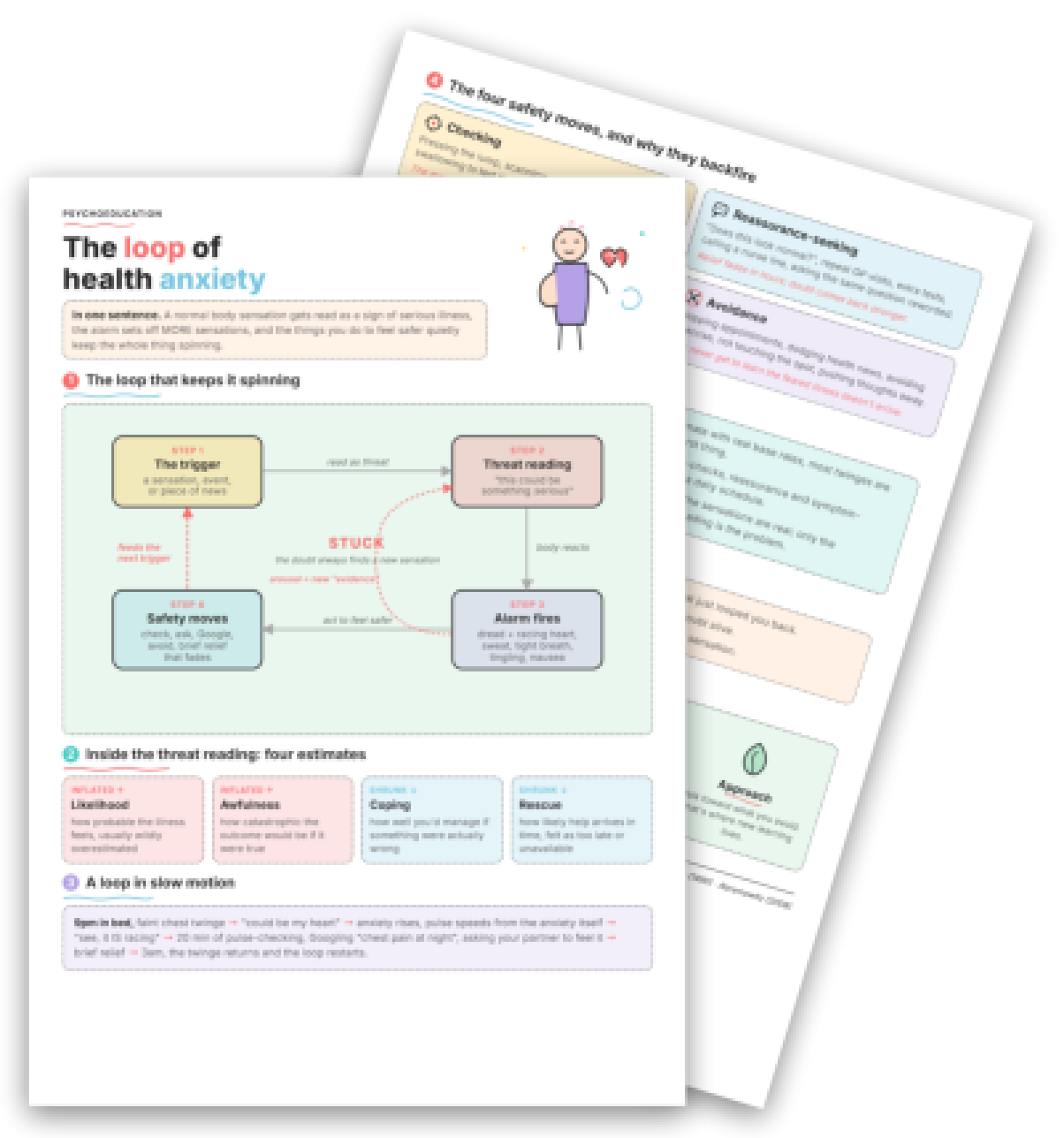
The fiche opens with a four-step loop diagram (trigger, threat reading, alarm firing, safety move) that makes the circularity explicit at a glance. Crucially, it labels the feedback arrows: "arousal = new evidence" and "feeds the next trigger", so patients can see, rather than just hear, why the loop is self-sealing. No verbal summary reproduces that structural clarity as efficiently.
Panel 2 unpacks the four cognitive estimates that inflate or shrink inside the threat appraisal: likelihood and awfulness are shown as systematically overestimated; coping capacity and rescue availability as systematically underestimated. This four-variable frame, drawn directly from the Salkovskis formulation, gives you a precise clinical vocabulary that you can return to across sessions without rebuilding the model from scratch each time. It also maps well onto the broader CBT cognitive model if you are working with comorbid presentations.
Panel 4 details the four safety behaviors (checking, reassurance-seeking, info-seeking, avoidance) with the specific backfire mechanism for each. The line "relief fades in hours; doubt comes back stronger" resonates with patients who have been told their checking is unhelpful but have never had the mechanism explained. This panel makes a natural entry point for the reassurance-seeking guided exercise as between-session work.
Panel 5 ("What loosens the loop") and Panel 6 ("To discuss in session") shift the fiche toward collaborative action planning: dropping one safety move at a time, re-estimating with real base rates, approaching avoided situations. The session prompts in Panel 6 ("name which box you're in") give the patient a portable map they can use outside the consulting room.
> Key point: This worksheet is a visual support that facilitates in-session explanation of the health anxiety maintenance cycle; it is not a self-report questionnaire. The clinician uses it to anchor the formulation while the patient can see the structure rather than hold an oral account in working memory.
750+ clinical tools
A library built with and for clinicians, ready to use in session and extend between appointments.
Access all the toolsWhen and How to Introduce This Worksheet
The worksheet fits best after initial assessment and before formal exposure work begins, typically Sessions 2 to 4. By then you have enough of a formulation to personalise the loop diagram without it feeling generic, and the patient has developed enough trust to hear that their safety moves are maintaining the problem.
A useful introduction: "I'd like to show you a diagram that maps out the pattern we've been describing. I find it easier to point at the moving parts than to describe them. Tell me whether this matches your experience." Framing it as hypothesis rather than verdict keeps the patient in an investigative stance rather than a defensive one.
For patients with prominent intolerance of uncertainty or significant checking rituals that overlap with OCD presentations, supplement with the Checking, Certainty, and Doubt worksheet. For those already motivated to begin exposure, the graded exposure hierarchy tool and the structured exposure therapy program provide the next clinical step. Patients with a pronounced fear of death or somatic preoccupation that centres on appearance rather than illness may need a different entry point, such as the CBT Model of BDD.
Debrief the worksheet session by asking the patient to locate one specific safety move they are willing to observe rather than enact before the next appointment. The anxiety physical sensations exercise can accompany this as structured self-monitoring. The worksheet stays with the patient as a reference; the loop diagram in particular gives them a map for moments when the doubt is loudest and the mechanism is hardest to remember.
Use it with your patients
Share this tool in the mobile app and follow the work between sessions.
Sources
- Abramowitz, J. S., & Braddock, A. E. (2011). Hypochondriasis and Health Anxiety. Hogrefe Publishing.
- Cooper, K., Gregory, J. D., Walker, I., Lambe, S., & Salkovskis, P. M. (2017). Cognitive Behaviour Therapy for Health Anxiety: A Systematic Review and Meta-Analysis. Behavioural and Cognitive Psychotherapy, 45(2).
Your session continues in your patients' pocket
Use with a patientYour resources, available everywhere
The handouts, exercises, programs and audios above: you choose which ones to make available to your patients, in the mobile app dedicated to them.
And far more than a library
The app goes well beyond resources, to support your patients every day:
Related categories
Explore other clinical resources by category.
Anxiety
Clinical hub for anxiety disorders: CBT and ACT worksheets, psychoeducation sheets, and exercises for assessment and treatment across the anxiety spectrum.

Understand
Clinical hub for the therapeutic aim 'Understand': worksheets and tools to build patient insight across CBT, ACT, schema therapy and more.

Build awareness
Clinical worksheets and tools to build awareness in therapy: cognitive distortions, schemas, emotions, ACT and CBT resources for practitioners.

CBT
CBT worksheets, cognitive restructuring exercises & behavioral tools for clinicians. Evidence-based resources for every phase of cognitive behavioral therapy.

Trauma
Clinical hub on trauma and PTSD: assessment, differential diagnosis, treatment phases, and printable resources for practitioners. 155 chars.

Mood
Evidence-based worksheets and clinical tools for mood disorders: CBT, ACT, and positive psychology resources for psychologists and therapists.