
Clinical picture. R., a 34-year-old teacher, presented with recurrent low mood and a persistent sense of inadequacy that intensified sharply whenever she received corrective feedback at work. During a session, she described submitting a report one day late and spending the following week convinced her line manager was preparing to dismiss her. The clinician introduced the iceberg worksheet to help R. map the layers beneath that reaction: the automatic thought ("She thinks I'm incompetent") sat above a longstanding rule ("If I am not perfect, I will be replaced"), which itself rested on a core belief of "I am only acceptable when I perform well," traceable to a childhood in which parental warmth was reliably conditional on achievement. Once R. could see the structure visually, she was able to name the reaction as belief-driven rather than evidence-based, which reduced the urgency of the rumination enough to allow behavioural experiments to be planned in the following session.
How Your Past Affects Your Present: PDF Worksheet, Tools and Exercises
A visual PDF worksheet to explain the three-layer CBT model, automatic thoughts, rules, and core beliefs, clearly and efficiently in session.
Clinical vignettes
Disproportionate Shame After a Missed Deadline
Avoidance Rooted in an Early Trust Belief
Clinical picture. M., a man in his late forties referred for generalised anxiety, reported that he routinely declined social invitations and gave vague excuses, yet felt guilty and isolated as a result. He described a recent situation in which a colleague invited him to a small team lunch; he declined, then spent the afternoon preoccupied by the idea that the colleague would eventually "find out what he was really like." Using the iceberg framework in session, the clinician walked through the three layers with M.: the automatic thought ("If I go, they'll see through me") connected to a rule ("If people get too close, they will use what they know against me"), rooted in a core belief of "People cannot be trusted," which M. linked to sustained peer bullying across his secondary-school years. Naming the belief as a learned conclusion rather than a current fact opened space to examine the cost of the avoidance pattern without M. feeling pathologised.
The three-layer CBT model, automatic thoughts, intermediate rules, core beliefs, is one of the most clinically load-bearing frameworks you work with, and one of the hardest to make genuinely land at the verbal level. Patients nod, they agree their past has shaped them, and then they keep collapsing every cognition into "just a thought." This PDF worksheet on the iceberg of the mind is built for exactly that moment: a single visual support that makes the hierarchical structure concrete, shared, and portable.
Use this resource with your patients
Handout, exercises and materials ready to use, right inside SessionFuel.
Why the Three-Layer Model Resists Oral Explanation
The problem is spatial. When you describe the iceberg verbally, patients anchor on the presenting complaint, the automatic thought, and struggle to hold the full vertical structure in mind. The distinction between a conditional rule ("if I please everyone, I'll be safe") and a core belief ("I am unlovable") collapses without a reference point. Patients routinely misidentify rules as beliefs, or treat a core belief as just another thought to challenge and discard. That confusion can cost several sessions.
Patients who use intellectualization as a primary maladaptive coping style are particularly susceptible: they can recite the three levels without any felt sense of which layer is actually driving their reactions. Similarly, those with significant alexithymia need an external, concrete structure before they can locate their own material within it. A diagram removes the cognitive overhead and lets you both point at the same map.
What the Fiche Contains: A Visual Anchor for the Iceberg Model
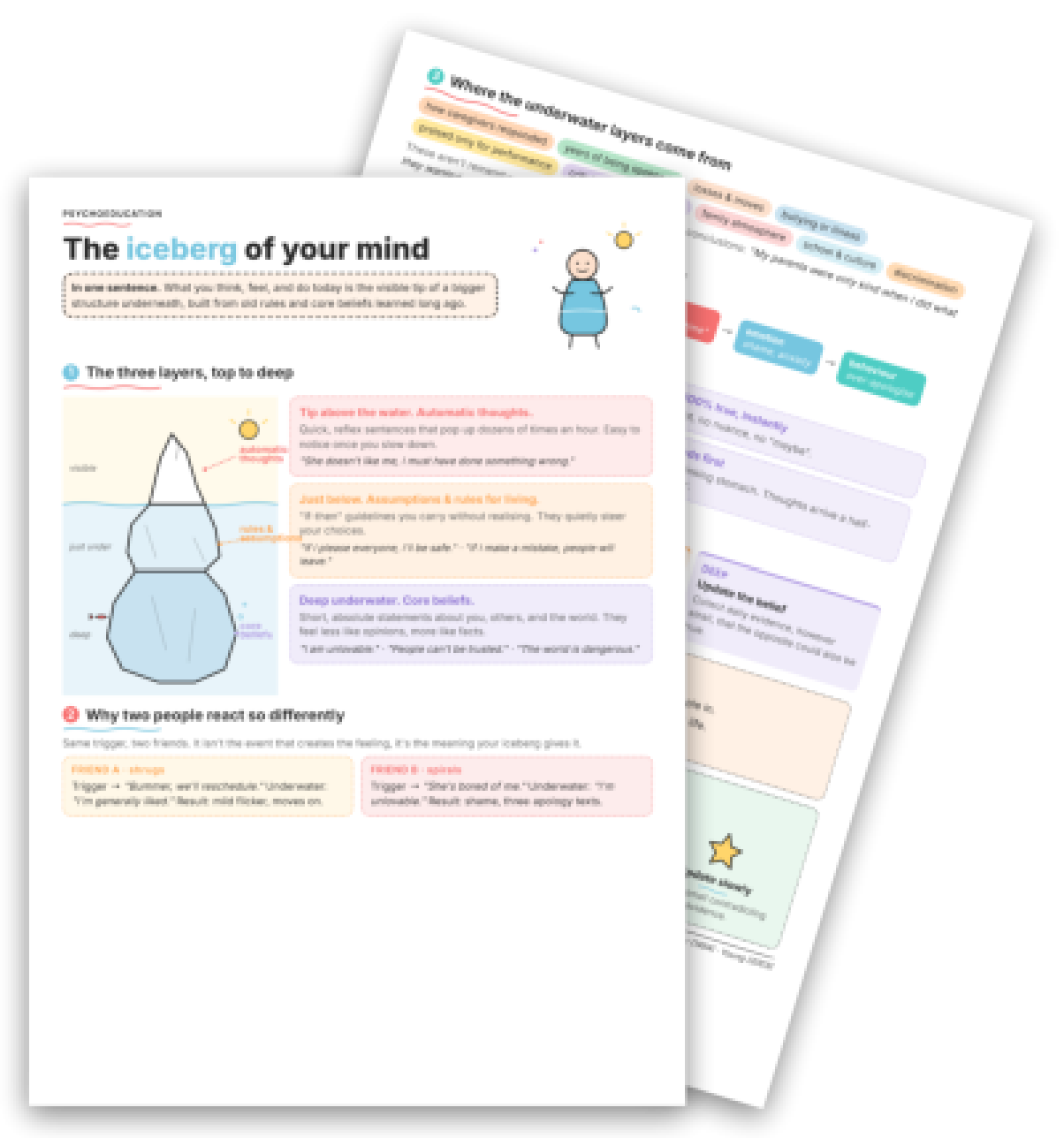
The fiche opens with a one-sentence psychoeducation frame, "what you think, feel, and do today is the visible tip of a bigger structure underneath, built from old rules and core beliefs learned long ago", then unfolds across six numbered panels.
Panel 1 presents the three-layer iceberg diagram with explicit spatial labels: automatic thoughts (visible, above water), rules and assumptions (just under the surface), core beliefs (deep underwater). That single image does what a whiteboard sketch rarely achieves cleanly.
Panels 2 and 3 are the clinical centrepiece. Panel 2 places two people side by side responding to the same trigger, a cancelled plan, and shows how divergent underwater structures ("I'm generally liked" versus "I'm unlovable") produce entirely opposite emotional outcomes. This parallel format makes the meaning, not the event principle visible at a glance, in a way no spoken formulation fully replicates.
Panel 4 traces the full chain from deep core belief through intermediate rule, automatic thought, emotion, and behaviour, with "over-apologise" as the endpoint, giving patients a complete longitudinal formulation in a single diagram they can take home.
Panel 5 lists four signs that a core belief has just been activated: reaction intensity disproportionate to the event, instant 100% certainty with no nuance, cross-situational recurrence ("same theme, different rooms"), and somatic flooding that precedes the thought. These markers are directly usable as self-monitoring cues between sessions and feed naturally into the downward arrow technique.
Panel 6 maps three entry points: surface (catch and test the automatic thought), middle (name and interrogate the if-then rule), deep (collect small contradicting evidence to begin updating the belief). A closing block offers three "to discuss in session" prompts the patient keeps as a reference.
> To note: the fiche is a visual support that facilitates the explanation of the three-layer model in session; it is not a self-completion questionnaire but a clinician-led psychoeducation tool that leaves the patient with a concrete reference rather than a task to complete alone.
750+ clinical tools
A library built with and for clinicians, ready to use in session and extend between appointments.
Access all the toolsWhen and How to Introduce the Fiche
This worksheet fits naturally in the psychoeducation phase of any CBT-oriented work, typically sessions 2 to 4, once the initial formulation is sketched and the patient has some familiarity with the thought-emotion-behaviour link from the cognitive triangle, but before you move into active schema restructuring.
It is particularly indicated with patients who present with relational repetition patterns: the "same theme, different rooms" marker from panel 5 resonates quickly when abandonment schema dynamics or defectiveness beliefs are organising the clinical picture. It also works well as a bridge toward examining the evidence against a core belief or beginning the origins-of-beliefs tracing work.
A clean introduction might be: "I'd like to show you a model that explains why the same situation can affect two people so differently, it's a quick diagram, and I think it will make a lot of what we're working on click into place." Avoid framing it as homework or as a questionnaire; it works best presented in session, walked through panel by panel, with the patient identifying their own material in each layer as you go.
As a debrief, ask which panel felt most recognisable and whether the "signs of activation" in panel 5 match anything they noticed that week. The clarifying a core belief exercise and the tracing-the-origin exercise are natural next steps once the patient has a working sense of their own iceberg structure.
One limit worth noting: patients in an acute crisis phase, or very early in the alliance, may find the three-layer depth confronting rather than clarifying. In those cases, stay at the surface layer and return to the full iceberg when the therapeutic relationship can hold it.
The fiche does not replace the schema work; it makes the map legible so the work can begin.
Use it with your patients
Share this tool in the mobile app and follow the work between sessions.
Sources
- Beck, J. S. (2021). Cognitive Behavior Therapy: Basics and Beyond. The Guilford Press.
- Beck, A. T., Rush, A. J., Shaw, B. F., & Emery, G. (1979). Cognitive Therapy of Depression. Guilford Press.
- Beck, A. T., & Haigh, E. A. P. (2014). Advances in Cognitive Theory and Therapy: The Generic Cognitive Model. Annual Review of Clinical Psychology, 10, 1-24.
- Young, J. E., Klosko, J. S., & Weishaar, M. E. (2003). Schema Therapy: A Practitioner's Guide. Guilford Press.
- Beck Institute for Cognitive Behavior Therapy. The Cognitive Model.
- Beck, A. T. (1967). Depression: Causes and Treatment. University of Pennsylvania Press.
Your session continues in your patients' pocket
Use with a patientYour resources, available everywhere
The handouts, exercises, programs and audios above: you choose which ones to make available to your patients, in the mobile app dedicated to them.
And far more than a library
The app goes well beyond resources, to support your patients every day:
Related categories
Explore other clinical resources by category.

Anxiety
Clinical hub for anxiety disorders: CBT and ACT worksheets, psychoeducation sheets, and exercises for assessment and treatment across the anxiety spectrum.

Trauma
Clinical hub on trauma and PTSD: assessment, differential diagnosis, treatment phases, and printable resources for practitioners. 155 chars.

Mood
Evidence-based worksheets and clinical tools for mood disorders: CBT, ACT, and positive psychology resources for psychologists and therapists.

Cognition
Printable cognitive therapy worksheets and clinical tools for therapists: CBT, ACT, schema work, defusion, distortions, and belief restructuring.

Understand
Clinical hub for the therapeutic aim 'Understand': worksheets and tools to build patient insight across CBT, ACT, schema therapy and more.

Build awareness
Clinical worksheets and tools to build awareness in therapy: cognitive distortions, schemas, emotions, ACT and CBT resources for practitioners.