
Clinical picture. T., a woman in her mid-thirties presenting with persistent low self-worth, reports that positive feedback at work leaves her unmoved while a single critical remark from a colleague can preoccupy her for days. Her therapist introduced the belief-magnet informational sheet during the session, inviting her to map recent examples onto the two poles. T. quickly identified her reflexive "yes, but" response to a colleague's praise and recognised the split-credit pattern: she attributed a well-received presentation to the topic being easy, yet held a minor stumble as evidence of fundamental inadequacy. By the following session she had noted three further instances in her diary, which opened a discussion about how the magnet mechanism, rather than the evidence itself, was sustaining her negative self-view.
Core Belief Magnet Metaphor: PDF Worksheet, Tools and Exercises
A visual PDF worksheet clinicians can use in session to explain how core beliefs selectively filter evidence, with concrete exercises to begin weakening them.
Clinical vignettes
Compliments That Never Land
When Reassurance Bounces Back
Clinical picture. M., a man in his late forties with a longstanding core belief of being fundamentally unlovable, had made limited progress despite several months of supportive therapy and repeated reassurance from his partner and clinician. His psychologist used the belief-magnet sheet to name why direct reassurance had not shifted things: each affirmation was being relabelled as politeness or obligation before it could register as real evidence. Working through the "sticky versus slippery" example, M. acknowledged that warm gestures from his adult children faded quickly from memory while a distant or distracted reply could occupy him for a week. The metaphor gave him a shared language with his clinician for interrupting the relabelling process, and he began practising a brief pause before discounting positive interactions rather than attempting to replace the belief through argument.
Explaining why a patient keeps dismissing evidence that contradicts a negative core belief is one of the more friction-heavy moments in schema work. Telling them their belief is a filter rarely lands. This fiche PDF gives you a concrete, visual mechanism to point at in session: the belief-magnet metaphor, grounded in Beck (1979), Young (2003), and Padesky (1994).
Use this resource with your patients
Handout, exercises and materials ready to use, right inside SessionFuel.
Why Core Beliefs Resist Explanation in Session
The central clinical problem is not that patients fail to understand the concept of confirmatory bias intellectually. Most can follow a verbal explanation. The problem is that the bias feels like perception, not selection. When you say "you're discounting the evidence," the patient experiences that as you failing to see the evidence they see.
Without a shared framework to name the mechanism, the therapeutic dialogue stalls in a debate about facts. The patient points to what "attracted" their belief; the clinician points to what was "repelled." Neither side is wrong, and the impasse blocks the cognitive restructuring work that should follow.
This is exactly the gap the fiche addresses, and why having a visual support matters: it externalizes the mechanism so both parties are looking at the same object, not arguing from inside their own perspective.
What the Fiche Contains: A Visual Support That Does the Explaining
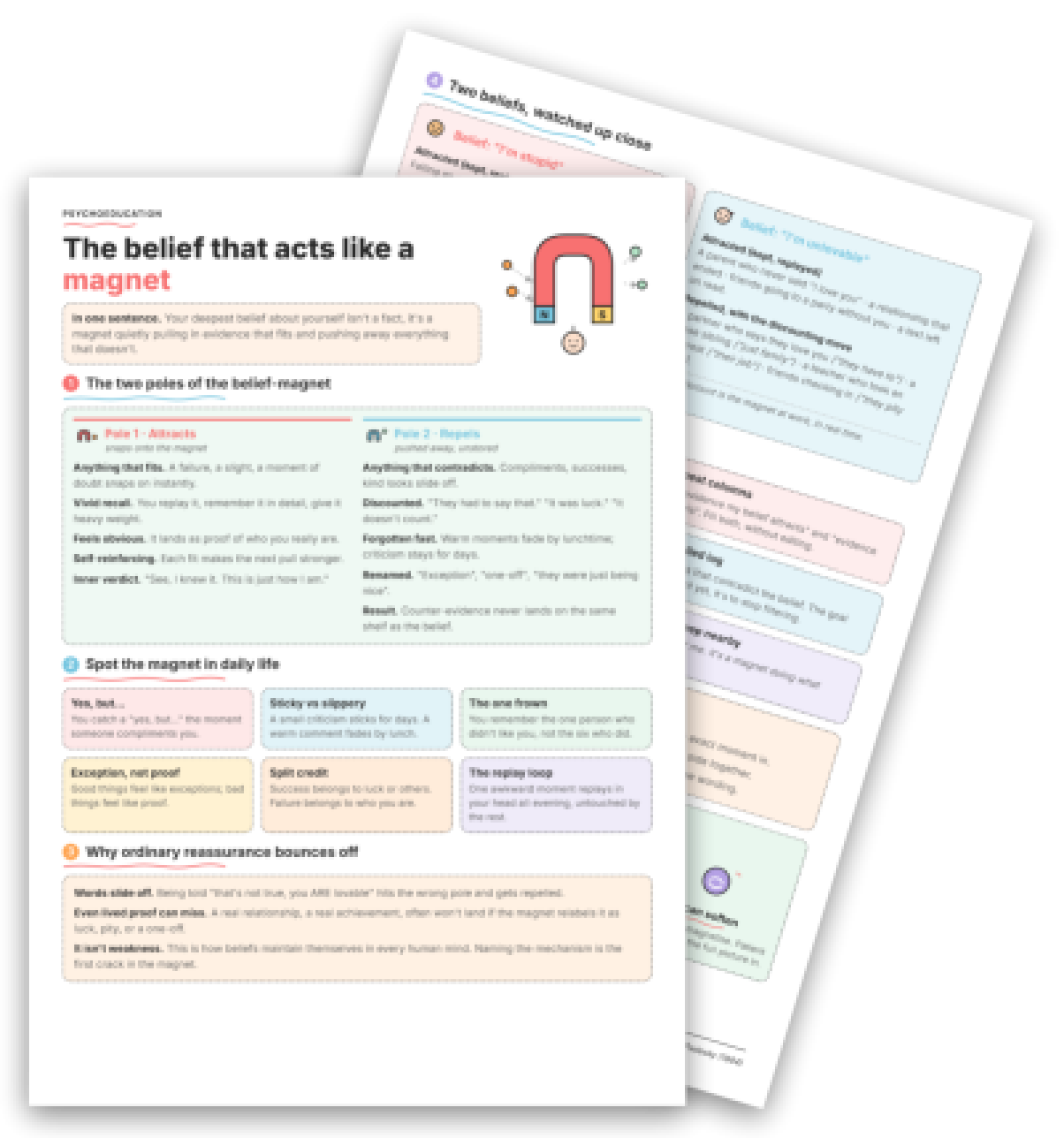
The sheet opens with a single sentence that frames the whole session: "Your deepest belief about yourself isn't a fact, it's a magnet quietly pulling in evidence that fits and pushing away everything that doesn't." That formulation is worth reading aloud before anything else.
The two-pole diagram (Pole 1: Attracts / Pole 2: Repels) is the structural spine. Each pole is broken into five observable features, such as "Vivid recall. You replay it, remember it in detail, give it heavy weight" on the attraction side, and "Discounted. 'They had to say that.' 'It was luck.' 'It doesn't count.'" on the repulsion side. Visual layout makes the asymmetry obvious in a way that oral explanation simply cannot: both columns are equally long, equally specific, and sitting side by side.
Section 2 operationalizes the mechanism with six behaviorally precise signs ("sticky vs slippery," "the one frown," "split credit," "the replay loop") that patients can self-recognize without any clinical framing. Section 3 directly names why reassurance bounces off, which preempts a common frustration for both parties.
The clinical centerpiece is Section 4: two fully worked examples ("I'm stupid" / "I'm unlovable") with concrete attracted and repelled items listed in parallel columns. This is where automatic thoughts connect back to schema-level beliefs, and where the fiche does the heavy lifting of psychoeducation rather than leaving it to your verbal explanation. Clinicians using schema-informed case formulation will recognize the structure immediately.
Section 5 offers six graded exercises to begin weakening the magnet: naming the belief as a sentence, filling honest two-column evidence logs, catching the discounting move in real time, keeping a daily repelled log, and asking three trusted people for their descriptions. A "To discuss in session" block closes the sheet with three ready-to-use debriefing prompts.
> Key takeaway: This fiche is a visual support that facilitates the explanation in session, not a self-administered questionnaire. Its two-column layout shows what oral explanation alone cannot: that both poles already exist, and the bias lies in which side gets seen.
750+ clinical tools
A library built with and for clinicians, ready to use in session and extend between appointments.
Access all the toolsWhen and How to Introduce This Fiche
The ideal moment is after the core belief has been named but before restructuring work begins. Attempting to challenge a belief before the patient understands its self-maintaining logic tends to produce therapeutic ruptures or superficial compliance. The fiche fits naturally at the junction between identifying the core belief and introducing exercises to reinforce an alternative.
A low-friction introduction: "I want to show you something that might explain why the usual encouragement hasn't stuck. It's about how beliefs maintain themselves, and it has nothing to do with willpower." This frames the fiche as a mechanism insight, not a criticism of the patient's effort.
For patients working through low self-esteem or approval-seeking patterns, Section 4 is particularly productive because the examples are immediately recognizable. For patients with more acute presentations, pause at Section 3 before moving further; normalizing why reassurance fails can itself shift the alliance.
Debrief by asking which discounting move the patient recognizes most in their own week, then anchor that observation to the between-session tracking exercises that follow. The fiche does not replace the therapeutic frame; it makes the explanation precise enough for the real work to begin.
Use it with your patients
Share this tool in the mobile app and follow the work between sessions.
Sources
- Riso, L. P., McBride, C. (2007). Introduction: A return to a focus on cognitive schemas. In L. P. Riso, P. L. du Toit, D. J. Stein, & J. E. Young (Eds.), Cognitive Schemas and Core Beliefs in Psychological Problems: A Scientist-Practitioner Guide (pp. 3-9). American Psychological Association.
- Clark, D. A., Beck, A. T. (2010). Cognitive Therapy of Anxiety Disorders: Science and Practice. Guilford Press.
Your session continues in your patients' pocket
Use with a patientYour resources, available everywhere
The handouts, exercises, programs and audios above: you choose which ones to make available to your patients, in the mobile app dedicated to them.
And far more than a library
The app goes well beyond resources, to support your patients every day:
Related categories
Explore other clinical resources by category.

Anxiety
Clinical hub for anxiety disorders: CBT and ACT worksheets, psychoeducation sheets, and exercises for assessment and treatment across the anxiety spectrum.

Mood
Evidence-based worksheets and clinical tools for mood disorders: CBT, ACT, and positive psychology resources for psychologists and therapists.

Identity
Clinical resources for self-identity work in therapy: CBT, ACT, schema tools for clinicians addressing self-concept, core beliefs, and identity disruption.

Relationships
Clinical worksheets and tools on relational functioning: attachment, schemas, assertiveness, and communication skills for therapists. Printable PDF resources.

Cognition
Printable cognitive therapy worksheets and clinical tools for therapists: CBT, ACT, schema work, defusion, distortions, and belief restructuring.

Understand
Clinical hub for the therapeutic aim 'Understand': worksheets and tools to build patient insight across CBT, ACT, schema therapy and more.