
Clinical picture. A., a woman in her late thirties, presented with recurrent depressive episodes and a longstanding core belief that she was "fundamentally incompetent" at work, which she had identified during a previous session. The clinician introduced the five-question exercise as a between-session task, asking A. to gather concrete evidence contradicting that belief before the next appointment. She returned having listed several recent projects she had completed without external rescue, and she formulated an alternative belief: "I am capable of managing most professional demands, even when I feel uncertain." When the clinician worked through questions four and five with her, A. acknowledged that the alternative was grounded in verifiable facts and that holding it reduced the anticipatory anxiety that had been driving her avoidance. Progress was modest but observable: she agreed to take on a postponed task she had been avoiding for three weeks.
Replacing a Negative Core Belief: A Guided CBT Exercise
A structured five-question homework exercise helping patients construct, reality-test, and internalize a genuine alternative belief.
Clinical vignettes
Replacing a Belief of Fundamental Incompetence
Testing an Alternative Belief About Likability
Clinical picture. T., a man in his mid-twenties with social anxiety, had identified the belief "people tolerate me but do not genuinely like me" as a central theme maintaining his withdrawal from social situations. The clinician assigned the guided exercise in writing, emphasising that question two required specific behavioural evidence rather than general impressions. T. noted three instances in which peers had initiated contact with him without any prompt, and he drafted the alternative belief: "Some people seek out my company because they find it worthwhile." In session, the clinician used question four to probe whether this formulation overstated certainty, and they revised it together to read "at least some people value spending time with me," which T. rated as more believable and therefore more usable. He did not report a dramatic shift, but he agreed to attend one optional social event the following week as a behavioural test of the new belief.
Why belief replacement is harder than it sounds
Identifying a negative core belief is already demanding clinical work. Getting a patient to genuinely replace it is something else. The difficulty is not logical but experiential: even when a patient can articulate why a belief is distorted, the alternative rarely feels true yet. Formulating a new belief that is both realistic and personally meaningful requires deliberate, scaffolded effort, not just an encouraging conversation.
Words exchanged in consultation fade quickly. What patients need between appointments is a structured sequence: name the belief, assemble disconfirming evidence, draft the alternative, test it against reality, evaluate its utility. Without that architecture, the alternative belief risks staying an abstract aspiration. This exercise is designed to fill that gap. It sits naturally after Clarifying a Core Belief: A Guided Self-Reflection Exercise and feeds directly into Reinforcing a New Core Belief: A Guided Clinical Exercise, forming a coherent working sequence across the belief-change phase of treatment.
Use this resource with your patients
Handout, exercises and materials ready to use, right inside SessionFuel.
What the exercise contains
The exercise unfolds across five targeted questions.
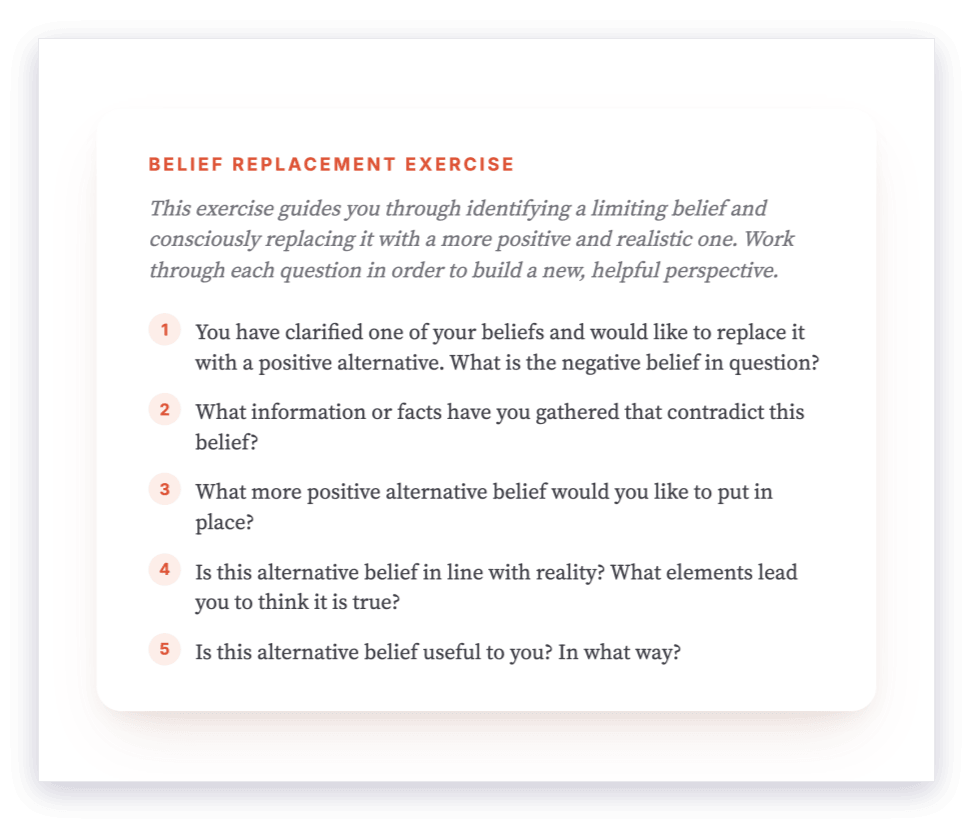
The image above is a static preview listing the five questions in sequence. The full guided exercise, including patient-facing instructions and space to write responses, is experienced by the patient directly in the app, on their own, and is not captured in this image.
The patient begins by naming the negative belief they have already clarified (Q1), then articulates the concrete disconfirming information or facts they have gathered that contradict it (Q2). Q3 invites them to formulate the alternative belief they would genuinely like to hold. Questions 4 and 5 form the clinical core: Q4 asks whether the alternative is aligned with reality and what specific elements support that assessment, while Q5 asks the patient to evaluate whether the belief is useful to them and in what way.
Key takeaway: The two-part test in Q4 and Q5 is what separates meaningful belief substitution from wishful thinking. A replacement belief must be both credible and functional to begin taking root.
This structure connects naturally to work done with Core Beliefs: Examining the Evidence and echoes the evidence-weighing logic in Automatic Thoughts: A Guided Cognitive Restructuring Exercise. For patients working on schema-level material, it runs alongside the Restructuring a Negative Core Belief worksheet or the Schema Cognitive Restructuring worksheet. The utility question in Q5 also pairs well with Evaluating Thought Utility: A Guided Metacognitive Exercise, which deepens the same metacognitive move.
This exercise is available to patients through the SessionFuel patient app, the dedicated mobile interface for patients whose clinicians use SessionFuel: you assign it as between-session homework, and your patient completes it directly on their phone, on their own, at their own pace.
750+ clinical tools
A library built with and for clinicians, ready to use in session and extend between appointments.
Access all the toolsUse it with your patients
Share this tool in the mobile app and follow the work between sessions.
Integrating this exercise as between-session work
This exercise suits patients who have already done the upstream work: they can name a specific negative belief and have begun gathering evidence against it. It fits naturally into CBT work on core beliefs about self, others, and the world, and integrates easily into structured programs such as Depression and Limiting Beliefs: A 4-Lesson Clinical Program or Anxiety and Limiting Beliefs: A 5-Lesson Clinical Program.
To introduce it, frame it as the active construction phase: the diagnostic work is done, now the patient builds. You can anchor Q2 in material already generated with tools like Tracing the Origin of a Negative Thought to Its Core Belief or Core Beliefs: A Guided Self-Reflection Exercise.
When the patient brings their completed exercise back, Q4 and Q5 are the richest entry points for clinical exploration. If the patient struggles to confirm the alternative's reality, the belief may be too ambitious, and you can work together to calibrate it downward. If they find it difficult to identify genuine utility, that often points to ambivalence about change worth exploring directly. Q5 also opens a productive conversation about the concrete daily difference a changed belief would make, connecting naturally to the Inner Self-Talk: A 4-Lesson Psychoeducation Program or to behavioral activation work. The written record itself, produced autonomously between sessions, gives you a precise, patient-authored text to return to across subsequent appointments.
Your session continues in your patients' pocket
Use with a patientYour resources, available everywhere
The handouts, exercises, programs and audios above: you choose which ones to make available to your patients, in the mobile app dedicated to them.
And far more than a library
The app goes well beyond resources, to support your patients every day:
Related categories
Explore other clinical resources by category.

Anxiety
Clinical hub for anxiety disorders: CBT and ACT worksheets, psychoeducation sheets, and exercises for assessment and treatment across the anxiety spectrum.

Mood
Evidence-based worksheets and clinical tools for mood disorders: CBT, ACT, and positive psychology resources for psychologists and therapists.

Identity
Clinical resources for self-identity work in therapy: CBT, ACT, schema tools for clinicians addressing self-concept, core beliefs, and identity disruption.

Behaviours
Clinical hub for behaviors in therapy: worksheets and tools for coping, eating disorders, CBT formulation, and maladaptive behavioral patterns.

Cognition
Printable cognitive therapy worksheets and clinical tools for therapists: CBT, ACT, schema work, defusion, distortions, and belief restructuring.

Restructure
Clinical hub for cognitive restructuring worksheets: distortion identification, belief disputation, ABC model, and schema work for evidence-based practice.