
Clinical picture. R., a man in his late thirties, presented with recurrent depressive episodes and a pervasive sense of inadequacy that had resisted several previous treatment attempts. His therapist introduced the My Beliefs exercise as between-session homework, asking him to write freely in response to the four structured questions about his beliefs regarding himself, others, the world, and his sense of purpose. R. returned the following week having written at length: he identified a core belief that he was fundamentally a burden to those around him, paired with a conviction that the world rewards only those who are self-sufficient. This written material gave the therapist a concrete entry point for collaborative examination of the origins and current costs of these beliefs, which had not emerged as clearly through conversational interview alone.
My Beliefs: A Guided Core Belief Self-Reflection Exercise
Help patients map their deep beliefs about self, others, the world, and life purpose with this structured between-session homework tool.
Clinical vignettes
Core Beliefs Surface in a Depression Case
Belief Mapping With a Socially Anxious Patient
Clinical picture. T., a woman in her mid-twenties, sought treatment for longstanding social anxiety that was limiting her professional development. The therapist assigned the My Beliefs exercise ahead of a session focused on schema identification, noting that the written format often allows patients to articulate material they hesitate to voice aloud. T. described a belief that others are inherently critical and waiting for her to fail, alongside a view of herself as someone who must perform perfectly to earn acceptance. She engaged thoughtfully with the question on life purpose, expressing surprise that she had never before considered what role she believed she was meant to play. The completed exercise shortened the assessment phase and allowed the subsequent session to move directly into examining the developmental roots of these patterns.
Why core beliefs resist ordinary conversation
Core beliefs are among the most clinically significant structures you work with, and among the most difficult to surface. Patients rarely arrive with them labeled. They show up as automatic reactions, recurring relational patterns, or a persistent sense that something is simply true about themselves or others, without any obvious origin story.
Asking "what do you believe about yourself?" in the room often produces blank stares or intellectualized answers. The schema is too close, too familiar to be seen clearly from the inside. And when a clinician begins probing those beliefs verbally, the cognitive load of real-time conversation competes with the kind of slow, honest reflection that genuine self-examination requires. The Core Beliefs About Self, Others, and World fiche and the Cognitive Case Formulation worksheet both show how much richer clinical work becomes when these three domains are made explicit. What is missing, for many patients, is a private moment to actually sit with the questions.
That is the gap this exercise fills.
Use this resource with your patients
Handout, exercises and materials ready to use, right inside SessionFuel.
What the exercise contains
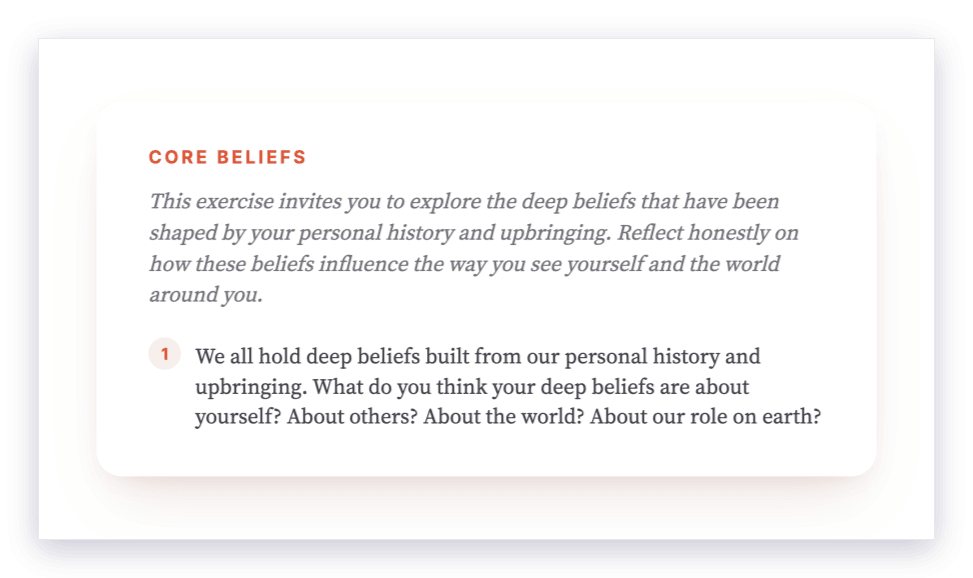
The exercise rests on a single, deliberately broad question that opens four distinct belief domains at once: beliefs about the self, beliefs about others, beliefs about the world, and beliefs about one's role or purpose in life. The patient is invited to reflect on how their personal history and upbringing have shaped each of these areas.
The image above lists the question as it appears in the exercise.
This image is a static preview of the question only. The full guided exercise, including patient-facing instructions and dedicated space to write, is experienced by the patient autonomously inside the app, not here.
The breadth of the question is intentional. By holding all four domains together, it invites patients to notice relational patterns (beliefs about others), worldview assumptions (beliefs about the world), and existential themes (beliefs about purpose) alongside self-referential content. Patients who would dismiss a narrow question about self-worth may find themselves writing at length about what they believe the world expects of them, or what they owe others. Often, that is exactly where the early maladaptive schema sits. Pairing this exercise with the Early Maladaptive Schemas fiche or the Longitudinal Case Formulation (5 Ps) worksheet gives you a richer formulation map to work from.
Key takeaway: A single broad question covering four belief domains often yields richer raw material than a targeted probe, because it gives the patient room to arrive at the core belief from whichever angle feels safest.
750+ clinical tools
A library built with and for clinicians, ready to use in session and extend between appointments.
Access all the toolsUse it with your patients
Share this tool in the mobile app and follow the work between sessions.
How to assign it as between-session work
This exercise is designed as autonomous homework, completed by the patient on their own between two consultations. Assign it when a patient has enough psychological safety to reflect without becoming destabilized, and when your formulation work has reached the point where beliefs, not just symptoms, are the therapeutic focus.
It suits patients working through themes of low self-worth, relational mistrust, chronic self-sacrifice, or persistent meaninglessness. It also opens productive ground before introducing more targeted tools such as The Origins of Beliefs, Tracing the Origin of a Negative Thought to Its Core Belief, or Clarifying a Core Belief.
To introduce it, you might say something like: "Before our next session, I'd like you to spend some quiet time with a few questions about the beliefs you carry, things you've come to take as simply true, about yourself, about others, about life in general." Keep the framing curious, not corrective.
When the patient brings their responses back, resist the urge to immediately reframe. Read aloud what they wrote. Ask where they first learned this. The written material becomes a stable clinical object you can return to across sessions, not a fleeting in-session statement. From there, the Reinforcing a New Core Belief and Replacing a Negative Core Belief exercises provide structured next steps, while the Anxiety and Limiting Beliefs or Depression and Limiting Beliefs programs offer a fuller between-session arc for patients who need sustained psychoeducation alongside the reflective work.
This exercise is available to patients through the mobile application that is the dedicated patient-side interface of SessionFuel: once you assign it inside SessionFuel, your patient receives it directly on their phone and completes it on their own, in their own time, between appointments.
Your session continues in your patients' pocket
Use with a patientYour resources, available everywhere
The handouts, exercises, programs and audios above: you choose which ones to make available to your patients, in the mobile app dedicated to them.
And far more than a library
The app goes well beyond resources, to support your patients every day:
Related categories
Explore other clinical resources by category.

Anxiety
Clinical hub for anxiety disorders: CBT and ACT worksheets, psychoeducation sheets, and exercises for assessment and treatment across the anxiety spectrum.

Mood
Evidence-based worksheets and clinical tools for mood disorders: CBT, ACT, and positive psychology resources for psychologists and therapists.

Identity
Clinical resources for self-identity work in therapy: CBT, ACT, schema tools for clinicians addressing self-concept, core beliefs, and identity disruption.

Behaviours
Clinical hub for behaviors in therapy: worksheets and tools for coping, eating disorders, CBT formulation, and maladaptive behavioral patterns.

Cognition
Printable cognitive therapy worksheets and clinical tools for therapists: CBT, ACT, schema work, defusion, distortions, and belief restructuring.

Build awareness
Clinical worksheets and tools to build awareness in therapy: cognitive distortions, schemas, emotions, ACT and CBT resources for practitioners.