
Clinical picture. A patient in his early forties, referred here as M., presented with persistent low mood following a missed promotion. Between sessions, he reported spending several hours each day rehearsing the thought: 'My manager never respected my work.' The clinician introduced the five-question exercise as a written homework task, asking M. to work through each prompt before the next appointment. On review, M. acknowledged that while the thought had some basis in real events (question 2), it did not prompt any action and consistently led him to discount his own contributions (questions 3 and 4). He concluded on his own that the thought was not constructive, which opened a brief but productive conversation about what a more useful appraisal might look like.
Is This Thought Useful? A Guided Cognitive Evaluation Exercise
A structured five-question homework exercise helping patients assess whether a recurring thought is constructive, legitimate, or simply draining mental space.
Clinical vignettes
Rumination After a Professional Setback
Chronic Self-Doubt in a Young Adult
Clinical picture. A university student referred to as L., aged around twenty, described an intrusive thought that resurfaced before most social interactions: 'People find me boring.' She completed the guided exercise in writing between sessions, noting that she had little concrete evidence to support the thought and that it caused her to withdraw rather than engage (questions 2 and 3). When she reached question 4, she recognised that the thought reliably led her to judge herself harshly. Her written response to the final question was brief: 'No, this thought is not constructive.' This self-generated conclusion gave the following session a clearer starting point for examining avoidance patterns, without requiring the clinician to argue against the belief directly.
The Clinical Problem: Patients Who Cannot Tell the Difference
One of the stickiest challenges in cognitive work is helping patients distinguish between thoughts worth examining and thoughts worth releasing. Many patients arrive with a recurring thought they feel guilty about, unsure whether it signals something real or simply loops without purpose. They already know the thought is unpleasant. What they cannot do, on their own, is apply a clear evaluative lens to it.
Telling a patient "ask yourself whether that thought is useful" during a session rarely produces lasting self-monitoring. The concept slides away. What is needed is a structured self-evaluation framework the patient can apply between appointments, on a concrete thought, at the moment it arises. This exercise was built for exactly that gap. It connects naturally to the broader clinical work of distinguishing constructive from harmful rumination, and complements psychoeducation tools such as the Restructuring Mental Ruminations worksheet.
Use this resource with your patients
Handout, exercises and materials ready to use, right inside SessionFuel.
What the Exercise Contains
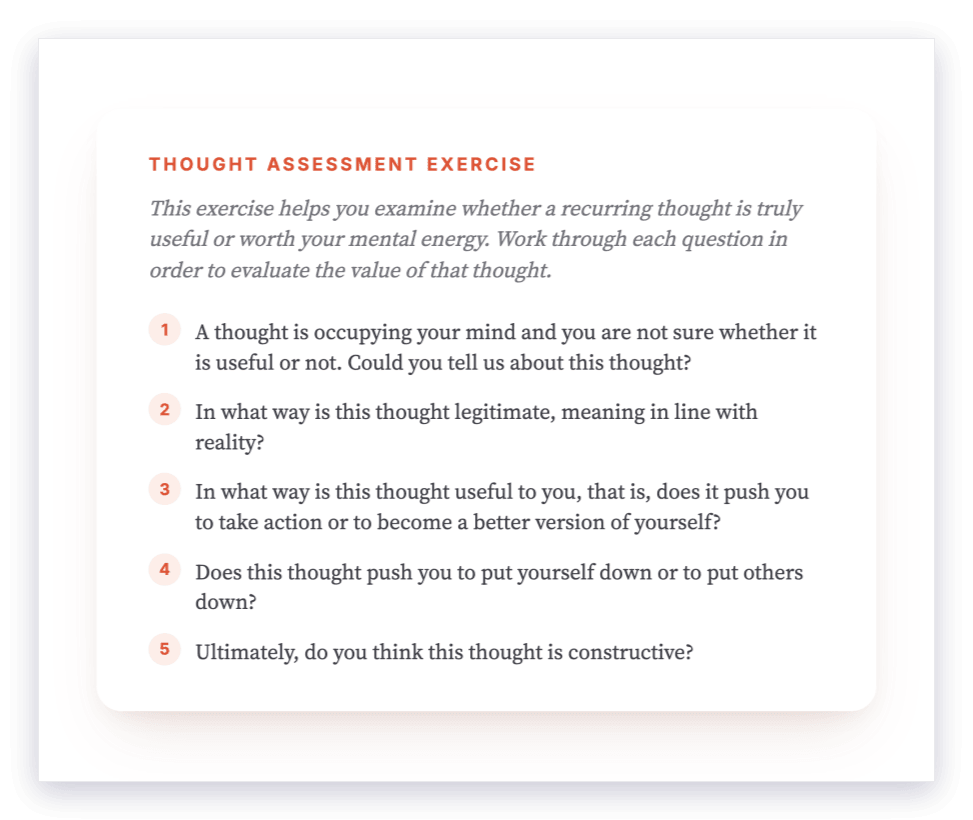
The exercise opens with a grounding question: the patient is invited to name the thought currently occupying their mind, acknowledging upfront that they are unsure whether it is useful. This single move reduces the defensive quality of self-monitoring; the patient is not being asked to judge themselves, only to describe a thought.
The following two questions probe two distinct dimensions of value. Question two asks whether the thought is legitimate, meaning aligned with reality. Question three asks whether it is useful in a functional sense, specifically whether it motivates action or growth. This distinction between accuracy and utility is one that Socratic questioning addresses in session but that patients rarely apply autonomously. Having it written as a concrete prompt changes that.
Question four introduces a self-compassion anchor: does the thought push the patient toward self-deprecation or belittling others? This surfaces the interpersonal and self-critical load of the thought, connecting the exercise to the kind of cognitive distortion work where harsh inner verdicts masquerade as realistic appraisals. Clinicians who work with self-blame or labeling patterns will recognise this step immediately.
The fifth and final question calls for a genuine synthesis: is the thought, on balance, constructive? This is not a rhetorical nudge but an open invitation, and what the patient writes there is often the most clinically rich material to bring back to session.
The image above lists the five questions in sequence with their brief orienting intro. This is a static preview only: the patient does not interact with this image. The full guided experience, with patient-facing instructions and space to respond, is completed autonomously in the app between sessions, not through this preview.
This exercise is available to patients through the patient mobile application of SessionFuel: once you assign it in your SessionFuel account, your patient receives it directly on their phone and completes it on their own, at their own pace, between sessions.
750+ clinical tools
A library built with and for clinicians, ready to use in session and extend between appointments.
Access all the toolsUse it with your patients
Share this tool in the mobile app and follow the work between sessions.
How to Assign It and Make Use of What Patients Bring Back
This exercise suits a wide range of patients: those prone to ruminative loops who have already been introduced to thought monitoring, those working on automatic thought identification, and those who over-justify their negative thinking by framing it as "realistic." It also pairs well after a session where you have introduced the fact versus opinion distinction or explored worry and attentional capture.
Key insight: The five-question sequence teaches patients to hold a thought at arm's length and rate it on two independent axes, legitimacy and utility, before the self-critical loop can close.
To introduce it, you might say: "Between now and our next meeting, if you notice a thought that keeps coming back and you are unsure what to do with it, I would like you to put it through these five questions on your own." This framing positions the exercise as active self-monitoring homework, not a reflective journal.
When the patient returns, their written answers give you a clinical entry point that is richer than recall alone. Focus on the gap between questions two and three: a thought can be partially accurate but still functionally corrosive. That tension is where productive cognitive restructuring begins. For patients where the exercise surfaces persistent loops, the Rumination: A Guided Self-Monitoring Exercise or the Rumination Psychoeducation Program can follow as a natural next step. For those whose answers reveal a strong self-deprecating pull, the Feeling Not Good Enough exercise or work on core beliefs may be indicated.
Your session continues in your patients' pocket
Use with a patientYour resources, available everywhere
The handouts, exercises, programs and audios above: you choose which ones to make available to your patients, in the mobile app dedicated to them.
And far more than a library
The app goes well beyond resources, to support your patients every day:
Related categories
Explore other clinical resources by category.

Anxiety
Clinical hub for anxiety disorders: CBT and ACT worksheets, psychoeducation sheets, and exercises for assessment and treatment across the anxiety spectrum.

Mood
Evidence-based worksheets and clinical tools for mood disorders: CBT, ACT, and positive psychology resources for psychologists and therapists.

Identity
Clinical resources for self-identity work in therapy: CBT, ACT, schema tools for clinicians addressing self-concept, core beliefs, and identity disruption.

Emotions
Clinical resources on emotion regulation: worksheets, coping tools, CBT, REBT, and ACT exercises for therapists working across diagnoses and age groups.

Behaviours
Clinical hub for behaviors in therapy: worksheets and tools for coping, eating disorders, CBT formulation, and maladaptive behavioral patterns.

Cognition
Printable cognitive therapy worksheets and clinical tools for therapists: CBT, ACT, schema work, defusion, distortions, and belief restructuring.