
Clinical picture. T., a woman in her mid-thirties, presented with generalised anxiety and a recent episode of acute distress following a procedural mistake at work. She described a rapid cascade of automatic thoughts centred on incompetence and anticipated dismissal. The clinician introduced the two-column worksheet, asking her to write the thought verbatim in the left column: "I ruined everything; they will fire me because I cannot do my job." In the session, T. was guided to populate the right column with specific counter-evidence, noting that her performance reviews had been positive and that one error had not previously altered her standing. She rated the original thought as 80% believable before the exercise and 45% after, a modest but clinically meaningful shift that the clinician framed as a starting point rather than a resolution.
Countering Negative Thoughts: PDF Worksheet, Tools and Exercises
A structured PDF worksheet clinicians can use as a visual support in session to explain cognitive countering, build a shared vocabulary, and give patients a concrete take-home reference.
Clinical vignettes
Thought Log After a Work Error
Labelling Thought in Relational Context
Clinical picture. M., a man in his late forties referred for low mood following marital conflict, reported a persistent self-label of "irresponsible" after his partner expressed frustration over a forgotten household task. The clinician used the worksheet to help M. first capture the thought exactly as it had sounded: "I forgot again; I am completely irresponsible." Together, they identified the cognitive distortion as labelling and examined the actual evidence, including M.'s consistent management of family finances and medical appointments over many years. The counter he drafted was deliberately proportionate: he had missed one task on one day, and that did not constitute a character trait. M. noted that the exercise felt less like positive thinking and more like cross-examination, which he found credible enough to practise between sessions.
Most patients can follow a verbal explanation of automatic thoughts in session. Very few can construct a genuine counter on their own, the first time, without either softening the original thought before examining it or producing a reply so optimistic it rings false. This PDF worksheet on countering negative thoughts gives you a structured visual support to walk through the two-column technique in session, and a concrete reference the patient carries home.
Use this resource with your patients
Handout, exercises and materials ready to use, right inside SessionFuel.
Why Countering Negative Thoughts Resists Oral Explanation
The difficulty isn't primarily conceptual. Patients understand, broadly, that automatic thoughts may be distorted. What they don't know is how to catch one verbatim without immediately editing it toward something more socially acceptable, and how to build a reply that the brain accepts rather than rejects as a hollow affirmation.
There is also a metacognitive confusion worth naming: many patients treat a distressing thought as a fact requiring disproof rather than an interpretation requiring a fairer alternative. When you explain this distinction verbally, it tends to dissolve the moment affect rises. A shared diagram on the table keeps the frame stable. You both have something to point at, and the patient can return to it between sessions without having to reconstruct your explanation from memory.
A third resistance point is believability. Forcing a positive counter that the patient cannot yet endorse actually reinforces the original thought by demonstrating that no alternative sticks. The worksheet addresses this directly, but only if the instruction is visible, not just spoken.
What's Inside the Worksheet: A Visual Scaffold for the Session
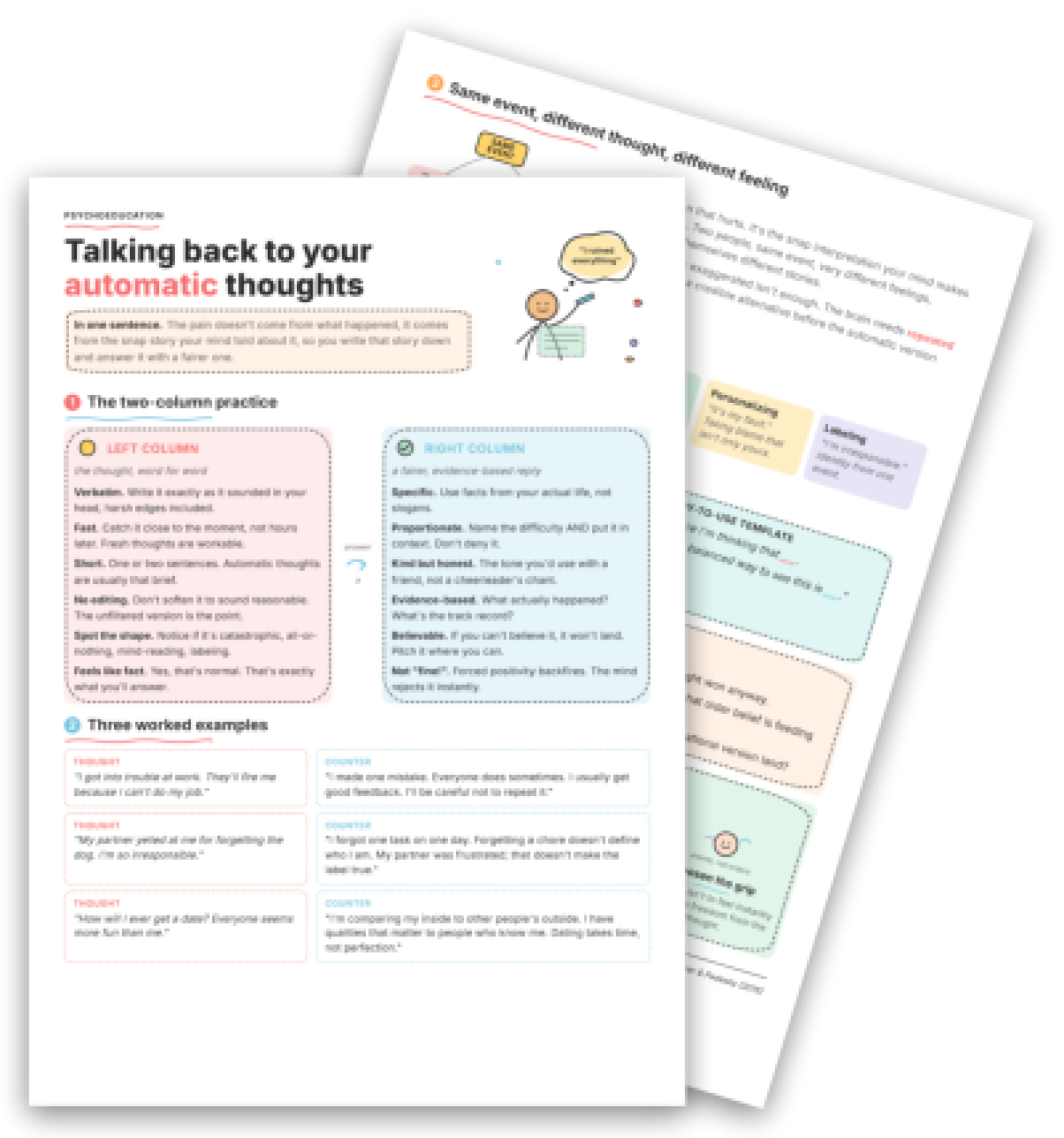
The fiche centers on what it calls "the two-column practice". The left column holds the automatic thought written verbatim, "harsh edges included." The right holds a fairer, evidence-based reply. Six guidance points accompany each column, covering capture timing, length discipline, the trap of pre-editing (left column), and the critical distinction between genuine balance and what the fiche names "empty positivity" (right column). Seeing both columns side by side makes the asymmetry between distorted cognition and a workable alternative immediately visible, in a way that a verbal description rarely achieves.
Three worked examples model the expected output concretely: "I made one mistake. Everyone does sometimes. I usually get good feedback." A separate panel shows the same event producing shame under the thought "I ruined it" and resolve under "I'll learn", which is the cognitive mediation principle rendered graphic rather than explained. This is particularly useful with patients who intellectually accept the principle but cannot apply it somatically.
The five common distortions section (catastrophizing, all-or-nothing thinking, mind reading, personalizing, labeling) functions as an in-session identification grid. Five counter-building questions (including "What would I say to a friend in this exact spot?") give patients a heuristic scaffold they can replicate without the clinician present. A ready-to-use template closes the technique section: "I notice I'm thinking that ___. A more balanced way to see this is ___."
The "To discuss in session" prompts at the bottom are explicitly not patient homework. They flag three clinical moments worth debriefing: when the counter felt fake, when the same thought appears week after week in the left column, and when the patient can write the rational reply but still doesn't believe it. Each of those is a different clinical problem, pointing respectively toward a believability gap, a core belief maintaining the distortion, or an insufficient behavioral evidence base.
> Key takeaway: This worksheet is a visual support that facilitates the explanation of cognitive countering in session. The clinician uses it to make the technique concrete and scaffolded; the patient takes it home as a reference, not a form to fill out alone.
750+ clinical tools
A library built with and for clinicians, ready to use in session and extend between appointments.
Access all the toolsWhen and How to Introduce the Worksheet
The fiche fits naturally into early-to-mid CBT work, once you have introduced the cognitive model and the cognitive triangle, and before you move toward restructuring deeply held core beliefs. It works well in session two or three of a standard CBT protocol, after the initial case formulation.
It is also a good companion to the Catching Your Thoughts fiche. Propose that one first to consolidate thought-monitoring, then introduce countering once the patient can reliably capture thoughts in writing.
For profiles with perfectionism or high standards, frame the exercise carefully: the goal is not the perfect counter but a believable one. For patients prone to experiential avoidance, the worksheet creates productive distance from the thought without requiring full defusion, which makes it a useful bridge before ACT-based defusion techniques.
A useful introduction: "I'd like us to look at a simple structure together. We're going to write down the thought exactly as it sounded, then build an answer that's fair rather than cheerful. There's no right answer, just something you can actually believe."
Debrief by going directly to the "To discuss in session" prompts at the bottom of the fiche. If the counter felt empty, that is your next clinical data point, not a failure of the exercise. The worksheet does not replace the therapeutic frame; it makes the explanation clear and leaves the patient with a working reference they can use before the next appointment.
Use it with your patients
Share this tool in the mobile app and follow the work between sessions.
Sources
- Beck, A. T., Rush, A. J., Shaw, B. F., Emery, G. (1979). Cognitive Therapy of Depression. Guilford Press.
- Burns, D. D. (1980). Feeling Good: The New Mood Therapy. William Morrow.
- Greenberger, D., Padesky, C. A. (2016). Mind Over Mood: Change How You Feel by Changing the Way You Think (2nd ed.). Guilford Press.
- Beck, J. S. (2021). Cognitive Behavior Therapy: Basics and Beyond (3rd ed.). Guilford Press.
- NHS Every Mind Matters. Thought Record CBT Exercise.
Your session continues in your patients' pocket
Use with a patientYour resources, available everywhere
The handouts, exercises, programs and audios above: you choose which ones to make available to your patients, in the mobile app dedicated to them.
And far more than a library
The app goes well beyond resources, to support your patients every day:
Related categories
Explore other clinical resources by category.

Anxiety
Clinical hub for anxiety disorders: CBT and ACT worksheets, psychoeducation sheets, and exercises for assessment and treatment across the anxiety spectrum.

Mood
Evidence-based worksheets and clinical tools for mood disorders: CBT, ACT, and positive psychology resources for psychologists and therapists.

Identity
Clinical resources for self-identity work in therapy: CBT, ACT, schema tools for clinicians addressing self-concept, core beliefs, and identity disruption.

Cognition
Printable cognitive therapy worksheets and clinical tools for therapists: CBT, ACT, schema work, defusion, distortions, and belief restructuring.

Build awareness
Clinical worksheets and tools to build awareness in therapy: cognitive distortions, schemas, emotions, ACT and CBT resources for practitioners.

Restructure
Clinical hub for cognitive restructuring worksheets: distortion identification, belief disputation, ABC model, and schema work for evidence-based practice.