
Clinical picture. T., a woman in her mid-forties, presented with persistent low mood and intrusive thoughts following her father's death from a cardiac event; she repeated, across several sessions, that she should have insisted he see his cardiologist sooner. The clinician introduced the psychoeducational sheet on self-blame and walked her through the pie chart exercise, asking her to list every contributing factor before assigning her own slice. T. identified her father's longstanding resistance to medical appointments, a three-week wait for an available slot, and an underlying arrhythmia diagnosed only at autopsy. When she added her own slice last, she allocated herself roughly eight percent of the pie; she sat quietly for a moment and said it was the first time the thought had felt "proportionate rather than total." Shame did not disappear, but she was able to move into a more action-oriented grief process in subsequent sessions.
Self-Blame: PDF Worksheet, Tools and Exercises for Clinical Practice
A printable PDF worksheet with tools and exercises to explain self-blame clearly in session, separate guilt from shame, and introduce the responsibility pie chart as a psychoeducation tool.
Clinical vignettes
Pie Chart Shifts Attribution in Grief
Naming the Characterological Voice
Clinical picture. M., a man in his early thirties with recurrent depressive episodes, described blaming himself for a relationship breakdown using language that was strikingly global: "I ruin everything, it's just who I am." The clinician used the two-flavour distinction from the informational sheet to help M. notice the difference between "I handled that conversation badly" and "I am fundamentally defective," and they mapped his habitual statements onto the characterological column together. M. recognised that the second type of thought closed off any route to repair, whereas the first, however uncomfortable, at least pointed somewhere. Over the following two sessions he began catching the characterological formulation in real time and redirecting it toward a more specific, behavioural account of what had occurred. Progress was modest and uneven, consistent with the depth of the pattern, though he reported the distinction itself as clinically useful.
Self-blame is one of those cognitive distortions patients nod at when you name it, then re-enact five minutes later. The verbal explanation rarely sticks because the pattern runs on affect and automaticity, not on insight alone. This fiche PDF gives you a structured visual support to make the distinction between behavioural guilt and characterological shame concrete enough to actually work with in session.
Use this resource with your patients
Handout, exercises and materials ready to use, right inside SessionFuel.
Why Self-Blame Resists Oral Explanation
The specific clinical difficulty is this: patients who over-blame themselves tend to hold an implicit equation between feeling responsible and being responsible. When you introduce the concept verbally, they agree intellectually, then pivot straight to "but in my case, I really was to blame." The distortion is not purely cognitive; it carries a hidden functional payoff the fiche names directly: a false sense of control ("if it's me, maybe I can prevent it next time"), an internalised critical voice shaped by early relational conditioning, and sometimes a protective attachment function ("better me at fault than them").
Without a visual map, each of these mechanisms can feel abstract. Laying them out spatially, in front of the patient, shifts the register from self-report to collaborative observation. The conceptual confusion patients bring most often is between guilt (linked to a specific behaviour, time-limited, actionable) and shame (global, identity-level, with no available way out). That distinction is very hard to hold in working memory during an emotionally charged conversation, which is exactly where a support visuel changes the dynamic.
750+ clinical tools
A library built with and for clinicians, ready to use in session and extend between appointments.
Access all the toolsWhat the Fiche Contains
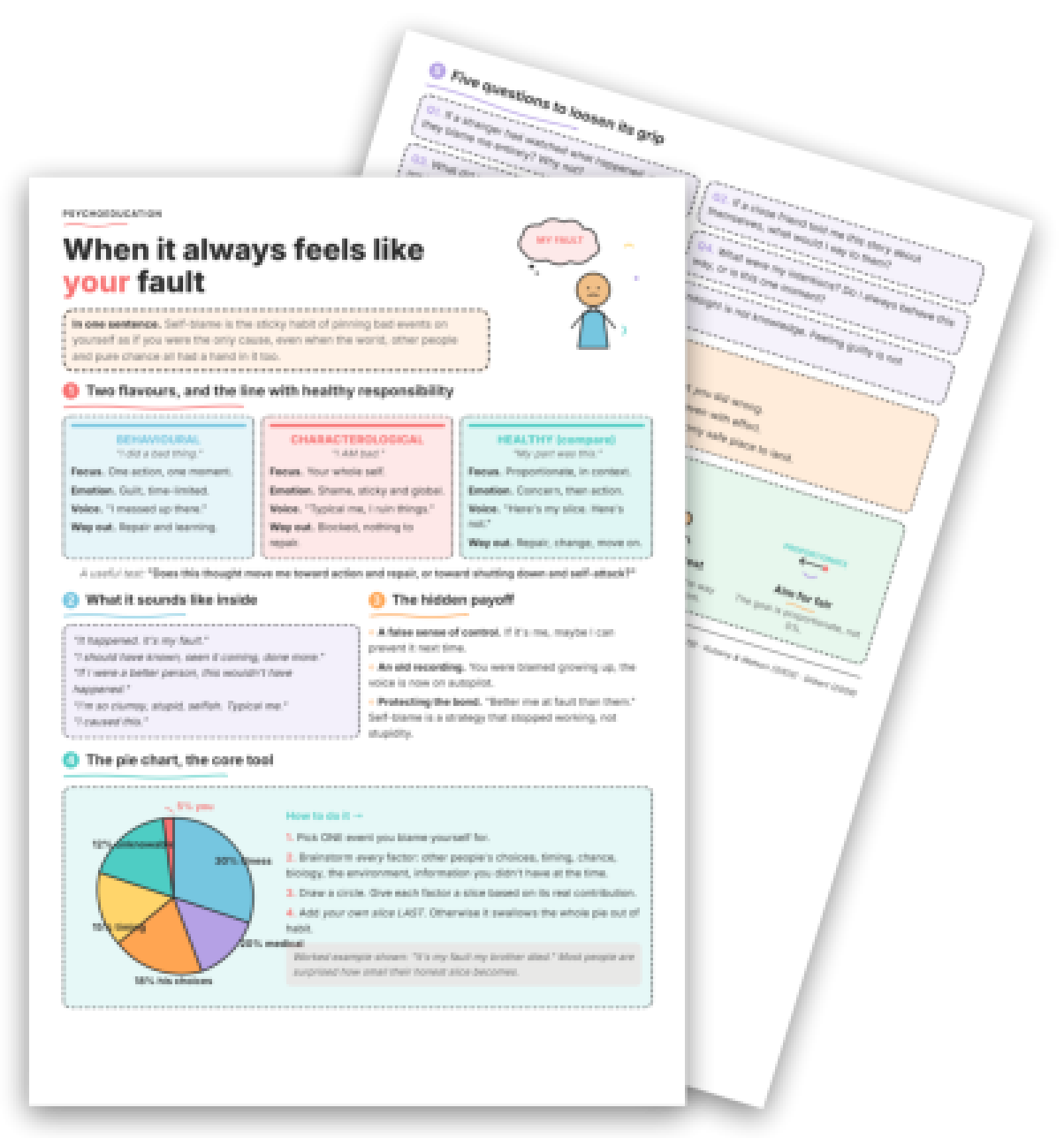
The fiche opens with a one-sentence anchor: "Self-blame is the sticky habit of pinning bad events on yourself as if you were the only cause, even when the world, other people and pure chance all had a hand in it too." That framing becomes an immediately shareable reference point with the patient.
The first panel presents a three-column comparison: behavioural self-blame ("I did a bad thing"), characterological self-blame ("I AM bad"), and healthy responsibility ("my part was this"). Each column specifies the focus, the associated emotion, the internal voice, and the available way out. Seeing this structure side by side does what verbal description cannot: it makes the architectural difference between guilt and shame visible at a glance. You can point directly to the "way out" row and invite the patient to locate themselves.
The centrepiece is the responsibility pie chart, a classic cognitive restructuring tool for self-blame. Patients brainstorm every contributing factor (other people's choices, timing, chance, biology, information they lacked at the time), assign each factor a proportionate slice, and add their own slice last. The fiche is explicit: "Add your own slice LAST. Otherwise it swallows the whole pie out of habit." A worked example ("It's my fault my brother died") normalises the exercise without minimising distress. This visual format is precisely what makes the personalising cognitive distortion so hard to sustain once the exercise is complete.
A panel of five Socratic questions complements the pie: checking whether a neutral observer would assign full blame, applying the friend test, distinguishing what was actually known at the time from hindsight bias, and separating intention from outcome. The fiche closes with a "Remember" panel covering four moves: name the thought, draw the pie, apply the friend test, and aim for proportionate responsibility rather than zero.
> To note: this fiche is a visual support that facilitates the in-session explanation of self-blame; it is not a self-administered questionnaire. The clinician uses it to point, prompt, and establish a shared vocabulary, then leaves the patient a concrete reference to take home.
Use it with your patients
Share this tool in the mobile app and follow the work between sessions.
When and How to Introduce It
The fiche is best introduced once the therapeutic alliance is solid enough for the patient to tolerate having a pattern named. A second or third session is generally early enough when the presenting complaint clearly involves self-criticism or guilt work. In post-trauma contexts, wait until the stabilisation phase is well under way: applying the pie chart to a traumatic event before sufficient grounding is in place can be destabilising. For those presentations, the common reactions to trauma fiche is a useful precursor.
Good candidate profiles include: chronic self-blame linked to low self-esteem, the defectiveness schema (see the punitiveness schema for a close companion presentation), post-bereavement guilt, and self-blame following interpersonal ruptures. The fiche also reinforces prior work on broader cognitive distortion patterns, and it pairs naturally with sessions targeting emotional reasoning, where feeling guilty is treated as evidence of guilt.
Introduce it without labelling: "I'd like to show you something that maps a pattern I think we've been circling around. Let's look at it together." Walk the three-column panel before moving to the pie chart. Debrief by asking where the patient placed themselves in the columns and what their honest slice felt like to construct. Watch for patients whose slice remains at 100% despite the exercise: that persistence is clinically meaningful, and worth exploring alongside shame-focused work or through the lens of the making mistakes self-compassion exercise as between-session consolidation. For a deeper structured follow-up, the Guilt Psychoeducation Program extends this work across multiple sessions.
The fiche does not replace case formulation, but it gives the patient a portable visual shorthand they can return to between sessions, which is where cognitive shifts actually consolidate.
Your session continues in your patients' pocket
Use with a patientYour resources, available everywhere
The handouts, exercises, programs and audios above: you choose which ones to make available to your patients, in the mobile app dedicated to them.
And far more than a library
The app goes well beyond resources, to support your patients every day:
Related categories
Explore other clinical resources by category.
Trauma
Clinical hub on trauma and PTSD: assessment, differential diagnosis, treatment phases, and printable resources for practitioners. 155 chars.
Mood
Evidence-based worksheets and clinical tools for mood disorders: CBT, ACT, and positive psychology resources for psychologists and therapists.

Identity
Clinical resources for self-identity work in therapy: CBT, ACT, schema tools for clinicians addressing self-concept, core beliefs, and identity disruption.

Cognition
Printable cognitive therapy worksheets and clinical tools for therapists: CBT, ACT, schema work, defusion, distortions, and belief restructuring.

Understand
Clinical hub for the therapeutic aim 'Understand': worksheets and tools to build patient insight across CBT, ACT, schema therapy and more.

Build awareness
Clinical worksheets and tools to build awareness in therapy: cognitive distortions, schemas, emotions, ACT and CBT resources for practitioners.