
Clinical picture. M., a 38-year-old project manager, presented with persistent irritability and difficulty concentrating, partly linked to a pattern of prolonged self-attack following minor professional mistakes. During a session focused on schema work, the clinician introduced the punitiveness informational sheet and invited M. to read the typo-spiral vignette aloud. M. recognised the pattern immediately, noting that after a recent reporting error she had spent the better part of two days replaying the moment and had been unable to engage with her family that evening. Using the punitiveness-versus-accountability comparison on the sheet, the clinician and M. mapped her internal monologue onto the left-hand column, which M. found clarifying rather than shaming. By the close of the session she could articulate, tentatively, that the goal of her inner voice seemed to be pain rather than repair, a distinction she said she had not previously been able to name.
Punitiveness Schema: PDF Worksheet, Tools and Exercises
A visual PDF worksheet with tools and exercises to help clinicians explain the punitiveness schema, contrast it with healthy accountability, and give patients a concrete in-session anchor.
Clinical vignettes
Replay Loop After a Minor Work Error
Withheld Forgiveness in Couples Context
Clinical picture. R., a 52-year-old referred for individual therapy following a marital crisis, described a recurring impasse in which he heard his partner's apologies but felt unable to respond with any softening, a pattern his partner experienced as punishment by silence. The clinician used the punitiveness schema sheet to introduce the idea that the refusal to soften can function as a debt-collection mechanism rather than a protective boundary. R. was initially resistant, framing his stance as reasonable standards, and the clinician acknowledged that boundary and accountability are legitimate while drawing his attention to the sheet's cost row: warmth dies, honesty stalls, nothing is learned. Over the following two sessions R. began distinguishing between a firm, forward-facing response and a verdict with no repair pathway, language he borrowed directly from the handout. Progress remained gradual, though he reported one instance of accepting a repair attempt without immediate counter-prosecution, which he described as effortful but not impossible.
The punitiveness schema is one of the harder schemas to name in session because patients don't experience it as a schema, they experience it as justice. This PDF worksheet gives you a visual anchor to distinguish the punitive stance from genuine accountability, making the psychoeducation land rather than slide off.
Use this resource with your patients
Handout, exercises and materials ready to use, right inside SessionFuel.
Why the Punitiveness Schema Resists Oral Explanation
The core difficulty is ego-syntonic presentation. Patients high on the punitiveness schema (Young, 2003) arrive convinced that their cold, unforgiving inner stance, toward themselves or toward others, is simply "having standards." The self-attack after a minor mistake feels like moral clarity, not pathology. Naming it as a schema meets immediate resistance: "But they really did mess up" or "I should have known better."
Working orally, you can describe the distinction between punitiveness and accountability, but the moment the patient hears it, their punitive voice reframes it as you defending mediocrity. What helps is a concrete visual contrast that externalizes the voice and makes its characteristic logic visible, before the patient has a chance to collapse the distinction. That is exactly what this fiche PDF is built to do.
What the Fiche Contains: A Visual Map of the Punitive Voice
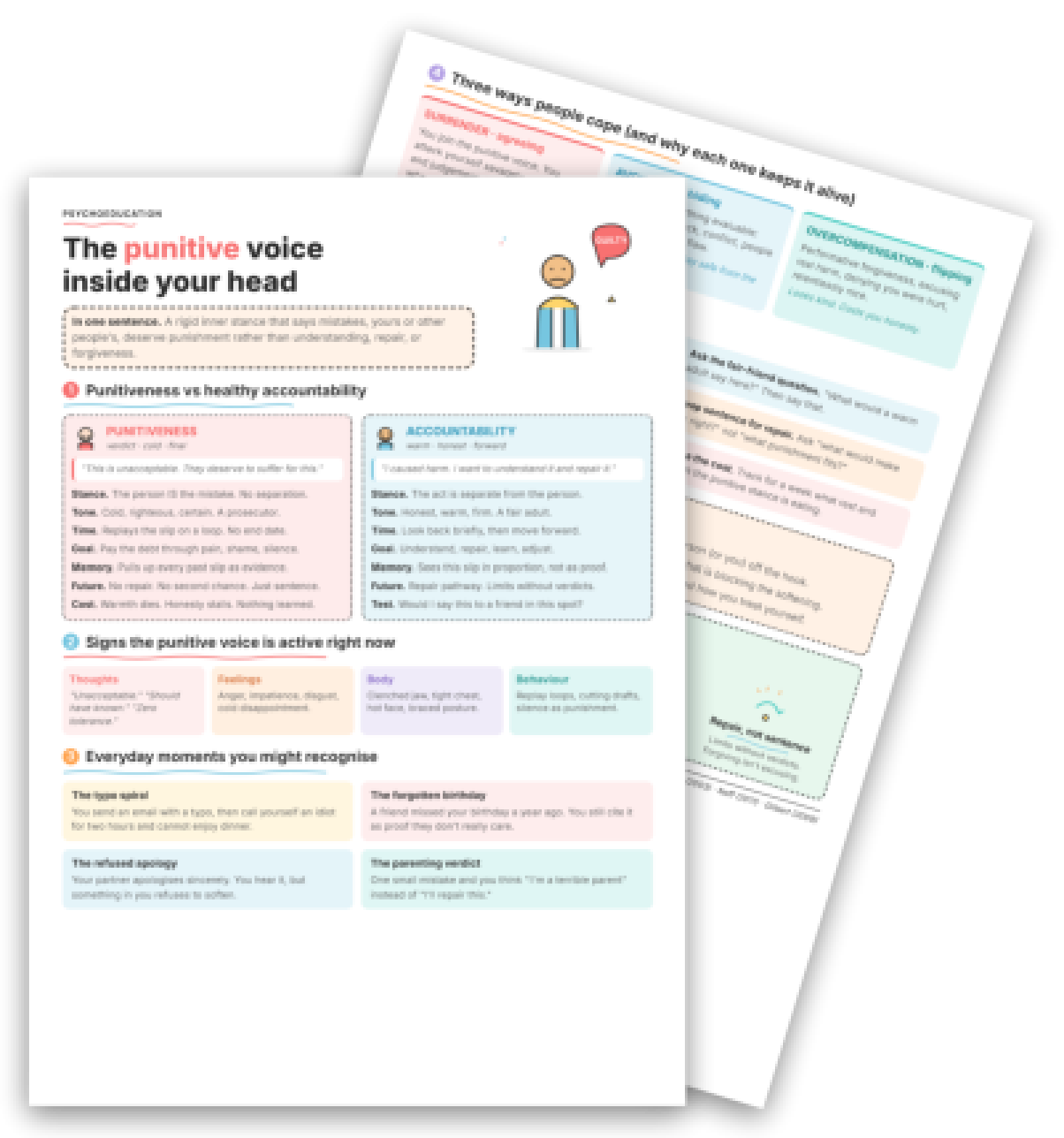
The fiche opens with a definition the patient can read alongside you: "A rigid inner stance that says mistakes, yours or other people's, deserve punishment rather than understanding, repair, or forgiveness." That sentence is clinically useful because it captures the relational scope, the schema operates on both self-directed and other-directed judgment.
The structural heart of the support is a two-column comparison between Punitiveness and Accountability across seven dimensions: stance, tone, time horizon, goal, memory use, vision of the future, and cost. The visual layout makes the contrast impossible to dismiss. Patients can see at a glance that punitiveness is "verdict · cold · final" while accountability is "warm · honest · forward," and that the punitive mode "replays the slip on a loop" with "no end date." That temporal dimension is often what breaks through: the loop finally has a name and a shape.
The fiche then maps signs the punitive voice is active across four channels: thoughts ("Unacceptable." "Zero tolerance."), feelings (cold disappointment, disgust), body (clenched jaw, braced posture), and behavior (silence as punishment, replay loops). The somatic column is particularly useful with patients who intellectualize, it grounds all-or-nothing thinking patterns in proprioception, not just cognition.
A third section offers four everyday vignettes, the typo spiral, the forgotten birthday, the refused apology, the parenting verdict, calibrated to feel ordinary, not clinical. Patients recognize themselves in one without having to endorse a schema label. Section 4 maps the three coping modes (surrender, avoidance, overcompensation) in plain language, directly aligned with Young's framework as covered in the Coping Styles in Schema Therapy fiche. Section 5 offers six softening exercises, including the "fair-friend question" and "swap sentence for repair", phrases you can lift directly into session dialogue.
> To retain: this fiche is a visual support that facilitates the in-session explanation of the punitiveness schema; it gives patients a concrete map to take away, not a questionnaire to fill in alone.
750+ clinical tools
A library built with and for clinicians, ready to use in session and extend between appointments.
Access all the toolsWhen and How to Introduce the Fiche
The fiche fits naturally from session two or three onward, once the alliance is established and you have behavioral data suggesting punitiveness is active. Strong indicators: perfectionism, chronic guilt (the Guilt Psychoeducation program pairs well here), difficulty accepting sincere apologies, or cold self-attack after perceived failures. You can introduce it simply: "I want to share something that describes a pattern I've been noticing in what you're telling me. We'll look at it together."
Walk through the Punitiveness vs. Accountability columns before the patient reads independently. The comparative layout invites them to locate themselves rather than be diagnosed. Debrief by asking which column feels most familiar and which body signal they recognize first. The "To discuss in session" prompts at the bottom, refusal to soften after a sincere apology, the fair-friend gap, give you three specific hooks for deeper early maladaptive schema work in subsequent sessions.
For patients carrying shame or defectiveness themes, pair this fiche with self-compassion exercises or the Accepting Mistakes exercise as between-session work. For other-directed punitiveness, entrenched resentment, person-level condemnation, the Forgiveness in Therapy fiche offers a natural next step. For patients whose punitive inner dialogue is pervasive across schemas, the Inner Self-Talk program provides a fuller psychoeducation arc.
The fiche doesn't replace schema mode work or the therapeutic relationship. It makes the conceptual architecture visible early enough to give both of you a shared vocabulary for what follows.
Use it with your patients
Share this tool in the mobile app and follow the work between sessions.
Sources
- Young, J. E., Klosko, J. S., & Weishaar, M. E. (2003). Schema Therapy: A Practitioner's Guide. Guilford Press.
Your session continues in your patients' pocket
Use with a patientYour resources, available everywhere
The handouts, exercises, programs and audios above: you choose which ones to make available to your patients, in the mobile app dedicated to them.
And far more than a library
The app goes well beyond resources, to support your patients every day:
Related categories
Explore other clinical resources by category.

Identity
Clinical resources for self-identity work in therapy: CBT, ACT, schema tools for clinicians addressing self-concept, core beliefs, and identity disruption.

Cognition
Printable cognitive therapy worksheets and clinical tools for therapists: CBT, ACT, schema work, defusion, distortions, and belief restructuring.

Understand
Clinical hub for the therapeutic aim 'Understand': worksheets and tools to build patient insight across CBT, ACT, schema therapy and more.

Build awareness
Clinical worksheets and tools to build awareness in therapy: cognitive distortions, schemas, emotions, ACT and CBT resources for practitioners.
Repair & soothe
Clinical resources for the repair and soothe therapeutic aim: worksheets, exercises and tools to build self-compassion, reduce shame and restore emotional safety.
CBT
CBT worksheets, cognitive restructuring exercises & behavioral tools for clinicians. Evidence-based resources for every phase of cognitive behavioral therapy.