
Clinical picture. A., a woman in her early forties, was referred for generalised anxiety following a prolonged conflict with a former manager who she felt had publicly undermined her work and ended her contract unfairly. Two years on, she reported waking at 3 a.m. rehearsing arguments, checking the manager's professional profile most evenings, and retelling the story to new acquaintances within minutes of meeting them. The clinician introduced the hook metaphor using the psychoeducational sheet, inviting A. to consider who was still paying the daily cost of remaining on the hook. A. identified, with some surprise, that the manager had since been promoted and showed no apparent distress, while she herself remained physiologically activated at any workplace reminder. By the following session, A. noted one full day in which the manager had not crossed her mind, and described this as the first concrete evidence that loosening was possible, without any requirement to reframe what had happened as acceptable.
Unforgiveness: The Hook, PDF Worksheet, Tools and Exercises
A printable PDF fiche, tools, and exercises helping clinicians explain unforgiveness, its internal mechanisms, and the multiple routes to releasing it in session.
Clinical vignettes
Rumination After a Workplace Betrayal
Unforgiveness Confused With Loyalty
Clinical picture. M., a man in his mid-fifties, had been estranged from his adult son for six years following a significant breach of trust involving money and deceit. He entered therapy explicitly stating he had no intention of forgiving, and framed sustained anger as proof that the betrayal had been serious. The clinician used the worksheet's distinction between the internal act of loosening the hook and any external gesture of reconciliation, clarifying that getting off the hook does not require letting the other person back in. M. had conflated forgiveness with minimising the harm done and with re-exposing himself to further hurt; separating those ideas allowed him to examine, for the first time, what carrying the hook was costing him physically and relationally. He did not move toward reconciliation, but reported reduced ruminative thinking over four subsequent sessions and described choosing how to spend his attention rather than having the estrangement silently govern his days.
The clinical difficulty with unforgiveness is not explaining what it is. It is getting past the patient's immediate conviction that releasing resentment means excusing, forgetting, or extending a hand to someone who caused real harm. This fiche PDF gives the concept a visual architecture that short-circuits that misreading before it closes down the conversation.
Use this resource with your patients
Handout, exercises and materials ready to use, right inside SessionFuel.
Why unforgiveness resists explanation in session
Patients carrying chronic resentment often arrive with two competing pressures already in place: people around them are urging them to "just forgive," and that advice lands as a demand to betray themselves. Any clinical conversation that sounds like more of the same pressure will hit the same wall.
What oral explanation also consistently fails to land: the asymmetry. The offender has likely moved on, perhaps forgotten entirely. The patient is still paying the daily cost, rehearsing the same argument at 3am, tensing at a name, organizing whole areas of their life around the wound. That gap between who is suffering and who caused the suffering is easy to state and hard to make felt in words alone. A visual support changes that.
There is also a category confusion that talking rarely resolves cleanly: conflating an internal act with a relational one. Patients hear "let go" and picture a phone call, a handshake, or a silent agreement that the harm was acceptable. The fiche separates those two levels on the page, where the patient can actually see them. This is the core reason to use it.
What the fiche contains
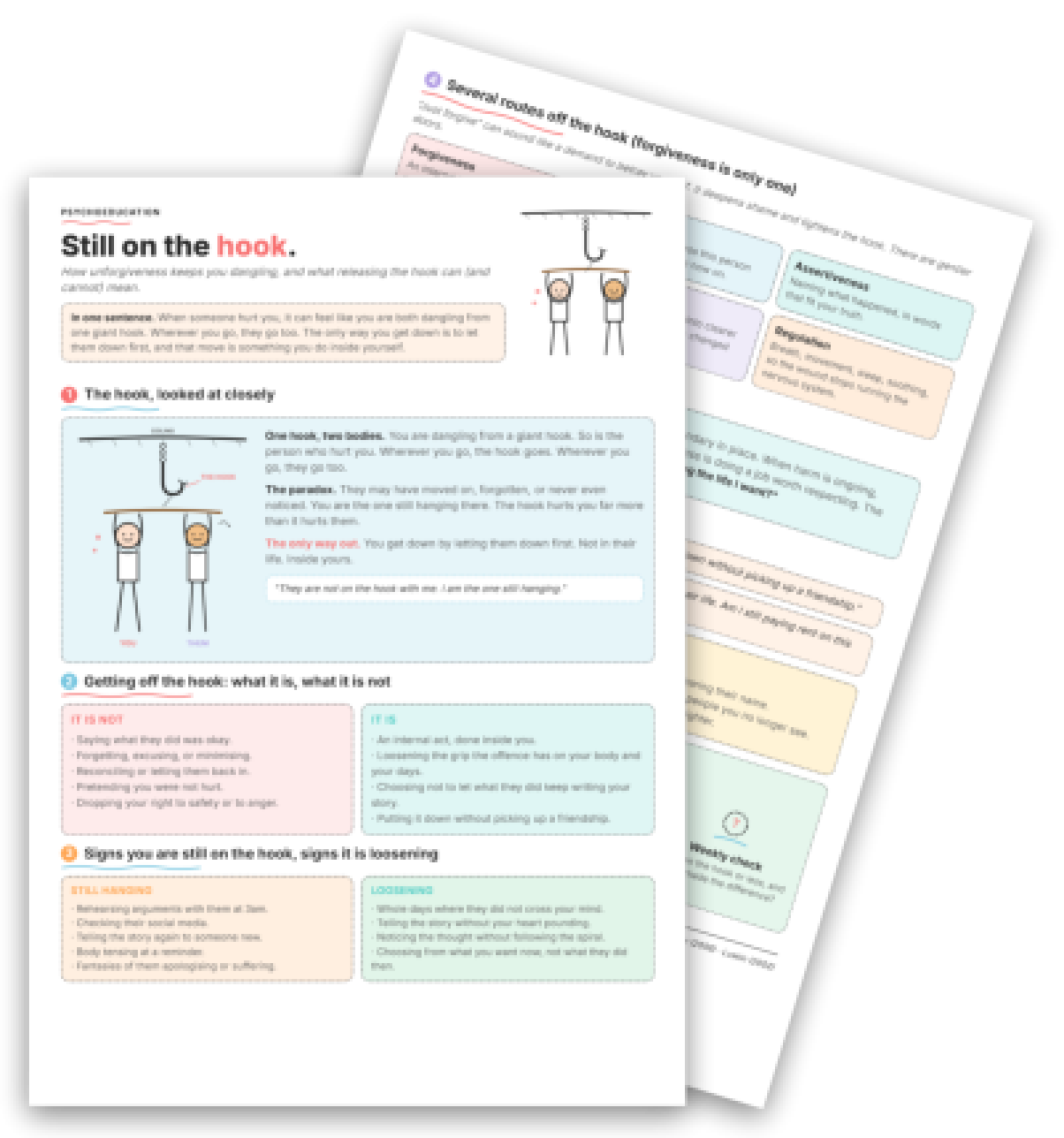
The entire resource is built around a single central image: one hook, two bodies. "You are dangling from a giant hook. So is the person who hurt you." That diagram does the conceptual work faster than several minutes of explanation. Six panels develop the metaphor:
- The hook examined: the paradox that the offender has moved on while the patient is still hanging.
- What releasing means and what it does not: two explicit columns distinguishing internal letting-go from excusing, forgetting, or reconciling. This directly addresses the most common clinical obstacle.
- Signs still on the hook versus signs it is loosening: behavioral and somatic self-monitoring indicators, from checking the person's social media and body tensing at a reminder, to "whole days where they did not cross your mind."
- Several routes off the hook: forgiveness is presented as one door among six, alongside setting personal limits, assertiveness, acceptance, meaning, and somatic regulation. For patients who feel blocked by the word "forgiveness" itself, this panel reframes the work entirely. It pairs well with the broader forgiveness in therapy toolkit and the how to forgive fiche.
- When the hook is also a harness: a nuanced panel acknowledging that sustained anger can be protective. The fiche frames the clinical question not as "should I let go?" but as "is this still serving the life I want?" This is particularly important for patients with trauma histories, ongoing harm, or a situation where anger is the only boundary currently in place. It connects naturally to anger iceberg work and to radical acceptance.
- Inner phrases that loosen the grip: six short formulations the patient can carry between sessions, including "Releasing them is not absolving them." and "They are living their life. Am I still paying rent on this pain?"
A "To discuss in session" block closes the fiche with three structured prompts, plus a weekly check-in question. You can use these directly as a debrief guide rather than leaving the patient to process the material alone.
> To note: This fiche is a visual support that facilitates explanation in session, not a self-help handout to complete independently. The hook diagram and the side-by-side panels make abstract distinctions concrete on the page, freeing session time for the patient's specific situation rather than concept clarification.
750+ clinical tools
A library built with and for clinicians, ready to use in session and extend between appointments.
Access all the toolsWhen and how to introduce it
The fiche fits naturally once a patient names a person they cannot stop thinking about, resent, or feel controlled by, even without using the word "forgiveness." You do not need to frame it as a forgiveness exercise. A low-pressure introduction: "There's a way of looking at this I'd like to show you. It's not about excusing anyone. See what fits."
It works particularly well for patients who have received unhelpful "just forgive" pressure from family or a previous clinician, since the fiche explicitly names that pressure as potentially deepening shame rather than relieving it. It suits perceived injustice work where rumination is organizing the patient's daily life around the wound, and trust rupture contexts where the relational versus internal distinction is especially charged.
Use the "still on the hook / loosening" checklist as a session-by-session tracking tool, pairing it with adaptive coping monitoring. For patients with complex trauma, the "hook as harness" panel warrants more time, and may open a conversation about self-forgiveness or the beliefs that keep relational wounds alive. The fiche does not replace clinical formulation; it gives the patient a shared vocabulary and a concrete reference to return to between sessions.
Use it with your patients
Share this tool in the mobile app and follow the work between sessions.
Sources
- Enright, R. D. (2001). Forgiveness Is a Choice: A Step-by-Step Process for Resolving Anger and Restoring Hope. American Psychological Association.
- Enright, R. D. (2015). 8 Keys to Forgiveness. W. W. Norton.
- Harris, R. (2021). ACT with Love: Stop Struggling, Reconcile Differences, and Strengthen Your Relationship with Acceptance and Commitment Therapy. New Harbinger Publications.
- U.S. Department of Veterans Affairs - Whole Health Library. Forgiveness: The Gift We Give Ourselves. U.S. Department of Veterans Affairs.
Your session continues in your patients' pocket
Use with a patientYour resources, available everywhere
The handouts, exercises, programs and audios above: you choose which ones to make available to your patients, in the mobile app dedicated to them.
And far more than a library
The app goes well beyond resources, to support your patients every day:
Related categories
Explore other clinical resources by category.

Trauma
Clinical hub on trauma and PTSD: assessment, differential diagnosis, treatment phases, and printable resources for practitioners. 155 chars.

Mood
Evidence-based worksheets and clinical tools for mood disorders: CBT, ACT, and positive psychology resources for psychologists and therapists.

Identity
Clinical resources for self-identity work in therapy: CBT, ACT, schema tools for clinicians addressing self-concept, core beliefs, and identity disruption.

Emotions
Clinical resources on emotion regulation: worksheets, coping tools, CBT, REBT, and ACT exercises for therapists working across diagnoses and age groups.

Relationships
Clinical worksheets and tools on relational functioning: attachment, schemas, assertiveness, and communication skills for therapists. Printable PDF resources.

Understand
Clinical hub for the therapeutic aim 'Understand': worksheets and tools to build patient insight across CBT, ACT, schema therapy and more.