
Clinical picture. A., a woman in her early forties, presented with persistent low mood and recurrent anger following her father's departure from the family home during her childhood. She had attempted, on her own, to "just forgive and move on," and reported feeling ashamed that resentment kept returning. The clinician introduced the psychoeducation handout in session, directing her attention specifically to the distinction between forgiveness and forgetting, and to the description of forgiveness as a process unfolding in waves rather than a single decision. A. read the section aloud and paused at the line clarifying that anger returning is not failure. In the weeks that followed she reported a modest but meaningful reduction in self-criticism around the topic, and became willing to explore acceptance as a parallel path alongside, rather than instead of, forgiveness.
Forgiveness: PDF Worksheet, Tools and Exercises for Clinical Practice
A structured psychoeducation handout helping clinicians explain forgiveness clearly in session, separate it from reconciliation, and give patients a concrete visual reference to take home.
Clinical vignettes
Reframing Forgiveness After Parental Abandonment
Separating Forgiveness From Reconciliation After Betrayal
Clinical picture. T., a man in his mid-thirties, was referred following a serious breach of trust by a close colleague who had taken sole credit for a joint project; the incident had triggered rumination and difficulty concentrating at work. He held a firm belief that forgiving meant condoning the behaviour and implicitly allowing the colleague back into his professional circle. The clinician offered the handout as pre-reading between sessions and asked T. to mark any statements he disagreed with. He returned having underlined the assertion that forgiveness and justice are not mutually exclusive. Discussing this in session allowed him to separate the inner work of setting down resentment from the external steps he was already planning, including a formal complaint to management, and he described feeling less paralysed by what had previously seemed like a forced choice.
Forgiveness is one of those notions patients arrive with already half-loaded, shaped by family scripts, religious frameworks, or cultural pressure, and that oral explanation alone rarely untangles. This PDF worksheet exists precisely to do what a verbal unpacking cannot: lay the concept out visually, separate its components, and hand the patient something concrete to return to between sessions.
Use this resource with your patients
Handout, exercises and materials ready to use, right inside SessionFuel.
Why Forgiveness Is So Hard to Explain in Session
The core difficulty is semantic contamination. Patients commonly collapse forgiveness, reconciliation, excusing, and forgetting into a single act, which means that proposing forgiveness often lands as a request to minimize harm or restore contact with someone who hurt them. The therapeutic alliance can take a quiet hit when that happens.
A second clinical obstacle is premature pressure. Many patients have already been told by a parent, a priest, or a well-meaning friend that they "should have forgiven by now." By the time they reach your office, the word carries moral weight rather than clinical utility. Addressing that pressure verbally, in the same register as those earlier messages, tends to reinforce rather than dissolve it.
Patients working through trust rupture in relationships, those carrying abandonment schemas, or those managing chronic guilt are particularly likely to hold distorted maps of what forgiveness requires of them.
What the Handout Contains: A Visual Map of a Complex Process
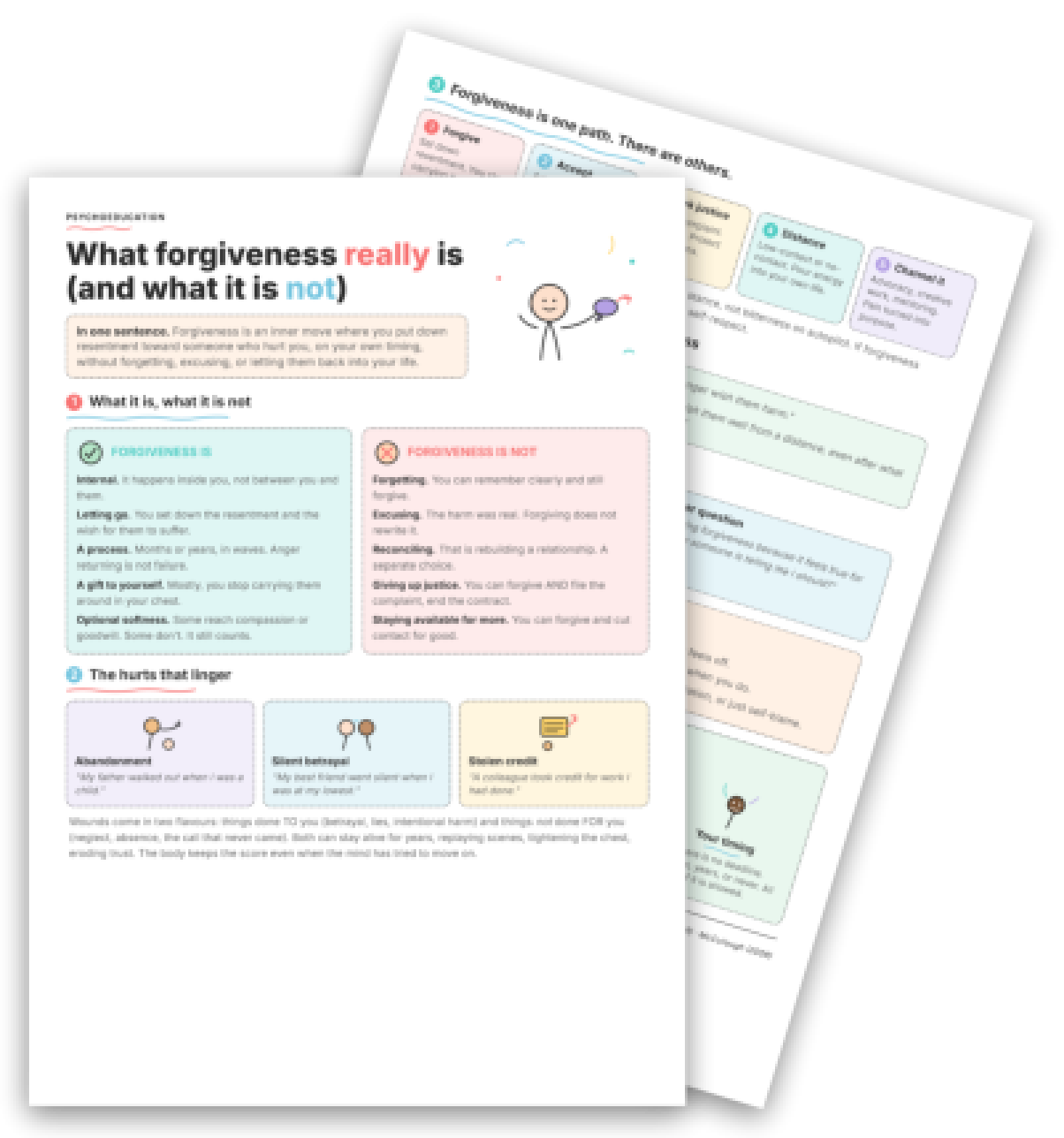
The fiche opens with a working definition in plain language: "Forgiveness is an inner move where you put down resentment toward someone who hurt you, on your own timing, without forgetting, excusing, or letting them back into your life." That single sentence, visible on the page, does more calibration work than a paragraph of verbal explanation.
The handout then unfolds across five structured panels:
- Panel 1 (Is / Is Not): Two columns lay out what forgiveness is (internal, a process, optional softness) against what it is not (forgetting, excusing, reconciling, giving up justice, staying available for more harm). The visual contrast is the point: patients can track exactly where their own understanding diverged.
- Panel 2 (The hurts that linger): Three clinical vignettes (abandonment, silent betrayal, stolen credit) anchor the concept in lived experience, and a short explanatory note distinguishes acts of commission from acts of omission. This maps directly onto the formulation work you may already be doing around early relational wounds or shame schemas.
- Panel 3 (Five paths): Forgiveness is presented as one option among five (forgive, accept, seek justice, distance, channel), each defined briefly. The handout states explicitly that "choosing not to forgive can also be a considered, eyes-open stance, not bitterness on autopilot", which gives patients permission to stop treating refusal as moral failure. Useful to pair with work on adaptive coping choices.
- Panel 4 (Inner statements): Four short first-person statements model what forgiveness sounds like from the inside, for patients unsure whether what they feel "counts."
- Panel 5 (Pressure and timing): A direct note that "pressure is not the same as readiness" and a self-monitoring question ("Am I considering forgiveness because it feels true for me?") the patient can use between sessions. Three "To discuss in session" cues are included for the clinician.
The visual layout does specific work that speech cannot: the Is/Is Not columns disconfirm multiple misconceptions simultaneously, and the five-path diagram normalises non-forgiveness without requiring the clinician to argue for it explicitly. Patients working on perceived injustice or guilt and responsibility often find the five-path panel particularly orienting.
> Key point: This handout is a visual psychoeducation tool for use during the session itself, not a questionnaire patients complete alone. You guide the reading, the patient engages with the layout, and the fiche stays with them as a reference point.
750+ clinical tools
A library built with and for clinicians, ready to use in session and extend between appointments.
Access all the toolsWhen and How to Introduce It in Session
The handout fits naturally in the early-to-mid phase of work with patients presenting grief, relational betrayal, interpersonal trauma, or chronic resentment. It is especially useful before opening a deeper exploration of rumination patterns or when emotion regulation work has plateaued because the patient is still carrying unprocessed anger toward a specific person.
You might introduce it this way: "I'd like to show you something that maps out what forgiveness actually means clinically, because the word gets used in a lot of different ways. Let's go through it together and see what fits your situation." That framing positions the handout as a shared investigation, not a recommendation.
Watch for patients who linger on the Is/Is Not panel: that's often where the productive clinical work is. The "To discuss in session" cues in Panel 5 can serve as direct conversation starters if the patient has been circling the topic without landing.
One genuine limit: patients in acute PTSD or early after a significant trauma may not yet have the regulatory window for this material. The Common Reactions to Trauma handout or basic distress tolerance skills would come first. For most other presentations, this fiche shortens the conceptual groundwork considerably and leaves the patient with a map they can actually use.
Use it with your patients
Share this tool in the mobile app and follow the work between sessions.
Sources
- Enright, R. D., & Fitzgibbons, R. P. (2015). Forgiveness Therapy: An Empirical Guide for Resolving Anger and Restoring Hope. American Psychological Association.
- Worthington, E. L., Jr. (2003). Forgiving and Reconciling: Bridges to Wholeness and Hope. InterVarsity Press.
- Luskin, F. (2002). Forgive for Good: A Proven Prescription for Health and Happiness. HarperOne.
Your session continues in your patients' pocket
Use with a patientYour resources, available everywhere
The handouts, exercises, programs and audios above: you choose which ones to make available to your patients, in the mobile app dedicated to them.
And far more than a library
The app goes well beyond resources, to support your patients every day:
Related categories
Explore other clinical resources by category.
Trauma
Clinical hub on trauma and PTSD: assessment, differential diagnosis, treatment phases, and printable resources for practitioners. 155 chars.

Mood
Evidence-based worksheets and clinical tools for mood disorders: CBT, ACT, and positive psychology resources for psychologists and therapists.

Relationships
Clinical worksheets and tools on relational functioning: attachment, schemas, assertiveness, and communication skills for therapists. Printable PDF resources.

Understand
Clinical hub for the therapeutic aim 'Understand': worksheets and tools to build patient insight across CBT, ACT, schema therapy and more.
Repair & soothe
Clinical resources for the repair and soothe therapeutic aim: worksheets, exercises and tools to build self-compassion, reduce shame and restore emotional safety.

CBT
CBT worksheets, cognitive restructuring exercises & behavioral tools for clinicians. Evidence-based resources for every phase of cognitive behavioral therapy.