
Clinical picture. M., a woman in her late forties, presented with prolonged grief and persistent rumination following the sudden death of her father, with whom she had an unresolved history of emotional neglect. She described spending several hours each day replaying past arguments and composing imagined confrontations she knew could never happen. The clinician introduced the informational sheet on forgiveness methods, using the "what it is not" section to address her immediate concern that forgiving him would erase or minimise the harm. Once M. understood that naming the wrong clearly was the starting point rather than a concession, she engaged with the first two steps of the Klimes roadmap across three sessions. She reported a modest but noticeable reduction in the intrusiveness of the replays, without feeling she had surrendered her account of events.
Forgiveness in Therapy: PDF Worksheet, Tools and Exercises
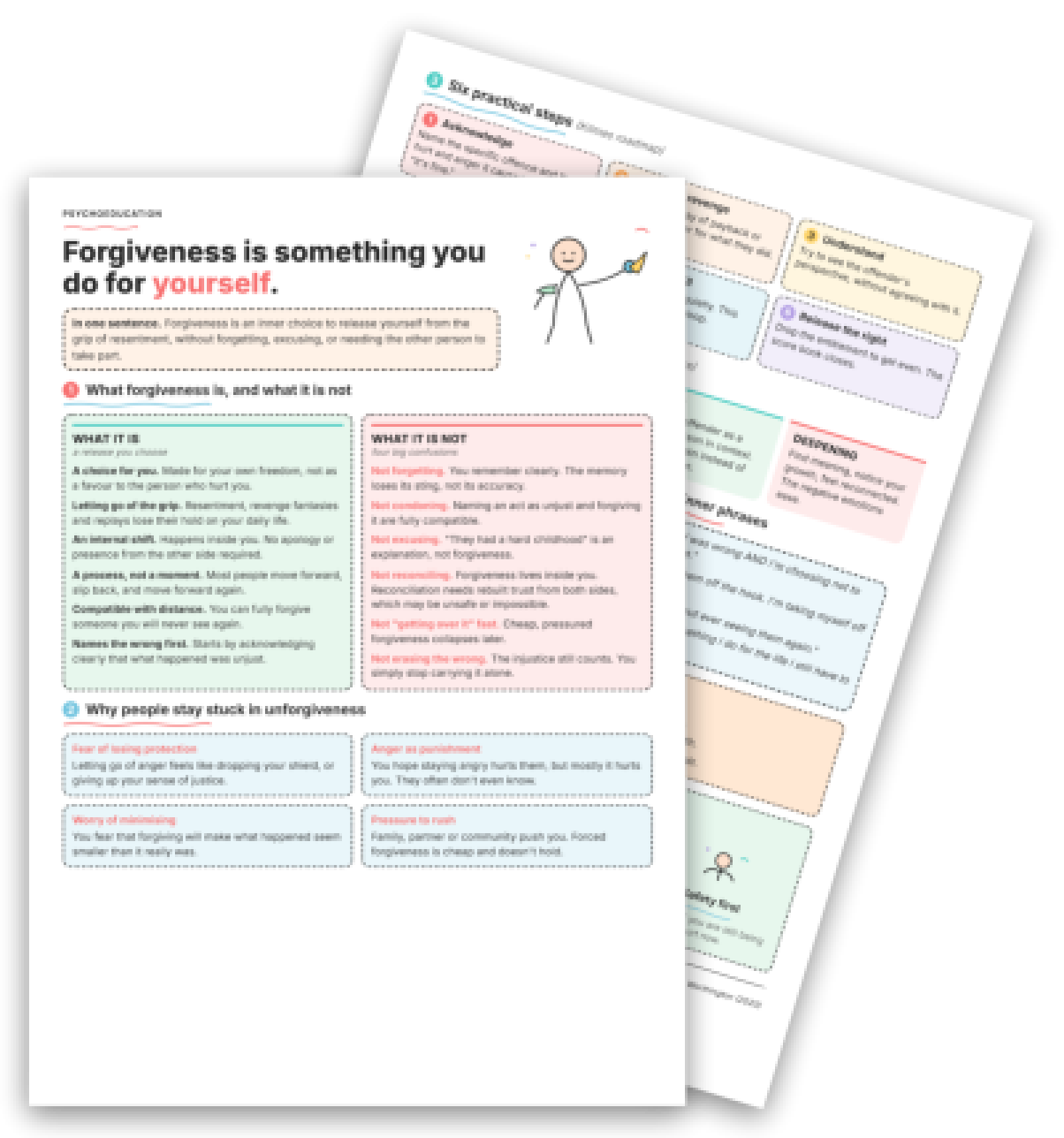
A printable PDF fiche to support psychoeducation on forgiveness in session: key distinctions, clinical frameworks, and practical tools to help patients stop carrying resentment.
Clinical vignettes
Resentment Blocking Grief Work
Anger Mistaken for Self-Protection
Clinical picture. R., a man in his mid-thirties, was referred following a workplace betrayal by a former business partner, and he presented with chronic irritability, sleep difficulties, and a stated refusal to consider any forgiveness work. During psychoeducation, the clinician used the sheet's section on why people stay stuck, focusing specifically on the idea that sustained anger often functions as a perceived shield rather than an effective one. R. recognised the description of anger as punishment and acknowledged, with some reluctance, that his former partner was unlikely to be aware of the extent of his distress. Over the following weeks he began working through the acknowledgement and contextualisation steps at his own pace, without any pressure toward reconciliation. Progress was non-linear, consistent with the sheet's framing of forgiveness as a process rather than a single decision.
Explaining forgiveness in session often generates polite agreement and quiet resistance in equal measure. Patients either collapse it into reconciliation, experience it as moral pressure to minimise the wrong, or perform it prematurely and then wonder why the resentment returns. This fiche PDF gives you a structured visual support to hold those distinctions clearly in front of the patient, in session, rather than relying on an oral explanation that each person filters through their own distortions.
Use this resource with your patients
Handout, exercises and materials ready to use, right inside SessionFuel.
Why Forgiveness Resists Explanation in Session
The core clinical difficulty is definitional: forgiveness carries enormous cultural and familial freight before the patient ever enters your office. Most patients arrive already believing that forgiving means forgetting, condoning, or reconciling, and the moment they hear the word, one of those equations activates.
Oral psychoeducation alone rarely dislodges this. When a patient who has experienced real injustice hears "forgiveness can be healing", they frequently experience it as a request to minimise their suffering. The resulting perceived injustice and emotional reactivity can collapse the alliance before the actual concept has even been presented. What patients often need is not a better explanation, but a clear visual layout that separates the definition from its confusions in a way they can see and re-read.
The second difficulty is motivational. Patients frequently maintain resentment as a form of self-protection, or because chronic anger feels functional even as it costs them. The idea that releasing resentment is something they do for themselves, not a concession to the person who hurt them, needs more than one sentence to land.
What the Fiche Contains: A Visual Tool for a Layered Concept
The fiche is structured across six panels, each building on the last, and is designed to be shown to the patient during the session as you talk through the concept together. It is not a questionnaire to complete alone.
The first panel opens with a single definitional sentence: "Forgiveness is an inner choice to release yourself from the grip of resentment, without forgetting, excusing, or needing the other person to take part." Reading that sentence together with the patient, rather than saying it, gives them something to push back against concretely, which is exactly where the useful clinical work begins.
The second panel lays out what forgiveness is and what it is not in two parallel columns. The four "big confusions" named in the fiche (not forgetting, not condoning, not excusing, not reconciling) map directly onto the most common maladaptive beliefs patients hold about relationships. Showing this visually short-circuits the need to argue each distortion one by one.
Panels three and four present two complementary frameworks: a six-step practical roadmap (the Klimes model, covering acknowledgement, renouncing revenge, perspective-taking, accepting the hurt, extending goodwill, and releasing the right to retaliate) and the four-phase Enright and Fitzgibbons model (uncovering, decision, work, deepening). Having both on the page is clinically useful: some patients respond to the step-by-step behavioural framing; others need the phase model's acknowledgement that the process is non-linear and includes moving backward.
Panel five, "When it is not the right move yet," is often the most important for clinical safety. It names safety concerns, ongoing harm, unfelt anger and grief, and external pressure as explicit contraindications, a grounded visual anchor for patients at risk of premature or performed forgiveness. Panel six offers inner phrases the patient can take away ("I'm not letting them off the hook. I'm taking myself off the hook."), and a brief section of session discussion prompts, including self-forgiveness.
> Key point: This fiche is a visual support that facilitates the explanation of forgiveness in session. It is not homework to complete independently; it is an in-session psychoeducation tool that leaves the patient with a concrete, portable reference after the appointment.
750+ clinical tools
A library built with and for clinicians, ready to use in session and extend between appointments.
Access all the toolsWhen and How to Introduce It in Practice
The fiche is best suited from the second or third session onward, once the therapeutic alliance is established and you have a sense of the patient's relational history. It is particularly indicated where rumination on a past hurt is sustaining depression or chronic anger regulation difficulties, or where work on trust ruptures in a current relationship keeps circling back to an older, unprocessed grievance.
For patients carrying guilt or shame alongside resentment, specifically where self-forgiveness is the actual clinical target (noted in the fiche's discussion prompts), introduce the fiche explicitly as a map for that direction, not just for interpersonal forgiveness. The fiche flags this distinction clearly enough to make the pivot without it feeling like a change of subject.
A neutral framing to introduce it: "I'd like to show you something that maps what forgiveness actually is and isn't, because the word itself tends to mean different things to different people. Let's look at it together." Then work through panels one and two before moving further. Observe where the patient slows down or pushes back; that is your case formulation material.
A practical contraindication: avoid introducing the fiche when the patient is still in an unsafe relational situation. Panel five names this explicitly, but the clinician needs to have assessed it first. In the context of rebuilding a healthy relationship framework or working with guilt and moral responsibility, the fiche integrates naturally into a longer-arc treatment without requiring a dedicated session of its own.
The fiche does not replace the therapeutic relationship; it makes a genuinely complex concept legible enough for the patient to engage with it honestly, and leaves them with something concrete to return to between sessions.
Use it with your patients
Share this tool in the mobile app and follow the work between sessions.
Sources
- Enright, R. D., & Fitzgibbons, R. P. (2015). Forgiveness Therapy: An Empirical Guide for Resolving Anger and Restoring Hope. American Psychological Association.
- Enright, R. D. (2001). Forgiveness Is a Choice: A Step-by-Step Process for Resolving Anger and Restoring Hope. American Psychological Association.
- Klimes, R.. Five Steps for Granting the Gift of Forgiveness.
- Worthington, E. L., Jr.. REACH Forgiveness Workbook. Discover Forgiveness.
Your session continues in your patients' pocket
Use with a patientYour resources, available everywhere
The handouts, exercises, programs and audios above: you choose which ones to make available to your patients, in the mobile app dedicated to them.
And far more than a library
The app goes well beyond resources, to support your patients every day:
Related categories
Explore other clinical resources by category.
Mood
Evidence-based worksheets and clinical tools for mood disorders: CBT, ACT, and positive psychology resources for psychologists and therapists.

Emotions
Clinical resources on emotion regulation: worksheets, coping tools, CBT, REBT, and ACT exercises for therapists working across diagnoses and age groups.
Relationships
Clinical worksheets and tools on relational functioning: attachment, schemas, assertiveness, and communication skills for therapists. Printable PDF resources.

Understand
Clinical hub for the therapeutic aim 'Understand': worksheets and tools to build patient insight across CBT, ACT, schema therapy and more.
Repair & soothe
Clinical resources for the repair and soothe therapeutic aim: worksheets, exercises and tools to build self-compassion, reduce shame and restore emotional safety.
CBT
CBT worksheets, cognitive restructuring exercises & behavioral tools for clinicians. Evidence-based resources for every phase of cognitive behavioral therapy.