
Clinical picture. A, a woman in her mid-forties, presented with persistent low mood and intrusive rumination following a serious betrayal by a former business partner several years prior. She had avoided any discussion of forgiveness in previous therapy, equating it with excusing the harm done and implicitly condoning dishonest conduct. The clinician introduced the psychoeducational sheet during session, working through the IS / IS NOT distinction and pausing on the sentence that forgiveness and reconciliation are not the same process. A noted visible relief when she grasped that forgiving internally placed no obligation on her to resume contact or soften her legal boundaries. Over the following two sessions she reported a modest but tangible reduction in the daily mental load she described as carrying the story everywhere.
What Is Forgiveness? PDF Worksheet, Tools and Exercises for Clinical Practice
A printable PDF worksheet, tools and exercises helping clinicians explain forgiveness accurately in session, dismantle the most persistent misconceptions, and separate it clearly from reconciliation.
Clinical vignettes
Forgiveness Without Reconciliation
Premature Pressure to Forgive
Clinical picture. T, a man in his early thirties, arrived stating his family had told him repeatedly that he needed to forgive his father for childhood neglect and that his refusal was the reason he remained depressed. He presented the belief that if he had not yet forgiven, he was failing at his own recovery. The clinician used the sheet's final section to clarify that forgiveness cannot be forced and that wanting to forgive is not the same as having forgiven; pushing the process tends to backfire. T identified the coercion dynamic clearly once it was named on paper, and the session shifted to exploring what, if anything, he genuinely wanted for himself rather than what others expected. The immediate clinical gain was modest: reduced shame about his current position, which allowed more honest engagement with the underlying grief.
Telling a patient that forgiveness is not the same as condoning tends to go in one ear and out the other. The concept carries too much cultural weight and too many competing definitions for a verbal explanation to stick. This fiche PDF gives you a shared visual reference to anchor the psychoeducation and move the session forward.
Use this resource with your patients
Handout, exercises and materials ready to use, right inside SessionFuel.
Why Forgiveness Resists Verbal Explanation in Session
The word itself is the first obstacle. Many patients hear "forgiveness" and immediately load it with meanings rooted in religious upbringing, family pressure, or cultural scripts: excusing the harm, welcoming the person back, saying it out loud, or pretending it never happened. That semantic activation happens before you have even finished your sentence.
The clinical cost is real. Patients working through betrayal, abuse histories, or relational ruptures often refuse to engage with forgiveness-based interventions precisely because they mistake the construct for capitulation. Others attempt to force it prematurely, skip the affective processing phase entirely, and arrive at a fragile, unstable pseudo-acceptance. Both errors are predictable when the concept has not been precisely delineated.
A visual support that explicitly separates what forgiveness is from what it is not short-circuits the semantic confusion before it derails the alliance.
What the Fiche Contains: A Visual Tool for Explaining Forgiveness in Session
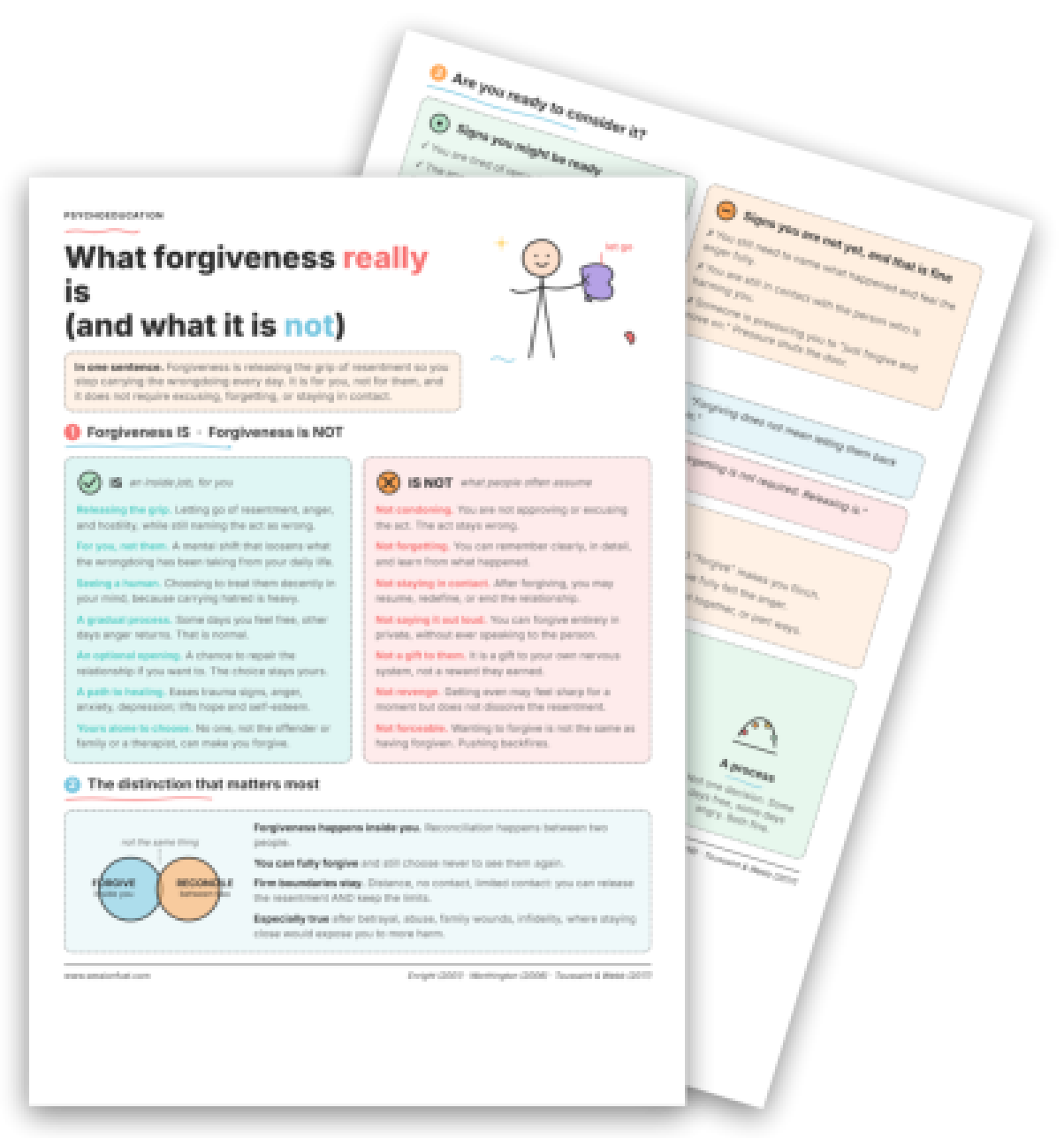
The fiche organises its content into four numbered sections, each designed to be walked through with the patient during the consultation rather than handed over as homework.
Section 1 presents a two-column layout: Forgiveness IS on one side, Forgiveness IS NOT on the other. Each item is direct and brief. The "is" column names forgiveness as "an inside job, for you" and "a gradual process"; the "is not" column addresses the most common clinical misconceptions ("Not condoning. You are not approving or excusing the act", "Not forgetting", "Not staying in contact"). This side-by-side structure does what spoken language rarely achieves in a single session: it holds both truths simultaneously and visibly.
Section 2 carries the most clinically decisive clarification. A simple diagram distinguishes Forgiveness (inside you) from Reconciliation (between two people), with the explicit statement that the two are "not the same thing." For patients navigating post-abuse dynamics, infidelity, or estranged family relationships, this visual separation is often the moment the concept becomes workable.
Section 3 offers two parallel checklists of readiness indicators: signs a patient may be ready to consider forgiveness (resentment is costing more than it protects; the event is replaying chronically) and signs they are not yet there (still in contact with someone causing harm; still needing to name the anger fully). This normalises non-readiness without pathologising it. Clinicians treating complex trauma or working within an EMDR or schema therapy frame will find this particularly useful for pacing.
Section 4 provides four inner reframes the patient can return to between sessions, plus a short "To discuss in session" block that flags three specific moments worth exploring: confusing forgiveness with excusing, feeling pressured to forgive prematurely, and deciding whether forgiveness and reconciliation should or should not travel together.
> Key point: this fiche is a visual support that facilitates the explanation of forgiveness during the session itself. It is not a self-administered questionnaire. Its value lies in giving both patient and clinician a shared, printed reference, reducing semantic drift and leaving the patient with a concrete, portable reminder.
750+ clinical tools
A library built with and for clinicians, ready to use in session and extend between appointments.
Access all the toolsWhen and How to Introduce the Fiche
The fiche fits naturally at any point in the treatment where forgiveness becomes clinically relevant: in processing work after betrayal, when working through resentment linked to mistrust schemas, or when a patient with PTSD begins asking whether they should forgive the perpetrator.
For patients carrying chronic anger, you might introduce it alongside tools addressing the deeper layers of anger. For those caught in cycles of perceived injustice, pairing it with the Perceived Injustice exercise before introducing this fiche tends to reduce defensiveness.
A low-friction opening: "There's a lot of confusion about what forgiveness actually means clinically. I'd like to show you a one-page summary so we're working with the same definition." Framing it as definitional rather than prescriptive removes the pressure.
During the debrief, the most productive questions tend to cluster around Section 2. Ask which items in the "IS NOT" column the patient had previously assumed were true, and which items in the readiness checklist resonate right now. That exchange usually surfaces the underlying schema work: self-sacrifice patterns, unforgiveness as a hook, or unprocessed ambivalence about whether an apology is even possible.
One limit worth naming: the fiche is not a substitute for graduated emotional processing. Patients still in active threat exposure or who have not yet completed the anger and grief phases of trauma recovery are not candidates for forgiveness work at all. Presenting the fiche too early can feel invalidating. Used at the right moment, in the right case, it reliably shortens the explanation time and gives patients a reference point that travels with them beyond the session.
Companion resources in the forgiveness cluster address the process itself in more depth, and the self-forgiveness worksheet extends the work to self-directed resentment, which often surfaces once interpersonal forgiveness becomes conceivable.
Use it with your patients
Share this tool in the mobile app and follow the work between sessions.
Sources
- Enright, R. D. (2001). Forgiveness Is a Choice: A Step-by-Step Process for Resolving Anger and Restoring Hope. American Psychological Association.
- Enright, R. D., Fitzgibbons, R. P. (2000). Helping Clients Forgive: An Empirical Guide for Resolving Anger and Restoring Hope. American Psychological Association.
- Worthington, E. L., Jr. (2006). Forgiveness and Reconciliation: Theory and Application. Routledge.
- Toussaint, L., Worthington, E. L., Jr., Williams, D. R. (2015). Forgiveness and Health: Scientific Evidence and Theories Relating Forgiveness to Better Health. Springer.
Your session continues in your patients' pocket
Use with a patientYour resources, available everywhere
The handouts, exercises, programs and audios above: you choose which ones to make available to your patients, in the mobile app dedicated to them.
And far more than a library
The app goes well beyond resources, to support your patients every day:
Related categories
Explore other clinical resources by category.

Mood
Evidence-based worksheets and clinical tools for mood disorders: CBT, ACT, and positive psychology resources for psychologists and therapists.

Identity
Clinical resources for self-identity work in therapy: CBT, ACT, schema tools for clinicians addressing self-concept, core beliefs, and identity disruption.

Emotions
Clinical resources on emotion regulation: worksheets, coping tools, CBT, REBT, and ACT exercises for therapists working across diagnoses and age groups.

Relationships
Clinical worksheets and tools on relational functioning: attachment, schemas, assertiveness, and communication skills for therapists. Printable PDF resources.

Understand
Clinical hub for the therapeutic aim 'Understand': worksheets and tools to build patient insight across CBT, ACT, schema therapy and more.

Repair & soothe
Clinical resources for the repair and soothe therapeutic aim: worksheets, exercises and tools to build self-compassion, reduce shame and restore emotional safety.