
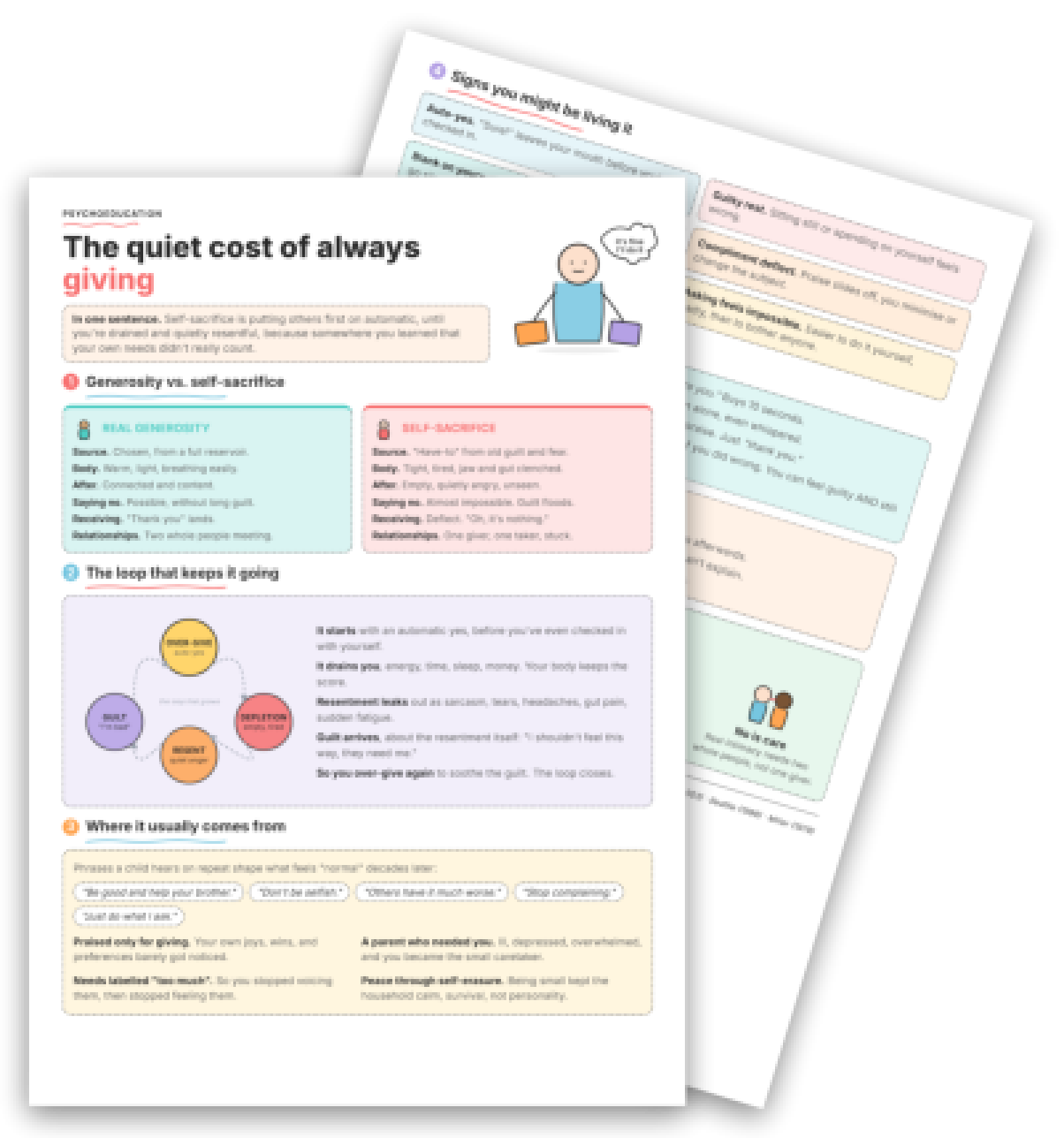
Clinical picture. A is a 41-year-old secondary school teacher referred for persistent fatigue and low mood, who describes feeling "used up" at home and at work yet cannot identify a single recent occasion on which she declined a request. In session, the clinician introduces the self-sacrifice schema psychoeducation sheet and invites A to read the loop diagram aloud, then to name where she typically enters it. A locates herself at the over-giving stage and, unprompted, recalls the childhood phrase she heard most often: "Don't be selfish." She acknowledges, with some surprise, that her body signals resentment well before her mind registers it. Over the following fortnight she begins tracking automatic yeses in a brief daily log, which surfaces enough data to anchor subsequent schema-level work.
Self-Sacrifice Schema: PDF Worksheet, Tools and Exercises for Clinical Practice
A printable PDF worksheet, clinical tools, and structured exercises to help clinicians explain the self-sacrifice schema visually and integrate it into schema therapy practice.
Clinical vignettes
Recognising the Auto-Yes Pattern
Distinguishing Giving From Obligation
Clinical picture. M is a 55-year-old man seen in outpatient psychotherapy for recurrent depressive episodes, whose history includes years of caring for a chronically ill parent during adolescence. The clinician uses the generosity-versus-self-sacrifice comparison table from the sheet to invite M to rate recent acts of helping along the "chosen from a full reservoir" to "have-to from guilt" continuum. M rates nearly all of them at the obligation end and notices that the bodily descriptor "tight, tired, jaw clenched" matches his presentation most mornings. The exercise does not resolve ambivalence quickly, but it gives M a shared language to name the difference between acts that replenish and acts that deplete, which he begins to use in subsequent sessions when reviewing interpersonal situations.
Patients carrying the self-sacrifice schema rarely walk in saying "I give too much." They arrive depleted, quietly resentful, sometimes presenting with burnout symptoms or low self-esteem, and framing the problem as everyone else's needs being too large. This fiche PDF gives you a visual support to reframe that pattern efficiently, without the patient experiencing the reframe as an accusation of selfishness.
Use this resource with your patients
Handout, exercises and materials ready to use, right inside SessionFuel.
Why the Self-Sacrifice Schema Is Hard to Name in Session
The central clinical difficulty is that compulsive over-giving feels virtuous. When you first introduce the idea that automatic helpfulness might be schema-driven rather than freely chosen, the immediate response is often defensiveness, shame, or a flat "but I genuinely want to help." That is not resistance in the pejorative sense; it reflects something structurally true. The patient cannot yet feel the difference between generosity chosen from a full reservoir and giving that runs on old guilt and fear.
Verbal explanation alone struggles here. Saying "you give because you learned your needs didn't count" can land as accusatory, abstract, or simply too large to hold. The distinction between healthy generosity and self-sacrificial compulsion needs to be shown, not just stated. The same problem applies to the resentment dimension: patients feel it, often express it somatically (headaches, gut tension, sudden fatigue), but won't name it as resentment because naming it triggers a second layer of guilt. Without a concrete map of the maintenance cycle, that loop stays invisible.
This schema also frequently co-occurs with approval-seeking patterns, the punitiveness schema, and emotional inhibition. Placing those overlaps in the case formulation early shapes how you pace the work.
What the Fiche Contains: Five Panels That Make the Schema Visible
The fiche PDF is organized into five visual panels plus a dedicated debriefing section, each grounded in schema therapy (Young, 2003) and the self-in-relationship literature.
- Panel 1, Generosity vs. self-sacrifice: a side-by-side comparison table covering source, body cues, aftermath, capacity to say no, response to receiving, and relational dynamic. The contrast between "Chosen, from a full reservoir" and "Have-to from old guilt and fear" is laid out so the patient can locate themselves without being labeled.
- Panel 2, The maintenance loop: a circular diagram tracing the path from auto-yes through depletion, quiet resentment, and guilt, back to over-giving. Seeing the loop closes the explanatory gap that oral description leaves open.
- Panel 3, Developmental origins: specific phrases the patient may have heard repeatedly in childhood ("Don't be selfish," "Others have it much worse"), plus five structural origin patterns including the parentified child and the child whose needs were labeled "too much." This panel is particularly useful when tracing a core belief back to its origins in earlier sessions.
- Panel 4, Behavioral signs: a checklist of six observable markers, from the automatic yes before any internal check-in, to compliment deflection, body protest symptoms, and the impossibility of asking for help.
- Panel 5, First steps: three concrete micro-practices (pause before yes, naming needs out loud, receiving on purpose) framed at the behavioral level, making them immediately actionable.
The To discuss in session section provides three cued prompts the patient can use between appointments to anchor observation to lived moments, not abstract reflection.
> Key point: this fiche is a visual support that facilitates explanation in session, not a self-administered questionnaire. The clinician walks through it with the patient, panel by panel, using the diagrams to externalize the schema rather than interpret the patient's character.
750+ clinical tools
A library built with and for clinicians, ready to use in session and extend between appointments.
Access all the toolsHow and When to Introduce It in the Care Plan
This fiche PDF fits naturally after an initial case formulation has identified self-sacrifice as a primary or secondary schema, typically from the third or fourth session onward once the therapeutic alliance is established. For patients presenting with relational exhaustion, chronic coping styles of surrender or over-compensation, or schema maintenance cycles built around hyper-responsibility, it can accelerate psychoeducation considerably.
A low-pressure introduction: "I'd like to look at something with you that might help name what we've been circling around. It's a diagram, not a test." Moving through Panel 1 together, rather than handing it over to read alone, lets you observe which column the patient gravitates toward and where they push back, both diagnostically rich.
For debriefing, Panel 2's loop is the productive starting point: ask where the patient entered the cycle most recently. Panel 3 often opens emotionally significant material, so time it accordingly. The fiche pairs well with assertiveness tools, self-compassion exercises, and early maladaptive schema mapping work. For patients who deflect praise visually depicted in Panel 4, the difficulty accepting compliments exercise offers a behaviorally concrete next step.
One limit to note: when self-sacrifice is organized around a trauma-based relational dynamic (parentification, chronic emotional neglect), the developmental panel can activate quickly. Build in enough session time to process what it surfaces before the patient leaves with the printout.
The fiche does not replace the formulation or the relational work; it makes the concept concrete enough that the patient leaves the session holding something they can actually see.
Use it with your patients
Share this tool in the mobile app and follow the work between sessions.
Sources
- Young, J. E., Klosko, J. S., & Weishaar, M. E. (2003). Schema Therapy: A Practitioner's Guide. Guilford Press.
- Arntz, A., Rijkeboer, M., Chan, E., Fassbinder, E., Karaosmanoglu, A., Lee, C. W., & Panzeri, M. (2021). Towards a Reformulated Theory Underlying Schema Therapy: Position Paper of an International Workgroup. Cognitive Therapy and Research.
Your session continues in your patients' pocket
Use with a patientYour resources, available everywhere
The handouts, exercises, programs and audios above: you choose which ones to make available to your patients, in the mobile app dedicated to them.
And far more than a library
The app goes well beyond resources, to support your patients every day:
Related categories
Explore other clinical resources by category.

Identity
Clinical resources for self-identity work in therapy: CBT, ACT, schema tools for clinicians addressing self-concept, core beliefs, and identity disruption.

Relationships
Clinical worksheets and tools on relational functioning: attachment, schemas, assertiveness, and communication skills for therapists. Printable PDF resources.

Cognition
Printable cognitive therapy worksheets and clinical tools for therapists: CBT, ACT, schema work, defusion, distortions, and belief restructuring.

Understand
Clinical hub for the therapeutic aim 'Understand': worksheets and tools to build patient insight across CBT, ACT, schema therapy and more.

Build awareness
Clinical worksheets and tools to build awareness in therapy: cognitive distortions, schemas, emotions, ACT and CBT resources for practitioners.
CBT
CBT worksheets, cognitive restructuring exercises & behavioral tools for clinicians. Evidence-based resources for every phase of cognitive behavioral therapy.