
Clinical picture. L., a 34-year-old teacher presenting with persistent low mood and chronic overcommitment, described feeling unable to decline requests from colleagues without guilt or lengthy justification. During a session focused on interpersonal patterns, the clinician introduced the assertiveness worksheet and walked through tips 2, 4, and 12 together: a brief mental rehearsal, owning the message with an "I" statement, and preparing a short, repeatable refusal. L. role-played declining a last-minute cover request, repeating a calm one-sentence refusal each time the clinician re-raised the ask. By the following week, L. reported using the same approach once in vivo; the colleague accepted the refusal on the second repetition, and L. noted reduced anticipatory anxiety before the interaction.
Assertiveness: PDF Worksheet, Tools and Exercises for Clinical Practice
A visual PDF worksheet, practical tools, and concrete exercises to help clinicians explain assertiveness clearly in session and give patients a reference they can actually use.
Clinical vignettes
Rehearsing a Refusal at Work
Naming Behaviour Without Attacking
Clinical picture. M., a 47-year-old in couples-focused individual therapy, struggled to address his partner's interrupting without escalating into criticism of her character, which reliably ended conversations. The clinician used the worksheet's tip 8 (behaviour not person) and tip 6 (behaviour, feeling, ask) to help M. restructure his usual opening. He drafted: "When I'm interrupted mid-sentence, I feel dismissed; I'd prefer we each finish before the other responds." In the following session M. reported trying the phrasing during a tense exchange; his partner did not become defensive, and the conversation continued rather than closing down. The clinician noted this as a partial shift worth consolidating, not a resolution of the broader relational pattern.
In most sessions, patients who need assertiveness work have already tried expressing themselves to others, repeatedly and unsuccessfully. The concept sounds simple enough. The moment you attempt to convey the precise boundary between assertion, aggression, and passivity using words alone, something blurs. This PDF worksheet was built to sharpen that line visually, in session, so patients leave with a shared vocabulary and a concrete reference rather than a fading memory of your explanation.
Use this resource with your patients
Handout, exercises and materials ready to use, right inside SessionFuel.
Why Assertiveness Resists Verbal Explanation in Session
The clinical difficulty is not definitional. Most patients can repeat back a working definition within minutes. The challenge is positional: they cannot feel where they currently stand on the aggressive-passive continuum, and they routinely misread their own behavior. Passive patients believe their silence protects the relationship. Aggressive patients believe their directness is just "being honest." Both distortions are self-reinforcing, and an oral explanation of assertiveness lands inside the same cognitive schema that produced the distortion.
A purely verbal psychoeducation sequence also carries an unintended subtext: the clinician holds the knowledge, the patient receives it. That dynamic works against the foundational assertive rights framework that effective assertiveness training rests on. Patients benefit more from a tool that shows them the structure and lets them locate themselves inside it.
The problem sharpens when assertiveness work intersects with anger warning signs or with the layered emotion structure beneath surface anger. Patients frequently conflate emotional flooding with assertive intensity, and that confusion is hard to untangle without a shared visual reference on the table.
What the Worksheet Contains: A Visual Support for In-Session Explanation
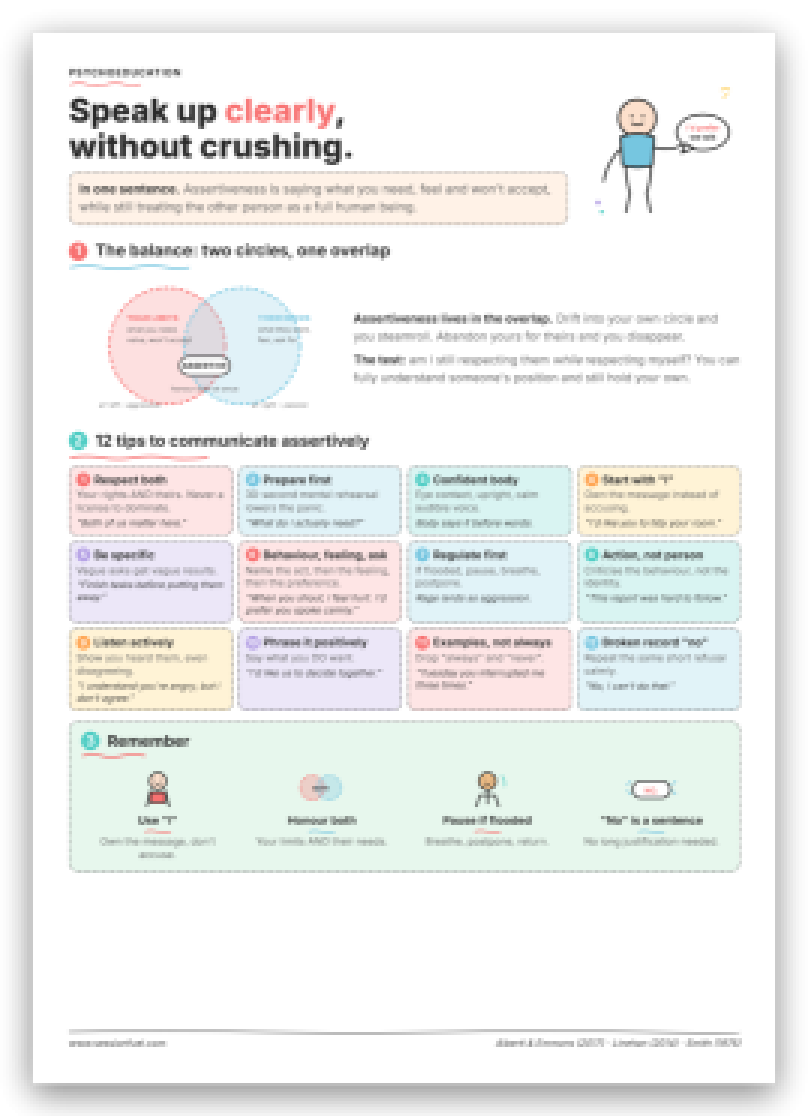
The fiche opens with Panel 1, a two-circle Venn diagram that maps the assertiveness space geometrically. The left circle carries YOUR LIMITS (what you need, value, won't accept); the right carries THEIR NEEDS (what they want, feel, ask for); the overlap is labelled ASSERTIVE, honour both at once. The failure modes are named directly beneath: "all-left = aggressive, all-right = passive." A test question anchors the whole structure: "Am I still respecting them while respecting myself?"
That single diagram typically accomplishes more in two minutes of session time than ten minutes of oral explanation, because it gives the patient a spatial metaphor they can return to between sessions without needing you to reconstruct it.
Panel 2 lists the 12 tips in a scannable format. Each tip carries a one-line principle, a brief clinical rationale, and a short example utterance. The range is deliberate: somatic preparation ("Confident body: eye contact, upright, calm audible voice"), linguistic ownership ("Start with 'I': own the message instead of accusing"), and emotional regulation ("Regulate first: if flooded, pause, breathe, postpone. Rage lands as aggression"). The structure pairs naturally with active listening and reflective communication work, and maps directly onto the frameworks used in couples communication therapy.
Panel 3 condenses the session into four icons: use "I", honour both, pause if flooded, and "'No' is a sentence, no long justification needed." Compact enough to photograph and consult before a difficult real-world conversation.
> Key point: this worksheet is a visual support that facilitates explanation in session, not a take-home questionnaire. You use it to anchor the psychoeducation while the patient is in front of you; they leave holding a printed reference they already understand.
750+ clinical tools
A library built with and for clinicians, ready to use in session and extend between appointments.
Access all the toolsWhen and How to Introduce It
This PDF worksheet fits from the second or third session onward, once you have a working formulation and a clear picture of the patient's interpersonal patterns. It is especially productive with:
- Patients in conflict cycles, where relational misalignment and blocked compromise or recurring interpersonal conflict is the presenting complaint
- Socially anxious patients who have completed initial psychoeducation and are ready to target assertive communication in social contexts
- Anger-presenting patients partway through an anger psychoeducation program, once trigger mapping is done and the work shifts to expression
A low-threshold introduction: "I want to show you a diagram that maps what we've been discussing. It takes about two minutes to walk through together." Start with the Venn diagram. Ask the patient where they usually land. Their spontaneous answer carries diagnostic weight, often more than a formal assessment. The Assertiveness Ladder worksheet can follow once this conceptual frame is solid and the patient is ready to move toward graded practice.
One limit worth tracking: patients with passive-aggressive relational patterns may initially self-place in the overlap even when the clinical picture says otherwise. Use the tip list in Panel 2 to test that self-placement before the session ends. The gap between stated position and selected tips is clinically telling.
The worksheet does not replace the therapeutic frame; it makes one central concept land faster, and leaves the patient holding a reference they already own.
Use it with your patients
Share this tool in the mobile app and follow the work between sessions.
Sources
- Alberti, R. E., & Emmons, M. L. (2017). Your Perfect Right: Assertiveness and Equality in Your Life and Relationships (10th ed.). New Harbinger Publications.
- Linehan, M. M. (2014). DBT Skills Training Manual (2nd ed.). Guilford Press.
- Smith, M. J. (1975). When I Say No, I Feel Guilty. Bantam Books.
Your session continues in your patients' pocket
Use with a patientYour resources, available everywhere
The handouts, exercises, programs and audios above: you choose which ones to make available to your patients, in the mobile app dedicated to them.
And far more than a library
The app goes well beyond resources, to support your patients every day:
Related categories
Explore other clinical resources by category.

Identity
Clinical resources for self-identity work in therapy: CBT, ACT, schema tools for clinicians addressing self-concept, core beliefs, and identity disruption.

Relationships
Clinical worksheets and tools on relational functioning: attachment, schemas, assertiveness, and communication skills for therapists. Printable PDF resources.

Understand
Clinical hub for the therapeutic aim 'Understand': worksheets and tools to build patient insight across CBT, ACT, schema therapy and more.

Build skills
Skill-building resources for clinicians: printable worksheets and exercises for coping, assertiveness, and communication skills training in therapy.
CBT
CBT worksheets, cognitive restructuring exercises & behavioral tools for clinicians. Evidence-based resources for every phase of cognitive behavioral therapy.

Integrative
Integrative therapy clinical resources: worksheets, psychoeducation programs, and exercises for eclectic, multimodal practice across orientations.