
Clinical picture. A patient in his early forties, referred after a workplace conflict, opens the session with: "Everything's fine, I just need to sort out the situation at work." His tone is flat, his posture closed. The clinician offers a tentative reflection: "What I'm picking up is that you're carrying more than a practical problem right now, almost like you're not sure it's safe to say so here." The patient pauses, then says he has felt humiliated for months but thought no one would take it seriously. The reflection did not resolve anything, yet it shifted the session from surface logistics to the underlying experience the patient had not yet named aloud.
Reflective Listening: PDF Worksheet, Tools and Exercises for Clinical Practice
A visual PDF worksheet with exercises and tools to help clinicians teach reflective listening in session, so patients genuinely distinguish it from parroting, agreeing, or summarising.
Clinical vignettes
Reflection Shifts a Guarded Opening
Teaching Reflection to a Couple
Clinical picture. During a couples session, a woman in her mid-thirties tells her partner, with visible frustration, that she always has to manage everything alone. Her partner's first instinct is to list counterexamples, a pattern the dyad recognises as escalating. The clinician pauses the exchange and asks the partner to try a reflection instead of a rebuttal. After a moment he offers: "So from your side, it feels like I'm absent even when I'm physically there, and that leaves you exhausted." His partner nods and her posture softens. The clinician notes that the reflection was imperfect in detail yet accurate enough in tone to interrupt the usual cycle, which became the focus of the remainder of the session.
Teaching reflective listening verbally rarely sticks. Patients nod, repeat back a few words the next week, and call it a reflection. This fiche PDF gives you a visual support to anchor the concept during the session itself, so the distinction between a genuine reflection and its lookalikes becomes concrete before the patient leaves the room.
Use this resource with your patients
Handout, exercises and materials ready to use, right inside SessionFuel.
Why Reflective Listening Resists Oral Explanation
The core difficulty is not that the skill is complex, it is that patients operate with a plausible but incorrect mental model. They assume reflecting means echoing words, validating feelings by agreement, or summarising content. All three confuse the form with the function. An oral explanation alone tends to stay at the level of definition, and the patient's prior model fills in the gaps.
The second obstacle is emotional: many patients working on relational communication, couples in high conflict, individuals with an avoidant attachment pattern, or those carrying beliefs that chronically damage their relationships, reflexively interpret "naming the other person's feeling" as capitulation. Without a visual support that explicitly separates reflecting from agreeing, the reassurance you give orally tends to evaporate between sessions.
A third layer: patients frequently jump straight to advice-giving, a pitfall that collapses the listening space and re-escalates conflict. If you are also working with the Four Horsemen model or NVC, the fiche slots directly into that psychoeducation arc.
What the Fiche Contains: A Visual Support for Session Use
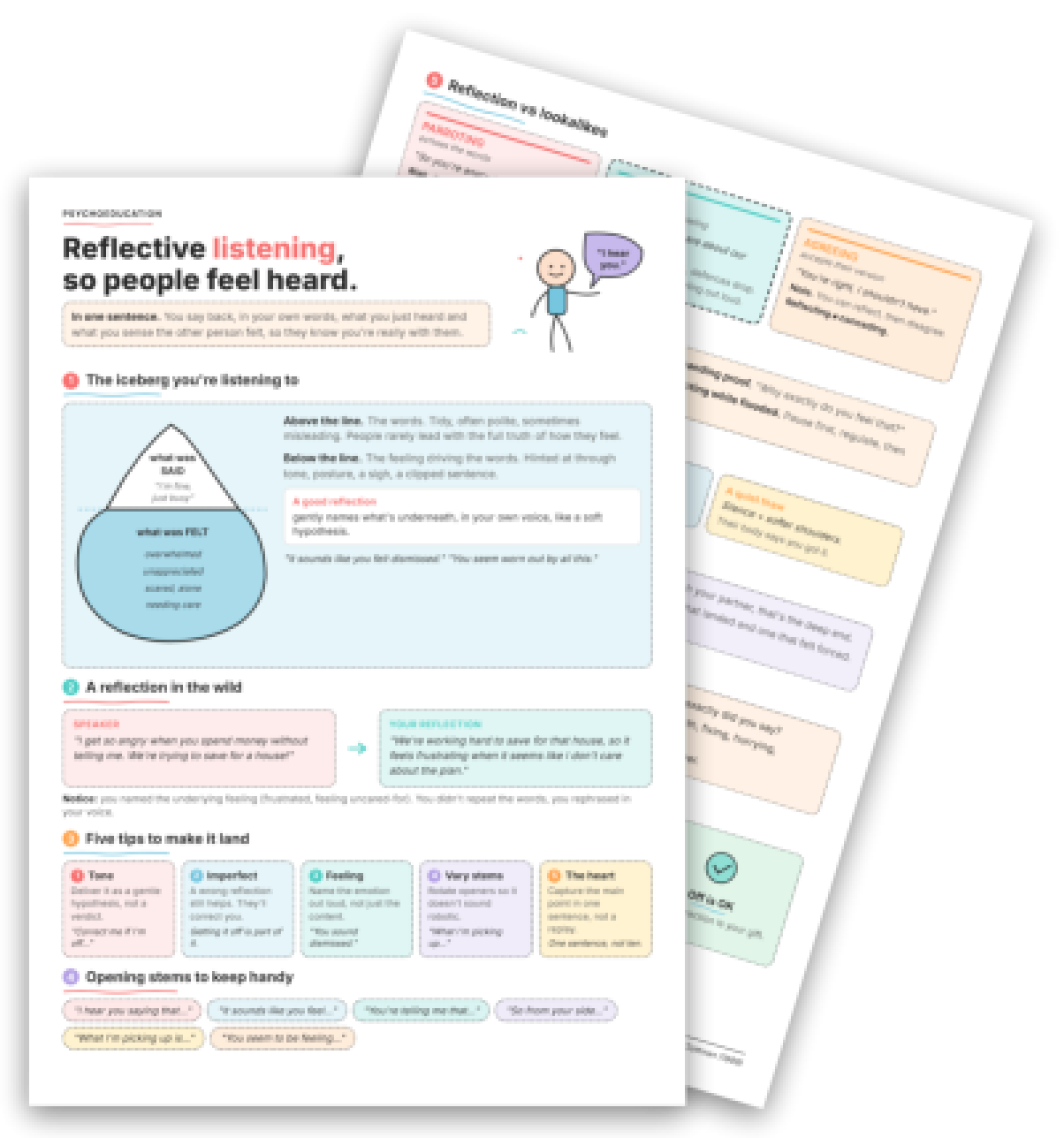
The fiche is structured across eight numbered panels, each building on the last. The opening panel frames the skill in a single sentence, "You say back, in your own words, what you just heard and what you sense the other person felt", and this precision is what you return to when the patient drifts toward parroting.
Panel 1 introduces the iceberg metaphor: above the waterline, "I'm fine, just busy"; below it, the cluster of feelings the words are carrying (overwhelmed, unappreciated, scared). This visual layout does something an oral explanation cannot: it makes the gap between surface content and underlying emotion spatially obvious. Pointing to the diagram in session is faster and clearer than restating it.
Panel 3 shows a worked example in real dialogue, a speaker complaining about unannounced spending, and a reflection that names frustrated and feeling uncared-for without repeating the speaker's phrasing. Patients often need this concrete model before they can generate their own.
Panel 5 is the section that tends to shift the most in session: the three-column comparison between parroting, reflecting, and agreeing. The column format makes visible what oral explanation flattens: that reflecting neither mocks nor concedes. The note "Reflecting ≠ conceding" often lands as a small revelation for patients who have been treating empathy as a zero-sum transaction.
Panel 3's five tips (tone as hypothesis, embracing imperfect attempts, naming emotion not just content, varying opening stems, capturing the heart in one sentence) and the stem bank in Panel 4 ("What I'm picking up is...", "So from your side...") give patients a portable toolkit they can take away and practice before the next session.
> Key takeaway: this fiche is a visual psychoeducation support designed for use during the session, not a self-assessment questionnaire. You navigate it with the patient, point to the columns, and use the worked example as shared reference. It leaves them with a concrete, annotated reminder to take home.
Clinical library
750+ clinical tools
A library built with and for clinicians, ready to use in session and extend between appointments.
Access all the toolsSeveral resource types
Psychoeducation handouts
Understand at a glance
Interactive exercises
To do and fill in
Interactive programs
A structured path
Audios
Meditation and relaxation
Psychometric tests
Automatic scoring
When and How to Introduce the Fiche
This fiche fits naturally once the therapeutic alliance is established and the patient has identified relational communication as a target, typically from the third or fourth session onward. It is particularly well-suited to work alongside active listening skills, assertive listening, or the Communication in Couples program.
For a first introduction, a low-stakes framing works well: "I want to show you a concept that tends to change how people listen, not by asking them to listen harder, but by giving them a different target." Avoid framing it as a corrective, especially with patients already carrying shame around their communication style.
Debrief Panel 6 (pitfalls) actively: ask the patient which pitfall they recognise in themselves. Sneaking advice in is nearly universal. Reflecting while flooded opens directly into affect regulation work, especially useful if you are building skills around emotional expression in relational contexts or working through interpersonal conflict.
Panel 8's three "to discuss in session" prompts are designed for exactly this debrief: they invite the patient to report on a real attempt, examine the urge to fix, and map moments of emotional flooding. Use them as your closing structure for the following session.
One practical limit: with patients in acute couples crisis or those with significant fair fighting deficits, introduce the fiche before high-stakes conversations, not after. The skill requires some window of regulation to practise, Panel 6 says it directly: "Reflecting while flooded. Pause first, regulate, then return."
The fiche does not replace the relational work; it makes the explanation precise enough that the patient can actually begin doing it.
Use it with your patients
Share this tool in the mobile app and follow the work between sessions.
Sources
- Rogers, C. R., & Farson, R. E. (1957). Active Listening. Martino Fine Books.
- Miller, W. R., & Rollnick, S. (2023). Motivational Interviewing: Helping People Change and Grow (4th ed.). Guilford Press.
- Gordon, T. (1970). Parent Effectiveness Training: The Proven Program for Raising Responsible Children. Three Rivers Press.
Patient mobile app
Your session continues in your patients' pocket
Use with a patientYour resources, available everywhere
The handouts, exercises, programs and audios above: you choose which ones to make available to your patients, in the mobile app dedicated to them.
Psychoeducation handoutsInteractive exercisesInteractive programsAudiosPsychometric tests
And far more than a library
The app goes well beyond resources, to support your patients every day:
Standardized tests
Therapy journal
Gamification
Wellbeing challenges
Introspection prompts
Therapist homework
Related categories
Explore other clinical resources by category.

Relationships
Clinical worksheets and tools on relational functioning: attachment, schemas, assertiveness, and communication skills for therapists. Printable PDF resources.

Understand
Clinical hub for the therapeutic aim 'Understand': worksheets and tools to build patient insight across CBT, ACT, schema therapy and more.

Build skills
Skill-building resources for clinicians: printable worksheets and exercises for coping, assertiveness, and communication skills training in therapy.
CBT
CBT worksheets, cognitive restructuring exercises & behavioral tools for clinicians. Evidence-based resources for every phase of cognitive behavioral therapy.

Motivational interviewing
Clinical hub for Motivational Interviewing resources: worksheets, exercises and programs to support MI-based behaviour change work in your practice.

Anxiety
Clinical hub for anxiety disorders: CBT and ACT worksheets, psychoeducation sheets, and exercises for assessment and treatment across the anxiety spectrum.