
Clinical picture. R., a woman in her late thirties, presented with low-grade depressive symptoms and recurring conflict with her partner, describing a long-standing habit of saying "it's fine" to avoid friction. During an individual session, the clinician introduced the three-style framework from the psychoeducational sheet, and R. recognised her own pattern immediately in the passive column, including the slumped posture and the resentment that accumulated silently over weeks. The clinician then walked through the "I feel... I would like..." sentence structure and invited R. to draft one statement about the unequal division of household tasks at home. She returned the following week reporting that she had used the sentence, that her partner had listened without escalating, and that she felt, in her own words, "less invisible." No generalisation was drawn; the clinician noted this as one data point worth building on.
Assertive Communication: PDF Worksheet, Tools and Exercises
A visual PDF worksheet to explain the three communication styles in session, with concrete tools, worked examples, and exercises clinicians can use immediately.
Clinical vignettes
Passive Pattern Shifts in Couples Context
Workplace Boundaries After Burnout Episode
Clinical picture. T., a man in his mid-forties recovering from occupational burnout, described a consistent difficulty declining requests from colleagues, fearing he would be perceived as unhelpful or hostile. The clinician used the informational sheet to distinguish assertive from aggressive refusal, focusing on the factual situation and concrete impact components of the "I feel" sentence, which T. had been conflating with complaint or attack. In session, T. practised declining a hypothetical overtime request by naming his need for recovery time without apologising or over-explaining. He identified the body-language cues as unexpectedly useful, noting that adopting an upright, relaxed posture changed how the words felt to him before they were even spoken. At follow-up, he reported one successful refusal at work, accompanied by some residual guilt, which became the focus of the next session.
Most patients who struggle with assertiveness can name the concept when you introduce it. The cognitive grasp comes quickly. What fails to transfer is the lived, relational texture of it: what an assertive sentence actually sounds like when the stomach is tight, who gets to have needs, and what the body is doing. Verbal explanation alone rarely closes that gap. This fiche PDF is a visual support built for exactly that moment in session, when your words are not enough and the patient needs something they can see, hold, and take home.
Use this resource with your patients
Handout, exercises and materials ready to use, right inside SessionFuel.
Why Assertive Communication Resists Explanation in Session
The core difficulty is that patients conflate assertiveness with aggression, or treat it as a personality trait rather than a trainable skill. Passive patients read the label "assertive" and hear "demanding." Patients with aggressive communication patterns often believe they already are assertive, because they do express their needs, loudly. Neither profile self-corrects from a definition.
There is also a body-language gap. You can describe a steady tone and relaxed posture in ten words, but the patient's working memory is already managing the emotional content of the session. Without a visual reference, the three styles blur. What the patient retains is usually a vague injunction to "speak up more," which is too diffuse to act on.
Finally, approval-seeking schemas and low self-esteem frequently underpin passive communication. Psychoeducating around assertiveness without surfacing those maintaining factors means the explanation lands in a vacuum. The fiche gives you an anchor for that conversation.
What the Fiche Contains: A Visual Scaffold for Three Communication Styles
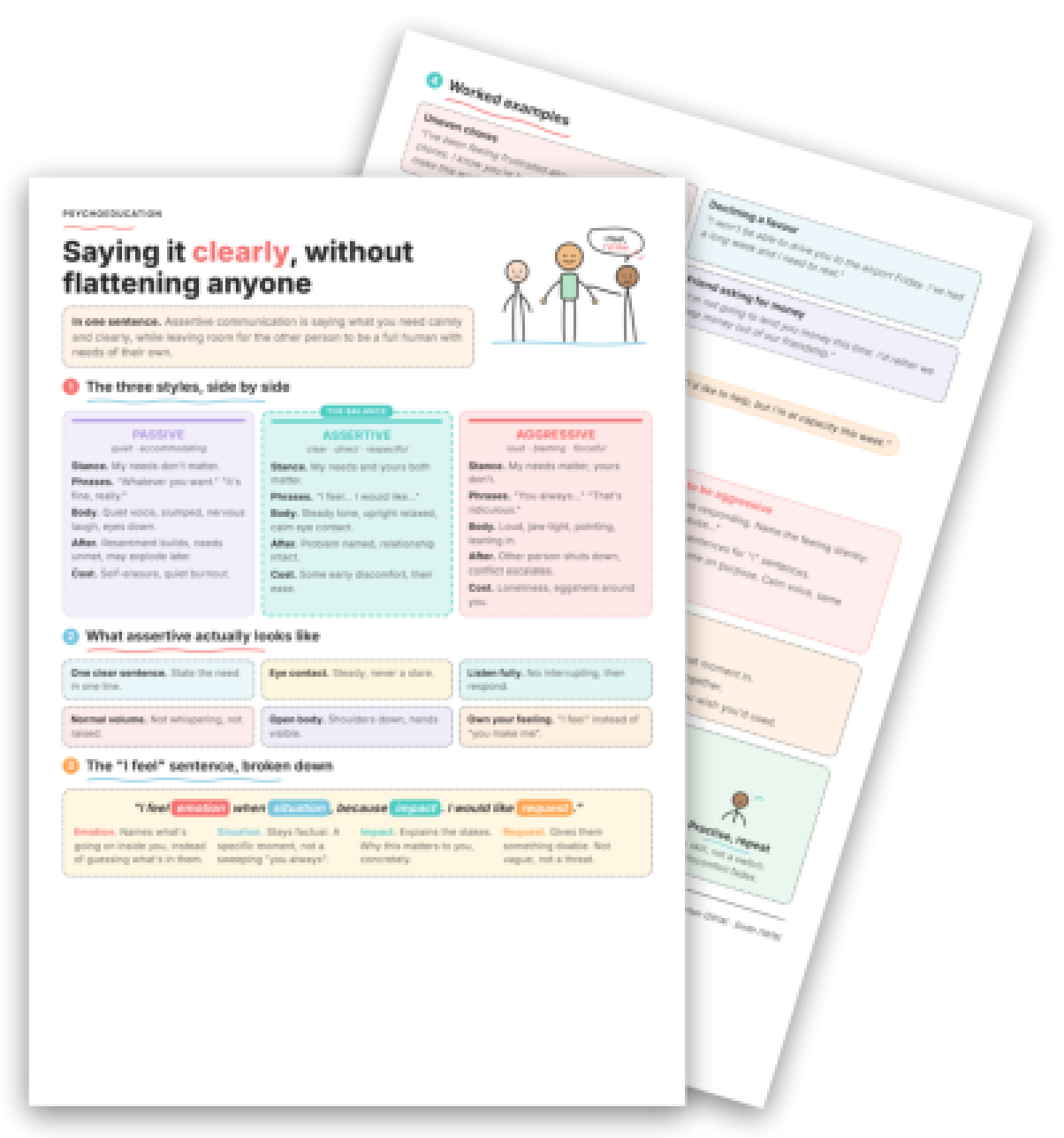
The fiche organises its content across six numbered panels, structured as a visual progression rather than a list of tips.
- Panel 1 presents the three styles, passive, assertive, and aggressive, in a side-by-side layout. Each column names the stance ("My needs don't matter" versus "My needs and yours both matter"), the characteristic phrases, the body signals, and the relational aftermath. Seeing all three on one page makes the contrast structurally obvious in a way that sequential verbal description cannot.
- Panel 2 breaks down what assertive behaviour actually looks like: one clear sentence, steady eye contact, normal volume, open posture, and owning the feeling with "I feel" rather than "you make me."
- Panel 3 deconstructs the "I feel" sentence into four named components: emotion, situation, impact, and request, with a fill-in template the patient can adapt.
- Panels 4 and 5 offer four worked examples (uneven chores, declining a favour, a noisy neighbour, a friend asking for money) plus a set of ready-made refusal phrases, giving the patient concrete verbal scripts rather than abstract principles.
- Panel 6 differentiates entry points depending on whether the patient tends passive or aggressive, with specific low-stakes first steps and body-based cues. A "To discuss in session" section closes the fiche with three prompts the patient can bring back to you.
> Key point: this fiche is a visual support that facilitates your explanation in session, not a self-administered questionnaire. The side-by-side layout earns its place precisely because it externalises a distinction that lives, for most patients, as a felt but unarticulated confusion.
The four-component template in Panel 3 pairs naturally with active listening skills and the communication techniques covered in Reflections, giving you a coherent psychoeducation sequence across sessions.
750+ clinical tools
A library built with and for clinicians, ready to use in session and extend between appointments.
Access all the toolsWhen and How to Introduce the Fiche in Your Work
This fiche fits naturally in early-to-mid treatment, once the formulation is clear and the alliance is established, but before graduated behavioural work begins. It is particularly useful with patients presenting social anxiety, chronic conflict avoidance, or interpersonal patterns driven by a defectiveness or subjugation schema.
For passive presentations, you can introduce it as: "I'd like to show you something that maps out what we've been discussing, so you have a concrete reference between sessions." For patients with aggressive tendencies, framing it around the relational cost column ("what happens after") tends to reduce defensiveness more than framing it around style change.
After reviewing the fiche together, the Panel 6 prompts work well as a between-session task: ask the patient to notice one moment where they said "it's fine" while their stomach tightened, and name it at the next appointment. The Assertiveness Ladder can then structure a graded exposure sequence, and Assertive Rights adds a values-based layer for patients who need permission before they can practise. For work with couples, the Communication in Couples program extends the same framework into the relational system. If a patient reports difficulty holding their ground with someone who pushes back hard, the Asserting Yourself With an Aggressive Person fiche addresses that specific scenario directly.
One contraindication worth naming: with patients in an actively volatile relational context (intimate partner conflict with escalation risk), move slowly. The fiche supports skills acquisition; it does not replace a safety assessment or interpersonal conflict work grounded in a solid formulation.
The fiche does not replace the therapeutic frame. It makes one specific explanation clearer, faster, and leaves the patient with something concrete to return to between sessions.
Use it with your patients
Share this tool in the mobile app and follow the work between sessions.
Sources
- Alberti, R. E., Emmons, M. L. (2017). Your Perfect Right: Assertiveness and Equality in Your Life and Relationships (10th ed.). Impact Publishers / New Harbinger Publications.
- McKay, M., Davis, M., Fanning, P. (2018). Messages: The Communication Skills Book (4th ed.). New Harbinger Publications.
- Yoshinaga, N., Cooper, S. (2025). The four pathways of assertiveness: a multidimensional framework for enhancing individual well-being. Frontiers in Psychology.
- Smith, M. J. (1975). When I Say No, I Feel Guilty. Dial Press.
- Cooper, S., Yoshinaga, N. (2025). The Four Paths of Assertiveness: Speaking Up, Jumping In, Embracing Compassion, and Accepting Life. Johns Hopkins University Press.
Your session continues in your patients' pocket
Use with a patientYour resources, available everywhere
The handouts, exercises, programs and audios above: you choose which ones to make available to your patients, in the mobile app dedicated to them.
And far more than a library
The app goes well beyond resources, to support your patients every day:
Related categories
Explore other clinical resources by category.

Identity
Clinical resources for self-identity work in therapy: CBT, ACT, schema tools for clinicians addressing self-concept, core beliefs, and identity disruption.
Relationships
Clinical worksheets and tools on relational functioning: attachment, schemas, assertiveness, and communication skills for therapists. Printable PDF resources.

Understand
Clinical hub for the therapeutic aim 'Understand': worksheets and tools to build patient insight across CBT, ACT, schema therapy and more.

Build skills
Skill-building resources for clinicians: printable worksheets and exercises for coping, assertiveness, and communication skills training in therapy.
CBT
CBT worksheets, cognitive restructuring exercises & behavioral tools for clinicians. Evidence-based resources for every phase of cognitive behavioral therapy.

Anxiety
Clinical hub for anxiety disorders: CBT and ACT worksheets, psychoeducation sheets, and exercises for assessment and treatment across the anxiety spectrum.