
Clinical picture. A, a woman in her late thirties, presented following a work-related burnout. She described herself as competent in her professional role yet unable to decline requests from colleagues, and she minimised her own needs with phrases such as "I just need to toughen up." The clinician introduced the three-pillar framework during a psychoeducation session, inviting A to rate each domain independently. She placed self-efficacy at 7, self-esteem at 4, and assertiveness at 3, and she noted with some surprise that her sense of competence had not protected the other two columns. Work in subsequent sessions prioritised the inner-critic reframe for self-esteem alongside structured assertiveness rehearsal; within six weeks A reported fewer somatic complaints on days she had held a boundary, a modest but clinically meaningful shift.
Three Pillars of Self-Confidence: PDF Worksheet, Tools and Exercises
A visual psychoeducation tool helping clinicians explain self-esteem, self-efficacy, and assertiveness as three distinct, trainable pillars in a single session.
Clinical vignettes
Uneven Pillars in Burnout Recovery
Avoidance Reframed as Low Self-Efficacy
Clinical picture. T, a man in his mid-twenties, sought help for social withdrawal following an academic failure. He attributed the avoidance to anxiety, but initial assessment suggested a more specific pattern: he would engage socially when rules were clear and stakes felt low, yet he consistently opted out of novel situations with the reasoning "I am just not that kind of person." The clinician used the three-pillar worksheet to separate this narrative from a global self-worth problem, locating it primarily in self-efficacy. T was asked to identify three past difficulties he had navigated without certainty in advance; he produced them reluctantly, then sat with the inconsistency between that evidence and his prediction. A graded task was agreed upon for the following week, kept deliberately small; completion of it became the first entry in an ongoing record of small actions taken before confidence was present.
When a patient says "I have no self-confidence," the complaint is clinically real but structurally opaque. Without a shared framework, the conversation drifts. This fiche PDF gives you a precise visual scaffold to pull the concept apart in session, target the weakest pillar immediately, and leave the patient with something concrete enough to use between appointments.
Use this resource with your patients
Handout, exercises and materials ready to use, right inside SessionFuel.
Why "confidence" is so hard to disentangle in session
The word functions as a catch-all. The patient presenting with a harsh inner critic is describing a deficit in self-esteem. The one who freezes before attempting anything new has a self-efficacy problem, in Bandura's sense: the expectancy that effort will produce results is broken. The one who swallows every refusal and builds quiet resentment is struggling with assertiveness. Clinically, these are distinct mechanisms with distinct intervention targets. Conflating them orally, in real time, is nearly inevitable because the patient's own vocabulary does not distinguish them.
The second sticking point is causal direction. Patients assume they must feel confident before they can act. Correcting that sequence in conversation is easy to lose; a visual that makes it explicit survives the session.
Working on social comparison patterns compounds the difficulty: a patient comparing themselves unfavorably across all three dimensions simultaneously resists any intervention that addresses only one thread. The fiche names the structure before any of that negotiation begins. It also pairs naturally with a more detailed look at signs and clinical features of low self-esteem when you want to deepen the formulation.
What the fiche contains, and why the visual layout earns its place
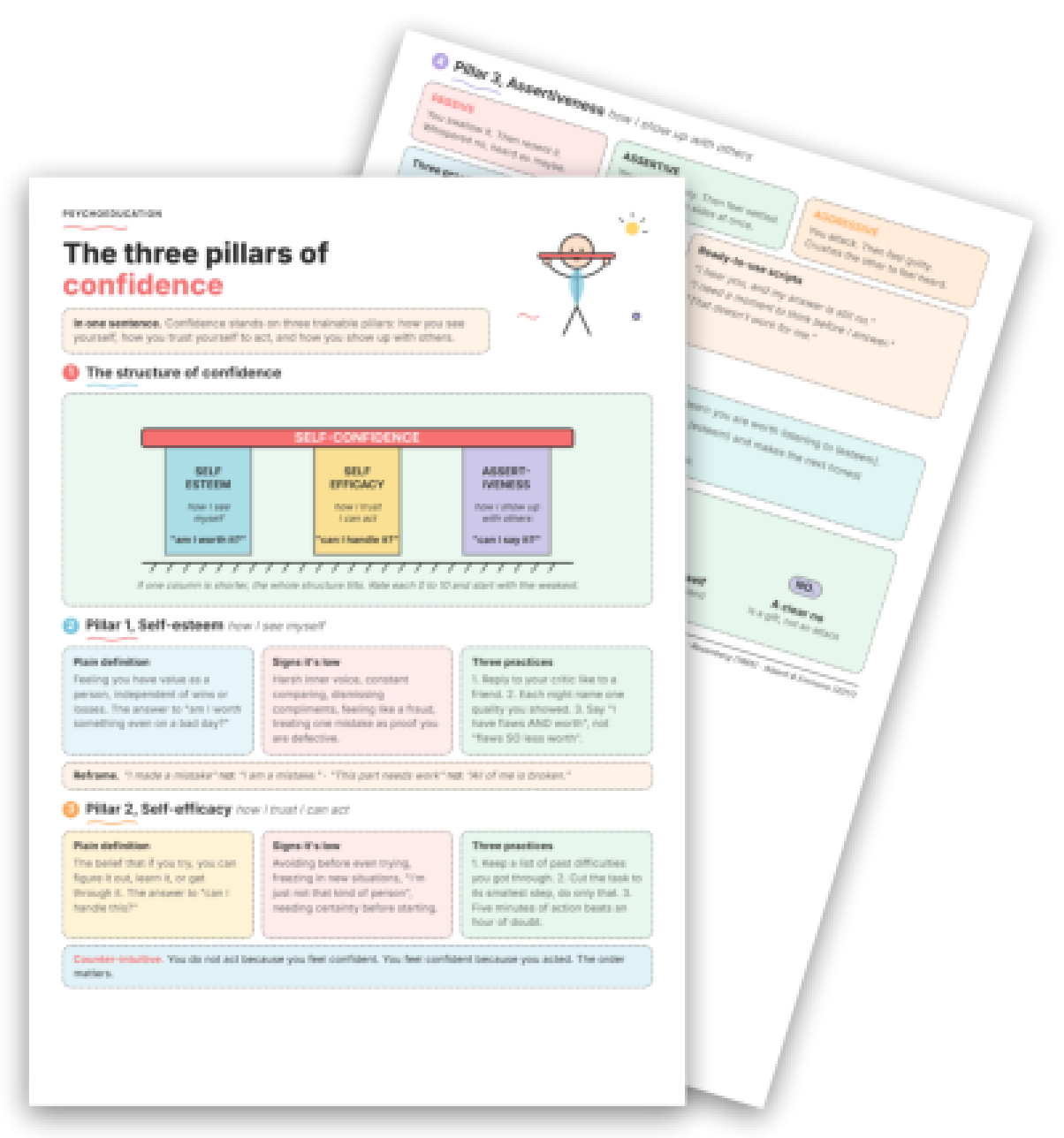
The fiche opens with a three-column diagram titled "The structure of confidence." Each column is labelled and anchored to a defining question: self-esteem ("am I worth it?"), self-efficacy ("can I handle it?"), assertiveness ("can I say it?"). Beneath the columns, a single instruction: "if one column is shorter, the whole structure tilts. Rate each 0 to 10 and start with the weakest." That prompt converts a diffuse complaint into a prioritised, measurable entry point before you have said another word.
Each pillar then gets a dedicated panel.
- Pillar 1, self-esteem: plain definition, five behavioural signs of deficit (including dismissing compliments and imposter functioning), three daily practices, and two reframe pairs contrasting "I made a mistake" with "I am a mistake."
- Pillar 2, self-efficacy: the counter-intuitive sequence made explicit in the fiche itself: "You do not act because you feel confident. You feel confident because you acted. The order matters." Plus three practices built around past evidence and minimal behavioural steps.
- Pillar 3, assertiveness: a three-column passive/assertive/aggressive contrast, I-statement practice, body posture anchors, and four ready-to-use scripts including "I hear you, and my answer is still no."
A final panel maps how the pillars feed each other, showing the virtuous cycle that begins with a single assertive refusal. That systemic view is what a purely oral explanation almost never produces.
> Key point: the fiche is a visual support that facilitates the in-session explanation of the three-pillar model; it is not a questionnaire the patient fills out alone, but a shared psychoeducation tool the clinician uses to make a complex structure concrete, save explanation time, and anchor a common vocabulary.
The assertiveness panel integrates smoothly with dedicated resources: assertive I-messages, assertive body language work, and the DBT DEAR MAN skill all extend what the fiche introduces.
750+ clinical tools
A library built with and for clinicians, ready to use in session and extend between appointments.
Access all the toolsWhen and how to propose the fiche
The fiche fits best in the early consolidation phase, once the alliance holds and the anamnesis is sufficient to identify the weakest pillar. For patients presenting with impostor syndrome or chronic self-comparison, pillar 1 is usually the entry point. For avoidance-driven profiles, start with pillar 2 and pair it with growth mindset work. Patients with a long history of swallowed refusals will benefit most from pillar 3 first; the setting personal limits resource makes a natural follow-up.
Introduce it simply: "I want to show you something that maps what you've been describing. Most of what you call confidence actually has three separate parts, and they don't all work the same way." Place the fiche between you, trace the column diagram together, then invite the 0-to-10 rating. The patient's own scores drive the next thirty minutes; your task is to go wherever the lowest number points.
For sustained work, the self-image and self-esteem psychoeducation program, the inner dialogue program, and exercises such as accepting compliments or self-acceptance and self-compassion extend the fiche into the medium and long term. The fiche does not replace the therapeutic frame; it makes the first explanation precise and leaves the patient with a map they can actually return to.
Use it with your patients
Share this tool in the mobile app and follow the work between sessions.
Sources
- Rosenberg, M. (1965). Society and the Adolescent Self-Image. Princeton University Press.
- Branden, N. (1994). The Six Pillars of Self-Esteem. Bantam Books.
- Alberti, R. E., Emmons, M. L. (2017). Your Perfect Right: Assertiveness and Equality in Your Life and Relationships (10th ed.). New Harbinger Publications.
- Ach, J. S., Pollmann, A. (2022). Self-Confidence, Self-Assertiveness, and Self-Esteem: The Triple S Condition of Personal Autonomy. Springer.
Your session continues in your patients' pocket
Use with a patientYour resources, available everywhere
The handouts, exercises, programs and audios above: you choose which ones to make available to your patients, in the mobile app dedicated to them.
And far more than a library
The app goes well beyond resources, to support your patients every day:
Related categories
Explore other clinical resources by category.

Identity
Clinical resources for self-identity work in therapy: CBT, ACT, schema tools for clinicians addressing self-concept, core beliefs, and identity disruption.

Understand
Clinical hub for the therapeutic aim 'Understand': worksheets and tools to build patient insight across CBT, ACT, schema therapy and more.

Build skills
Skill-building resources for clinicians: printable worksheets and exercises for coping, assertiveness, and communication skills training in therapy.

CBT
CBT worksheets, cognitive restructuring exercises & behavioral tools for clinicians. Evidence-based resources for every phase of cognitive behavioral therapy.

Positive psychology
Positive psychology clinical resources for therapists: worksheets, exercises & programs on well-being, strengths, gratitude, and resilience-based practice.
Anxiety
Clinical hub for anxiety disorders: CBT and ACT worksheets, psychoeducation sheets, and exercises for assessment and treatment across the anxiety spectrum.