
Clinical picture. M., a woman in her early forties, presented with a third depressive episode characterised by pervasive self-critical rumination and a firmly held belief that she had "nothing to offer." Her therapist introduced the List of 100 Strengths during a session, asking her simply to read through and tick any word that resonated even faintly, without evaluating or justifying each choice. M. moved through the list slowly, ticking fourteen items on the first pass; she circled "perseverance," "empathy," and "loyalty" as most representative on a second pass. She acknowledged these felt true, though unfamiliar to hold consciously, and agreed to keep the shortlist on her bedside table as concrete counter-evidence for the week ahead.
HandoutSelf & identityMood & depressionBuild awarenessEngage & motivateRepair & soothePositive psychologyCBT
List of 100 Strengths and Qualities: PDF Worksheet, Tools and Exercises
A printable PDF fiche clinicians can use in session to broaden a patient's self-perception beyond self-criticism and surface the capacities they already carry.
Clinical vignettes
Reorienting Attention in Recurrent Depression
Strengths Inventory After Burnout
Clinical picture. T., a man in his late thirties referred following occupational burnout, described a near-total collapse of his professional identity and stated he no longer knew "who he was" outside his former role. His psychologist offered the worksheet as a low-demand between-session task, framing it as a broad scan rather than a self-assessment exercise. T. returned the following week having ticked twenty-two items; he was visibly surprised by the number and noted he had almost skipped "curiosity" and "care for detail" before the instruction to override the inner veto prompted him to tick them anyway. The exercise opened a productive conversation about qualities that had existed before the role and would persist beyond it, which shifted the focus of subsequent sessions toward identity reconstruction rather than loss alone.
Ask a patient presenting with low self-esteem or perfectionism to name five of their strengths aloud, and the inner critic fills the silence before they can answer. This fiche PDF sidesteps that block by widening the visual field: a structured checklist of 100 qualities that pulls attention away from the deficit narrative and toward what the patient already carries.
Use this resource with your patients
Handout, exercises and materials ready to use, right inside SessionFuel.
Why Strengths Are So Hard to Name in Session
When self-criticism is running loudly, attention narrows. This is not a motivational problem; it is an attentional one. Patients tracking their failures are not scanning for capacity, and asking them to generate strengths spontaneously tends to trigger either the inner critic ("I can't think of any") or a performance response ("I guess I'm organised?"). The yield is thin, and the exchange rarely produces the durable, named evidence that reprocessing work requires.
The problem is compounded with patients in a depressive episode, where the negativity bias distorts self-evaluation globally, and with those caught in chronic social comparison, where any self-attributed quality is immediately benchmarked against someone else. Oral enumeration in those conditions rarely sticks.
A printed list operates differently. Reading 100 words in sequence requires much less generative effort than free recall, and the sheer breadth of the lexicon tends to catch qualities the patient would never have volunteered unprompted. The visual format does the retrieval work; the patient only has to recognise.
Clinical library
750+ clinical tools
A library built with and for clinicians, ready to use in session and extend between appointments.
Access all the toolsSeveral resource types
Psychoeducation handouts
Understand at a glance
Interactive exercises
To do and fill in
Interactive programs
A structured path
Audios
Meditation and relaxation
Psychometric tests
Automatic scoring
What the Fiche Contains: A Visual Tool for Broadening Self-Perception
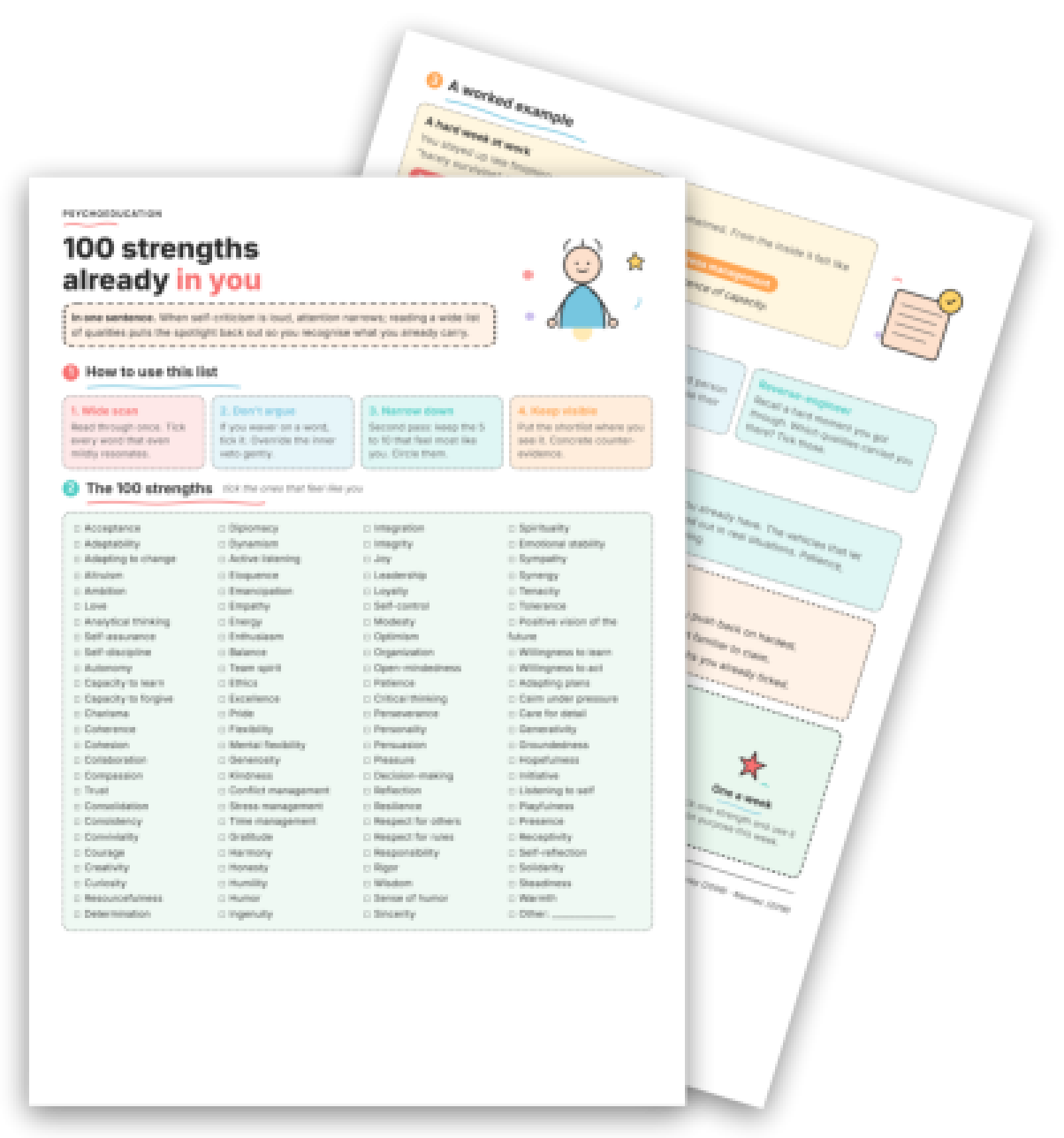
The fiche PDF is structured across five numbered panels.
Panel 1 outlines a four-step protocol: a first wide scan (tick everything that even mildly resonates), an instruction to override hesitation ("If you waver on a word, tick it"), a second pass to narrow to 5-10 core qualities, and a directive to keep the shortlist visible as "concrete counter-evidence." Panel 2 presents the 100 qualities as a tick-box grid, spanning entries as varied as Groundedness, Playfulness, Tenacity, Eloquence, and Calm under pressure, with a free-text "Other" field at the end.
Panel 3 offers a worked example: a patient who got through an overwhelming work week and, seen through the lens of the list, is carrying Perseverance, Self-discipline, Responsibility, and Stress management. The panel names this explicitly: "Naming them turns the week from 'I just survived' into evidence of capacity." Panels 4 and 5 address two frequent clinical situations: a blank sheet (where the fiche reframes non-ticking as information about the inner critic rather than absence of strengths) and a strengths-versus-values distinction that is genuinely useful to work through in session, clarifying that strengths are existing capacities while values are directions still being pursued.
The closing section carries three "To discuss in session" prompts and four brief reminders (Already in you, Keep it visible, Borrow eyes, One a week) that translate well into between-session directives.
> Key takeaway: The fiche is a visual support that facilitates the explanation of strengths-based work in session; it is not a questionnaire the patient completes alone. The clinician guides the scan, names the mechanism, and uses the shortlist as an anchor for the therapeutic conversation.
Use it with your patients
Share this tool in the mobile app and follow the work between sessions.
When and How to Propose It
This fiche integrates most naturally in the early-to-mid phase of work with patients whose self-representation is dominantly negative: presentations mapped on Fennell's CBT model of low self-esteem, schema therapy formulations organised around Defectiveness or Failure, or anyone for whom the feeling of not being good enough is a recurring session theme. It is also a strong complement to self-image and self-esteem programmes and pairs well with Best Possible Self exercises once the patient has some recognised capacity to anchor the projection.
To introduce it without triggering performance anxiety, a formulation like: "I'd like us to go through a list together, not to evaluate you, but because self-criticism tends to make the field very narrow, and this list is wider than what any of us can generate on the spot." The in-session use is collaborative: the clinician watches which items the patient skips quickly (the rejected items are diagnostically as rich as the ticked ones), names hesitations without arguing them, and helps the patient select a shortlist of 5-10 at the end.
For couples work, having each partner complete the list independently and then compare shortlists generates productive material about how each is seen by the other. The "Borrow a friend's eyes" instruction in Panel 4 translates directly into a between-session task. From there, celebrating personal successes and clarifying values are natural next steps that deepen the work the fiche opens.
The one limit worth noting: in presentations with active grandiosity or significant alexithymia, the tick-everything instruction may not function as intended. Use clinical judgment on timing, and consider pairing it with the I Am Unique holistic self-worth exercise for patients who need a more structured scaffold around self-description.
The fiche does not replace the formulation work; it gives the patient something concrete to carry out of the room and re-read when the inner critic is loudest.
Patient mobile app
Your session continues in your patients' pocket
Use with a patientYour resources, available everywhere
The handouts, exercises, programs and audios above: you choose which ones to make available to your patients, in the mobile app dedicated to them.
Psychoeducation handoutsInteractive exercisesInteractive programsAudiosPsychometric tests
And far more than a library
The app goes well beyond resources, to support your patients every day:
Standardized tests
Therapy journal
Gamification
Wellbeing challenges
Introspection prompts
Therapist homework
Related categories
Explore other clinical resources by category.
Mood
Evidence-based worksheets and clinical tools for mood disorders: CBT, ACT, and positive psychology resources for psychologists and therapists.

Identity
Clinical resources for self-identity work in therapy: CBT, ACT, schema tools for clinicians addressing self-concept, core beliefs, and identity disruption.
Build awareness
Clinical worksheets and tools to build awareness in therapy: cognitive distortions, schemas, emotions, ACT and CBT resources for practitioners.

Engage & motivate
Clinical hub: printable worksheets and exercises to build therapeutic engagement and motivation across ACT, CBT, and integrative practice. For clinicians.
Repair & soothe
Clinical resources for the repair and soothe therapeutic aim: worksheets, exercises and tools to build self-compassion, reduce shame and restore emotional safety.
CBT
CBT worksheets, cognitive restructuring exercises & behavioral tools for clinicians. Evidence-based resources for every phase of cognitive behavioral therapy.