
Clinical picture. A, a woman in her early forties, presented with moderate depressive symptoms following a prolonged period of occupational burnout; she described a pervasive sense of having "nothing left to offer." In session, the clinician introduced the Strengths List worksheet, noting that the task was not self-promotion but accurate description, and invited her to read through all 35 items slowly before circling anything. A circled seven qualities, pausing longest at empathy and persistence, and acknowledged that she had "never thought of those as anything special." The following week she returned having completed the anchoring step, linking persistence to a specific memory from years prior. This shift in self-description did not resolve her low mood, yet she reported that the inner monologue had become, in her words, "slightly less harsh."
Strengths List: PDF Worksheet, Tools and Exercises for Clinical Practice
A printable PDF worksheet clinicians can use in session to break through the 'blank' patients hit when asked what they are good at, with 35 named strengths and a six-step anchoring process.
Clinical vignettes
Naming Strengths After Burnout
Strengths Identification in Adolescent Low Self-Esteem
Clinical picture. T, a seventeen-year-old referred for low self-esteem and social withdrawal, gave a flat "I don't know" when asked in an early session what he was good at. The clinician offered the Strengths List as a take-home worksheet, framing it explicitly as a way to borrow words when one's own are unavailable. T returned having circled humor, loyalty (mapped onto kindness and love on the sheet), and logic, and had written a brief memory beside each. He noted that seeing the word humor printed neutrally on a clinical document made it feel "more real, less like I'm just saying it." Engagement with the worksheet opened a more substantive conversation about personal identity that had stalled in the preceding two sessions.
Most patients struggling with low self-esteem, depression, or a defectiveness schema do not lack strengths. They lack the vocabulary to access them. Ask "what are you good at?" and watch the freeze happen in real time. This PDF worksheet gives you a concrete, visual tool to break that freeze during the session itself, rather than waiting for insight to emerge spontaneously over weeks.
Use this resource with your patients
Handout, exercises and materials ready to use, right inside SessionFuel.
Why strength recognition resists verbal explanation
The difficulty is partly lexical and partly motivational. Patients fused with a negative self-image will dismiss any strength you name on their behalf as an exception, a fluke, or evidence of your naivety. The classic interpretive bias toward self-referential negative information (Beck's work on the negative cognitive triad) makes an oral exchange particularly fragile: the patient's working memory is already loaded with counter-evidence before you finish your sentence.
There is also the modesty inhibitor. Naming a strength aloud, to a clinician, triggers shame-adjacent monitoring in many patients. The fiche sidesteps both problems. Circling a word on paper is a far lower-stakes act than making a verbal assertion. The worksheet frames this explicitly: "Naming a strength is just accurate description, the same way you'd describe your eye colour." That reframe, delivered visually and in writing, lands differently than the same sentence spoken.
For patients working through impostor syndrome or persistent feelings of not being good enough, the gap between "I have no strengths" and "I cannot currently name my strengths" is clinically significant. The fiche makes that gap visible.
750+ clinical tools
A library built with and for clinicians, ready to use in session and extend between appointments.
Access all the toolsWhat the worksheet contains
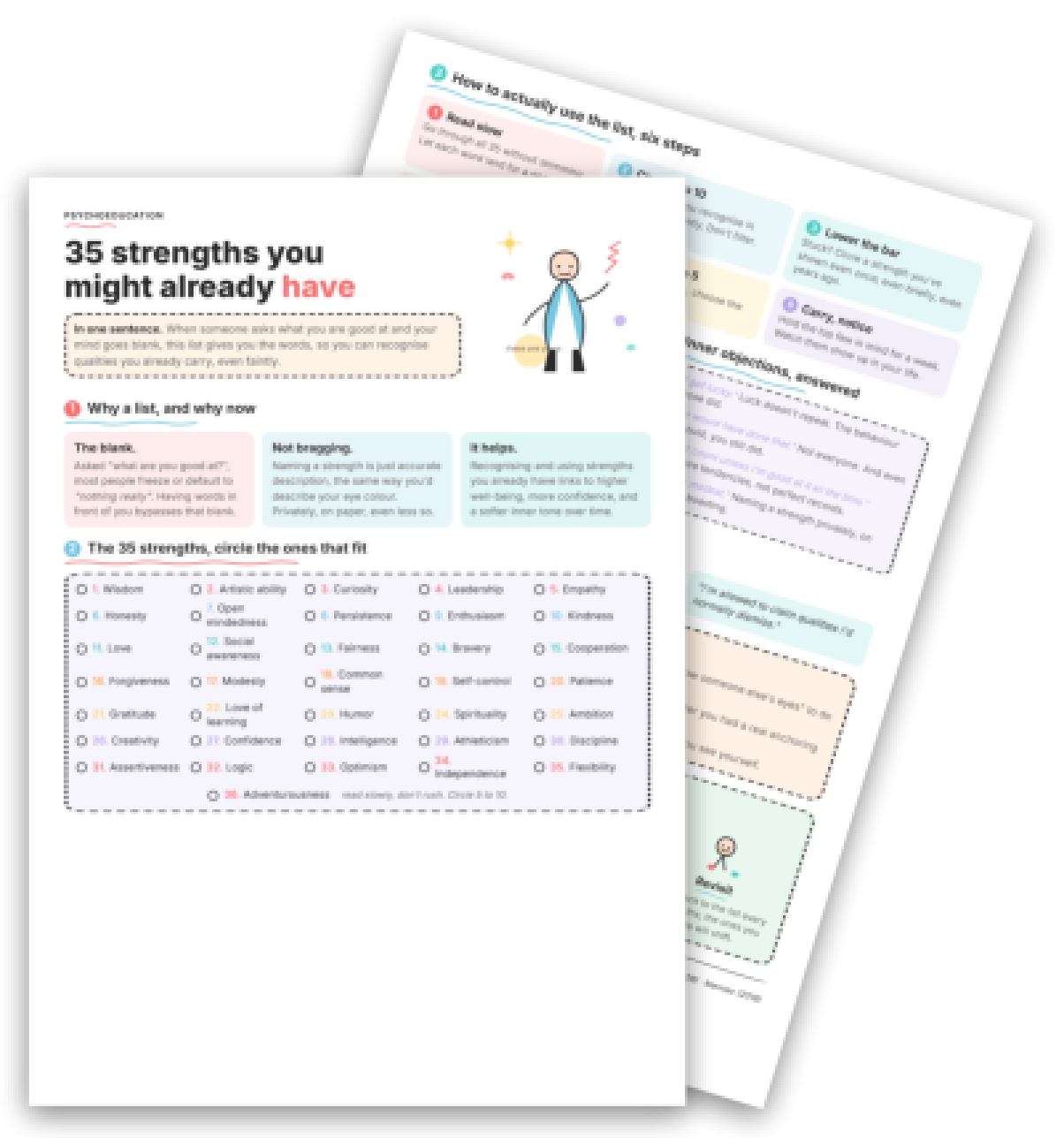
The fiche PDF is organized across six panels. The first contextualizes the exercise: why a list exists, the distinction between description and bragging, and the evidence base linking strengths use to well-being (Peterson & Seligman, 2004; Linley, 2008; Niemiec, 2018).
The core panel presents 35 named strengths to circle, from Wisdom and Empathy to Flexibility and Adventurousness, covering character virtues, social strengths, cognitive traits, and practical capacities. The visual layout matters: seeing all 35 simultaneously prevents the patient from stopping at the first one that does not fit. The instruction "read slowly, don't rush, circle 5 to 10" is printed directly on the sheet, so you do not have to keep repeating it.
A six-step process follows: slow reading, circling 5 to 10, lowering the bar (a strength shown even once counts), anchoring each circled item to a concrete autobiographical moment, selecting a top 3 to 5, and carrying those forward into daily observation. This sequence converts an abstract self-concept task into a grounded behavioral one, which is directly compatible with behavioral activation work and the Best Possible Self exercise.
Two further sections address in-session friction. The "if you're stuck" panel offers four strategies, including borrowing a close other's perspective and inverting the task by crossing out what definitely does not fit. The inner objections panel pre-empts the most common resistance ("I just got lucky," "it doesn't count unless I'm consistent"), with short written rebuttals the patient can re-read independently. The closing panel lists three prompts explicitly flagged "to discuss in session," which gives you a ready debrief structure without constructing it from scratch.
> Key takeaway: this is a visual support that facilitates the in-session explanation of strengths recognition; it is not a self-assessment the patient completes alone. The clinician uses it to anchor a concept that oral psychoeducation rarely consolidates on its own.
Use it with your patients
Share this tool in the mobile app and follow the work between sessions.
When and how to introduce the worksheet
The fiche is most productive in the mid-phase of a care plan, once the formulation is shared and the alliance is solid enough for the patient to tolerate mild cognitive challenge. Introducing it too early, before the patient has a working model of their own maintenance cycles, risks it being dismissed as generic positivity.
For patients carrying a positive traits checklist deficit or working through a growth mindset reframe, you can introduce it with a simple framing: "I'd like us to look at something together. Not to convince you of anything, just to see what words feel even faintly true."
Walk through the circling process alongside the patient rather than handing the sheet over and waiting. Observe what they skip, what they hover over, and what they dismiss quickly. That behavioral data is often more clinically rich than the final circled list. The celebrating personal successes exercise pairs well afterward, helping patients anchor their top 3 to 5 to specific autobiographical evidence. For couples work, the Couple's Strengths Exploration worksheet extends the same framework to the relational system.
The fiche does not replace a thorough self-compassion component or a holistic self-worth exercise, but it gives patients a concrete vocabulary before that deeper work becomes possible.
Your session continues in your patients' pocket
Use with a patientYour resources, available everywhere
The handouts, exercises, programs and audios above: you choose which ones to make available to your patients, in the mobile app dedicated to them.
And far more than a library
The app goes well beyond resources, to support your patients every day:
Related categories
Explore other clinical resources by category.
Mood
Evidence-based worksheets and clinical tools for mood disorders: CBT, ACT, and positive psychology resources for psychologists and therapists.

Identity
Clinical resources for self-identity work in therapy: CBT, ACT, schema tools for clinicians addressing self-concept, core beliefs, and identity disruption.
Build awareness
Clinical worksheets and tools to build awareness in therapy: cognitive distortions, schemas, emotions, ACT and CBT resources for practitioners.

Engage & motivate
Clinical hub: printable worksheets and exercises to build therapeutic engagement and motivation across ACT, CBT, and integrative practice. For clinicians.
Repair & soothe
Clinical resources for the repair and soothe therapeutic aim: worksheets, exercises and tools to build self-compassion, reduce shame and restore emotional safety.

ACT
Clinical hub for Acceptance and Commitment Therapy (ACT): worksheets, exercises, programs and audio resources for practitioners using the ACT model.