
M., a 34-year-old with recurrent depressive episodes, described a near-total inability to identify personal strengths during a session focused on self-concept work. The clinician introduced the Three Good People worksheet and asked M. to begin with a fictional character before touching on herself at all. M. chose a character from a fantasy novel and wrote at length about the character's persistence and quiet loyalty, then moved with surprising ease to a former teacher she admired. When she reached Step 3 and turned the lens on herself, she named persistence and loyalty without prompting, recognising them as patterns she had just traced twice. Her self-referential writing remained cautious but was markedly less self-dismissive than in previous exercises that had asked her to start from her own qualities directly.
Three Good People: PDF Worksheet, Tools and Exercises for Strengths Spotting
A printable strengths-spotting fiche that uses fictional characters and real-life figures as a warm-up, so patients can finally identify their own qualities in session.
Clinical vignettes
Bypassing the Self-Criticism Filter
Strengths Visibility in Chronic Low Self-Esteem
P., a 28-year-old referred for generalised anxiety with a longstanding history of social comparison and self-deprecation, had consistently produced blank or minimal responses to standard strengths-identification prompts across several sessions. The clinician offered the Three Good People sheet as a structured alternative, framing the fictional and admired-person steps as warm-up moves rather than the exercise itself. P. engaged readily with Step 1, choosing a video game character and describing their resilience and fairness in detail; Step 2 produced an account of a sibling's steadiness under pressure that P. noted felt easy and natural to write. Arriving at Step 3, P. identified steadiness and fairness as her own qualities, linking them to a concrete episode at work she had previously described only as stressful. The clinician used the completed sheet as a reference point in the following session, where P. was able to speak about her own capacities with slightly less hedging.
Ask a patient to list their own strengths and you will, more often than not, get a long pause, a dismissive shrug, or a list of achievements masquerading as qualities. The self-evaluative filter that blocks strength identification in adults is well-documented in the positive psychology literature (Peterson & Seligman, 2004; Linley, 2008). This fiche PDF routes around it by warming up the pattern recognition through two other people before asking patients to turn the lens on themselves.
Use this resource with your patients
Handout, exercises and materials ready to use, right inside SessionFuel.
Why Asking "What Are Your Strengths?" Almost Never Works
The difficulty is not motivational. Patients who genuinely want to build self-esteem can still freeze when asked to name their qualities directly. Labelling a strength about oneself activates the same cognitive filters that sustain low self-image: it sounds arrogant, it feels exaggerated, it conflicts with the existing negative core belief. The fiche makes explicit that this is a common and predictable mechanism, not a character flaw.
A second problem is vocabulary. Many patients have never been given a working definition of what a strength actually is. They reach for trophies, titles, or external validation rather than patterns of action, which leads to the classic "I don't have any achievements worth mentioning" dead-end. For patients carrying signs of low self-esteem or an impostor syndrome pattern, this confusion is especially common and especially costly.
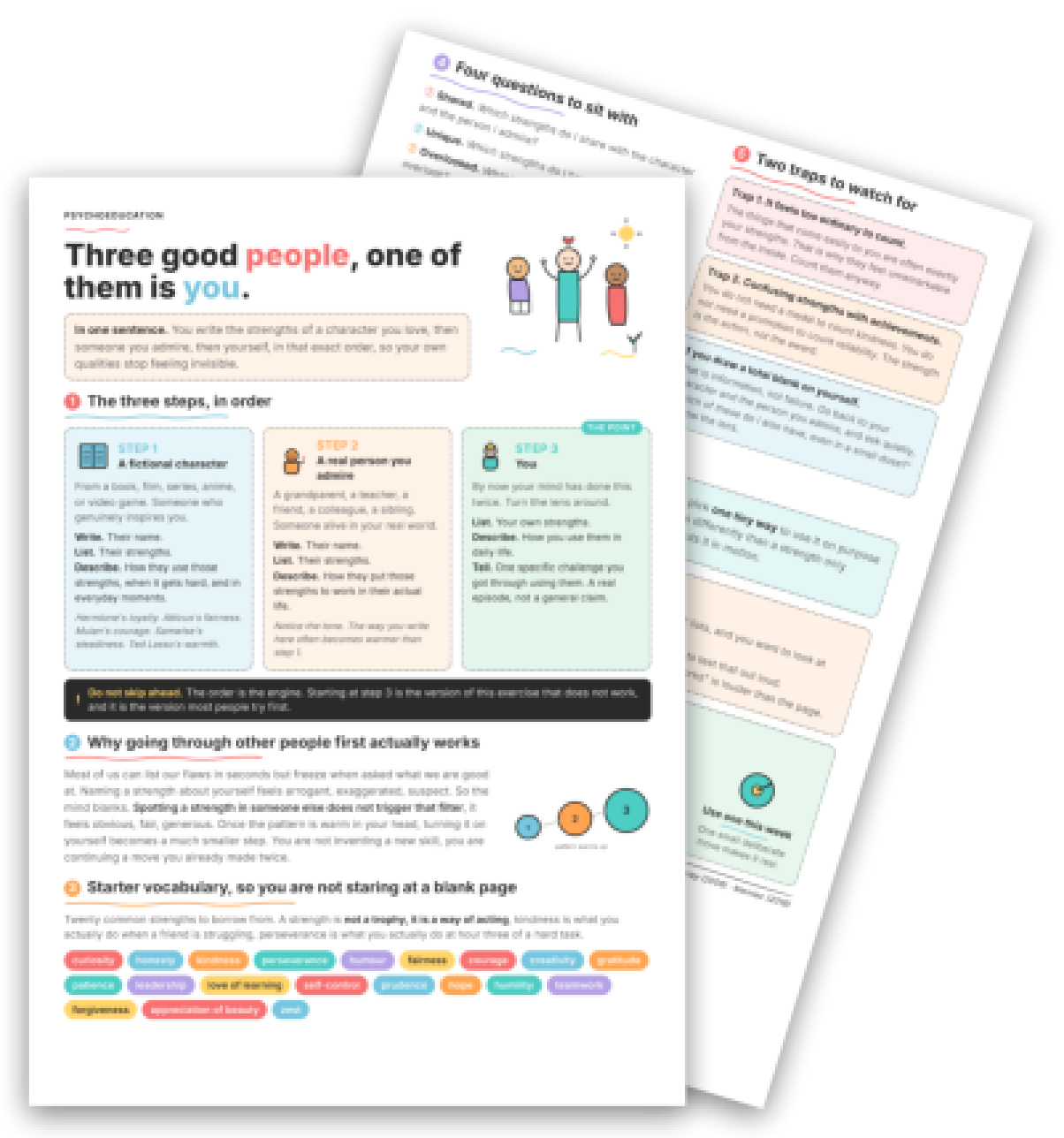
What the Fiche Contains: A Visual Scaffold for the Three-Step Sequence
The fiche is built around a three-step sequence that must be followed in order. Step 1 asks the patient to name a fictional character (from film, literature, a series, or a game) who genuinely inspires them, then list that character's strengths and describe how those strengths show up in hard moments and ordinary ones. Step 2 repeats the move with a real person from the patient's actual life. Only then does Step 3 ask the patient to turn the lens on themselves: list their own strengths, describe how they use them daily, and name one specific challenge they got through using them.
The fiche is explicit about the mechanism: "by now your mind has done this twice," so the cognitive pattern is already warm and the evaluative filter is lower. The visual layout shows the three steps numbered in sequence, with a clear warning panel: "Do not skip ahead. The order is the engine." That phrase alone is often worth projecting in session, because patients will almost always admit they would have gone straight to step 3.
The fiche also includes a starter vocabulary panel of twenty common strengths (curiosity, perseverance, humility, zest, and so on), framed as "a strength is a way of acting, not a trophy." A set of four structured questions invites the patient to identify shared strengths, unique ones, overlooked ones, and underused ones. Two trap-recognition panels address the two most common distortions: dismissing ordinary-feeling strengths, and confusing qualities with awards. A closing section names specific moments to bring the fiche back to session: when the step-3 list is noticeably shorter than the first two, when a patient dismisses their own entries as "ordinary," or before a setback when nothing-about-me-works is louder than the page.
> Key takeaway: this fiche works as a visual support that facilitates the explanation in session, not as an autonomous self-help exercise. The layout makes the sequencing and the underlying rationale transparent, so you can annotate it together with the patient rather than simply explaining the logic aloud.
750+ clinical tools
A library built with and for clinicians, ready to use in session and extend between appointments.
Access all the toolsWhen and How to Introduce It
The fiche fits naturally in the psychoeducation phase of work on self-worth, strengths exploration, or building a best possible self. It is particularly well-suited for patients presenting with low self-esteem, perfectionism, or chronic self-comparison. It also complements the Accepting Compliments exercise for patients whose main difficulty is receiving positive feedback, and pairs with the I Am Unique exercise when the goal is broadening a constricted self-concept.
Introduce it at the end of a session where self-worth or self-perception has come up, and frame it simply: "Before next time, I'd like you to work through this in order, starting with a fictional character, not with yourself. We'll look at what came up together." Debrief by comparing the three lists directly: length, tone, and any strengths that appear across all three. When the patient's self-list is shorter or more hedged than the other two, that gap becomes the clinical material.
For patients who draw a complete blank on step 3, the fiche offers a concrete prompt: "which of these do I also have, even in a small dose?" That reframing is often enough to unblock the exercise and open the conversation. Pair with the Strengths List or the List of 100 Strengths and Qualities for patients who need a broader vocabulary to work from.
The fiche does not replace the therapeutic frame. It gives the explanation a visual structure and leaves the patient with a concrete reference point between sessions.
Use it with your patients
Share this tool in the mobile app and follow the work between sessions.
Sources
- Peterson, C., & Seligman, M. E. P. (2004). Character Strengths and Virtues: A Handbook and Classification. American Psychological Association / Oxford University Press.
- Niemiec, R. M. (2024). Mindfulness and Character Strengths: A Practitioner's Guide to MBSP (2nd ed.). Hogrefe Publishing.
- VIA Institute on Character. Character Strengths and Virtues: The VIA Classification.
Your session continues in your patients' pocket
Use with a patientYour resources, available everywhere
The handouts, exercises, programs and audios above: you choose which ones to make available to your patients, in the mobile app dedicated to them.
And far more than a library
The app goes well beyond resources, to support your patients every day:
Related categories
Explore other clinical resources by category.

Identity
Clinical resources for self-identity work in therapy: CBT, ACT, schema tools for clinicians addressing self-concept, core beliefs, and identity disruption.
Build awareness
Clinical worksheets and tools to build awareness in therapy: cognitive distortions, schemas, emotions, ACT and CBT resources for practitioners.

Engage & motivate
Clinical hub: printable worksheets and exercises to build therapeutic engagement and motivation across ACT, CBT, and integrative practice. For clinicians.

Humanistic
Printable clinical resources for humanistic therapy: worksheets, exercises, and psychoeducation programs for practitioners using person-centered and experiential approaches.

Positive psychology
Positive psychology clinical resources for therapists: worksheets, exercises & programs on well-being, strengths, gratitude, and resilience-based practice.
Anxiety
Clinical hub for anxiety disorders: CBT and ACT worksheets, psychoeducation sheets, and exercises for assessment and treatment across the anxiety spectrum.