
Clinical picture. M., a 34-year-old software engineer, was referred after a recent promotion triggered persistent beliefs that colleagues would soon discover she was unqualified, leading to anticipatory anxiety before each team meeting. The clinician introduced the five-question written exercise as between-session homework, framing it as a structured way to examine the evidence behind her illegitimacy beliefs rather than simply challenge them verbally. M. returned the following week having written at length about a product launch she had led; completing question 3 had required her to name her specific contributions rather than attribute the outcome to luck or team effort. She reported that articulating her role in concrete terms produced mild but noticeable discomfort, which she identified as unfamiliarity with self-attribution rather than inaccuracy. The exercise opened a productive in-session discussion about decoupling self-worth from performance metrics, which M. described as a genuinely new perspective.
Impostor Syndrome: A Guided Self-Reflection Exercise
A structured five-question homework exercise helping patients examine illegitimacy beliefs, reconnect with genuine achievements, and build a more stable self-worth.
Clinical vignettes
Impostor Beliefs in a Newly Promoted Engineer
Self-Worth Instability in a Doctoral Candidate
Clinical picture. T., a 28-year-old doctoral candidate in the humanities, presented with recurrent shame episodes following supervisor feedback, interpreting routine corrections as confirmation that his admission to the programme had been a mistake. The clinician assigned the guided exercise after two sessions, noting that verbal reassurance had so far produced only short-lived relief. T.'s written responses to questions 4 and 5 revealed a pattern in which a single critical remark could erase weeks of perceived progress, and he articulated this dynamic himself rather than receiving it as a therapist interpretation. His answer to question 5, on the right to make errors, was initially brief and formulaic, which became a focal point for exploring why intellectual permission and felt permission remained separate for him. By the third session T. reported a modest but stable reduction in post-feedback rumination, attributing it partly to re-reading his own written account of recent achievements.
Why impostor syndrome resists purely verbal work
Most patients who present with impostor syndrome can articulate the cognitive distortion fairly quickly: they know, rationally, that their colleagues are not about to unmask them. What they cannot do is feel that knowledge. The gap between intellectual understanding and lived conviction is where this work stalls.
In session, psychoeducation about cognitive distortions or low self-esteem maintenance cycles lands cognitively but rarely disrupts the affective core of illegitimacy. Patients tend to deflect praise, attribute success to luck or circumstance, and treat each failure as irrefutable evidence, a pattern closely related to disqualifying the positive and to the Failure to Achieve schema. What is needed is structured, deliberate contact with the patient's own history of competence, something they produce themselves, in their own words, away from the consulting room.
Key takeaway: Impostor syndrome is maintained less by lack of insight than by the absence of a reliable, personal evidence base that the patient has built for themselves. The exercise creates that base.
Use this resource with your patients
Handout, exercises and materials ready to use, right inside SessionFuel.
What the exercise contains
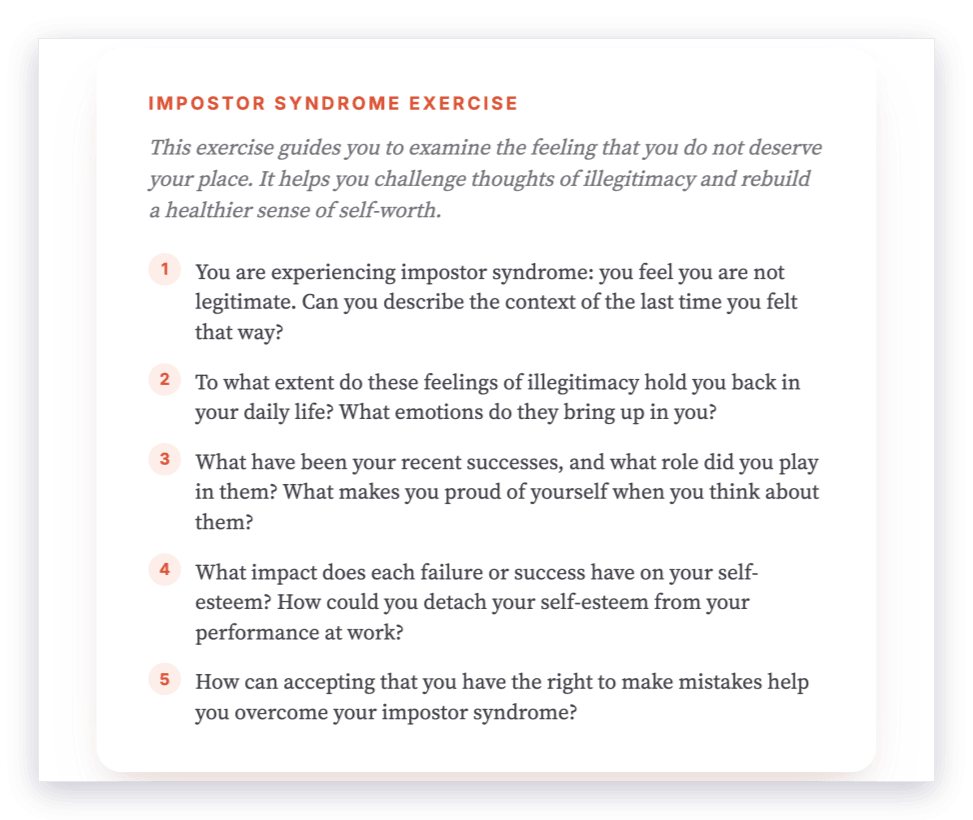
The five questions move through a deliberate clinical arc. The patient begins by naming a specific recent episode of illegitimacy: the context, the trigger, the moment it took hold. This grounds the work in lived experience rather than abstraction. The second question asks the patient to rate the functional impact of these thoughts and to identify the emotions they generate, building affective awareness alongside cognitive mapping.
Questions three and four form the therapeutic core. The patient is asked to recall recent successes and articulate their own role in those outcomes, then to examine the relationship between performance and self-worth directly. This is where the exercise begins to challenge the contingent self-esteem loop that connects impostor syndrome to patterns explored in tools such as Perfectionism: A Guided Self-Reflection Exercise and the Cognitive Behavioral Model of Perfectionism. The fifth question invites the patient to reflect on the right to make mistakes as a lever for loosening illegitimacy, connecting naturally with the work in Accepting Mistakes: A Guided Self-Compassion Exercise.
This image is a static preview listing the exercise questions. The full guided experience, with patient-facing instructions and space to write, is delivered to the patient through the app; it is not contained in this image.
The exercise is a concrete clinical support precisely because it asks for specifics, not generalities. A patient who writes three sentences about their role in a recent project outcome has done something that no amount of in-session reassurance replicates.
This exercise is available to your patients through the patient app of SessionFuel, the mobile interface reserved for the patients of clinicians who use SessionFuel. You assign it directly from your side, and your patient completes it autonomously on their phone, between two appointments.
750+ clinical tools
A library built with and for clinicians, ready to use in session and extend between appointments.
Access all the toolsUse it with your patients
Share this tool in the mobile app and follow the work between sessions.
Integrating this as between-session homework: profiles, introduction, and follow-up
This exercise suits patients who present with high professional functioning alongside chronically fragile self-worth: those who outperform but attribute results externally, those who avoid responsibility for fear of being exposed, and those whose self-criticism escalates precisely at moments of visible success. It also fits patients working on constant self-comparison or self-deprecation in social interactions, where the impostor dynamic is active in relational as well as professional contexts.
A natural introduction is to link the assignment to whatever emerged in the preceding session: "You described feeling out of place in that meeting. Before we meet again, I want you to work through a set of questions about that experience and about what you have achieved recently. You will do this on your own, at a moment when you have some quiet time." Framing it as an autonomous reflection, not homework to be evaluated, reduces the performance anxiety that this patient profile reliably brings to any task.
When the patient returns, three things are worth examining directly. First, how they described their own role in question three: did they minimise, qualify, or genuinely own the contribution? Second, what emerged in question four around decoupling self-esteem from performance, which may open the door to deeper work on core beliefs or to replacing a negative core belief. Third, the response to question five about the right to make mistakes, which frequently reveals the rigidity of internal standards and connects to the broader self-image and self-esteem work many of these patients need over time.
What the patient produces is not a finished piece of cognitive restructuring. It is raw material: specific episodes, named emotions, and a first attempt at owning competence. That material gives the next session a concrete starting point and makes the invisible pattern visible enough to work with.
Your session continues in your patients' pocket
Use with a patientYour resources, available everywhere
The handouts, exercises, programs and audios above: you choose which ones to make available to your patients, in the mobile app dedicated to them.
And far more than a library
The app goes well beyond resources, to support your patients every day:
Related categories
Explore other clinical resources by category.

Identity
Clinical resources for self-identity work in therapy: CBT, ACT, schema tools for clinicians addressing self-concept, core beliefs, and identity disruption.

Transitions
Clinical hub for life transitions: tools, worksheets and exercises to support psychosocial adjustment, role change and identity work in practice.

CBT
CBT worksheets, cognitive restructuring exercises & behavioral tools for clinicians. Evidence-based resources for every phase of cognitive behavioral therapy.

Compassion-focused
CFT clinical tools for practioners: exercises, programs and guided audio on shame, self-criticism, guilt and self-compassion. Ready to use in session.

Anxiety
Clinical hub for anxiety disorders: CBT and ACT worksheets, psychoeducation sheets, and exercises for assessment and treatment across the anxiety spectrum.

Trauma
Clinical hub on trauma and PTSD: assessment, differential diagnosis, treatment phases, and printable resources for practitioners. 155 chars.