
Clinical picture. M., a woman in her late thirties, presented with recurrent low mood and a longstanding core belief that she was fundamentally unlikeable, held with near-absolute conviction despite a stable social network. During a mid-treatment session, the clinician introduced the informational sheet on core beliefs and evidence filtering, walking through the three-bin model with a recent week from M.'s own diary. M. quickly identified that she had stored a colleague's brief curt reply as proof of the belief, while a birthday invitation from the same colleague two days earlier had registered as "probably an obligation" and left no emotional trace. Naming the filtering process aloud, rather than the belief's content, produced a small but noticeable shift: M. began keeping a running log of events she had placed in the "modified" or "rejected" bins, which became the basis for structured evidence review over the following three sessions. Her conviction rating for the belief dropped from 90% to 68% across that period, without any direct disputation of the belief itself.
Core Beliefs: Examining the Evidence, PDF Worksheet, Tools and Exercises
A visual PDF worksheet helping clinicians explain how core beliefs filter incoming evidence, and giving patients a concrete audit they can run between sessions.
Clinical vignettes
Auditing "I Am Fundamentally Unlikeable"
"Yes, But" in Chronic Self-Criticism
Clinical picture. T., a man in his mid-forties referred for persistent occupational difficulties, held a core belief of being incompetent that had survived fifteen years of objective professional success. The clinician used the filtering worksheet to map a single recent event: T.'s project had been praised in a team meeting, yet he had immediately reframed the feedback as the manager "being diplomatic." Reviewing the sheet together, T. recognised the "yes, but" qualifier as a habitual move rather than a reasoned conclusion, noting he could not recall storing any positive professional feedback without a neutralising clause attached. The clinician did not challenge the belief directly; instead, T. was asked to write each qualifying phrase verbatim for one week before applying it, introducing a brief delay between the evidence and the filter. T. reported that the delay alone made the qualifying move feel less automatic, and he identified three events that had previously received no storage at all.
Explaining to a patient why challenging a core belief feels impossible is one of the stickier moments in CBT or schema therapy: the patient understands the idea of confirmation bias in the abstract, yet their belief continues to feel like plain reality. This PDF worksheet on examining the evidence for core beliefs gives you a visual support to use in session, so that the filtering mechanism stops being a concept and becomes something the patient can actually see operating on their own experience.
Use this resource with your patients
Handout, exercises and materials ready to use, right inside SessionFuel.
Why Core Beliefs Resist Challenge in Session
The fundamental difficulty is circularity. The belief controls what counts as evidence before any conscious weighing takes place. When you explain this verbally, patients typically agree and then immediately apply a "yes, but" qualifier to the very example you just offered. They are not being resistant; the filter is running in real time, during the explanation itself.
A second obstacle is the phenomenology of certainty. As the fiche frames it: "when the belief feels obvious, you are seeing reality after the filter has run, not before." Patients rarely present this as a belief; they present it as a description of the world. That distinction is hard to establish through dialogue alone. A guided self-reflection exercise on core beliefs can surface the belief in words, but explaining why it persists requires showing the mechanism, not just naming it.
This is precisely the gap the visual layout of this fiche fills.
750+ clinical tools
A library built with and for clinicians, ready to use in session and extend between appointments.
Access all the toolsWhat the Worksheet Contains
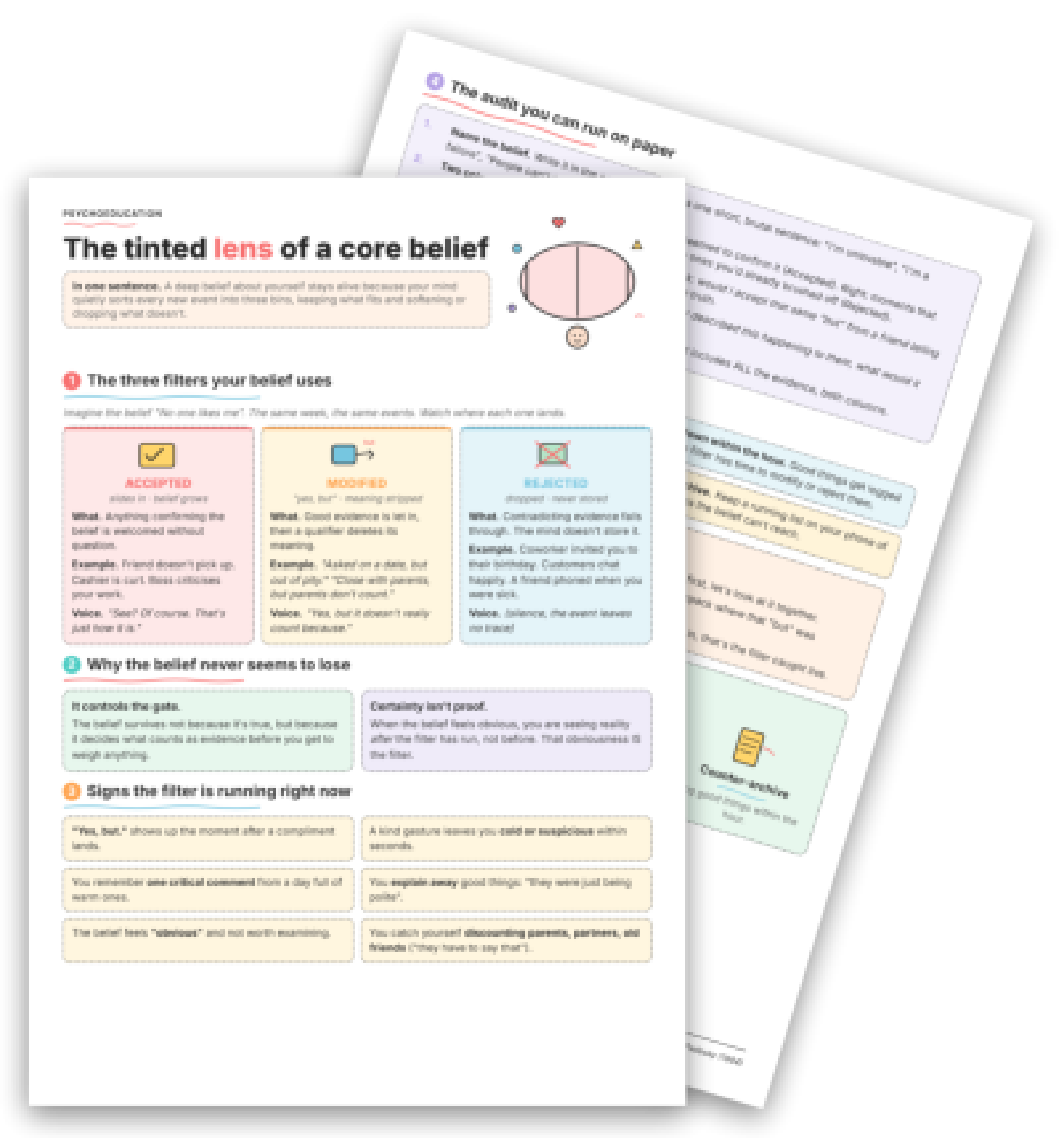
The fiche is structured around five numbered sections, each short and clinically precise.
Section 1 introduces the three-bin model with a worked example built around the belief "No one likes me." Three labeled columns (Accepted, Modified, Rejected) show how the same week of events is processed differently depending on which bin captures them. The visual contrast between the columns makes the asymmetry immediately legible; you can point to it rather than describe it.
Section 2 states the core insight plainly: "the belief survives not because it's true, but because it decides what counts as evidence." Printing this sentence and letting a patient read it often produces a different reaction than hearing you say it.
Section 3 lists six behavioral signs the filter is active right now, including the characteristic "yes, but" appearance immediately after a compliment, and the discounting of close relationships ("they have to say that"). This section is useful for orienting the patient's self-monitoring between sessions.
Section 4 lays out a paper audit in five steps: naming the belief as a single sentence, building two columns across the last two weeks (Accepted vs. Modified and Rejected), reading the qualifiers back, reweighting the Rejected items using a third-person perspective, and drafting a more evidence-inclusive sentence. This is the exercise the patient completes autonomously, then brings back for debriefing.
Section 5 provides four ready-to-use cognitive moves, including the friend test ("would I let a friend dismiss this?") and a counter-archive logged on their phone.
> Key takeaway: the fiche is a visual support that facilitates in-session explanation of the three-bin filtering mechanism; the audit in Section 4 becomes structured between-session homework once the patient grasps the model.
Pair this with the exercise for clarifying a core belief when the patient still needs help naming the belief itself before beginning the audit, and with the downward-arrow exercise for tracing a thought to its core belief when automatic thoughts are the entry point.
Use it with your patients
Share this tool in the mobile app and follow the work between sessions.
When and How to Introduce the Worksheet
This fiche fits naturally after the initial case formulation, once you and the patient have identified at least one candidate core belief explicitly. Introducing it too early, before the patient can name their belief concisely, means Section 4 will stall on the first step.
For patients presenting with low self-esteem, abandonment schema, or approval-seeking patterns, the three-bin model often produces an immediate recognition response, which strengthens the alliance and accelerates the shift from insight to behavioral experiment.
A useful framing to introduce it: "I want to show you a diagram that explains why, even when good things happen, the belief doesn't budge. Take a look at this and tell me if any of these bins sound familiar." This positions the patient as the expert on their own experience, not as someone receiving a correction.
For debriefing the Section 4 audit, the most productive questions are usually about the Modified column: which qualifiers reappeared, and where were they learned? That line of inquiry leads directly into restructuring the negative core belief and, later, reinforcing the alternative. The fiche connects cleanly to both, making it a natural bridge in the anxiety and limiting beliefs program or the depression and limiting beliefs curriculum.
One limit worth naming: patients with marked alexithymia or concrete thinking may struggle to generate Rejected items independently. In those cases, run the first audit column together in session before assigning it as homework.
The worksheet does not replace the therapeutic frame; it makes the explanation sharper and leaves the patient with a concrete reference point between sessions.
Your session continues in your patients' pocket
Use with a patientYour resources, available everywhere
The handouts, exercises, programs and audios above: you choose which ones to make available to your patients, in the mobile app dedicated to them.
And far more than a library
The app goes well beyond resources, to support your patients every day:
Related categories
Explore other clinical resources by category.

Identity
Clinical resources for self-identity work in therapy: CBT, ACT, schema tools for clinicians addressing self-concept, core beliefs, and identity disruption.

Cognition
Printable cognitive therapy worksheets and clinical tools for therapists: CBT, ACT, schema work, defusion, distortions, and belief restructuring.

Build awareness
Clinical worksheets and tools to build awareness in therapy: cognitive distortions, schemas, emotions, ACT and CBT resources for practitioners.

Restructure
Clinical hub for cognitive restructuring worksheets: distortion identification, belief disputation, ABC model, and schema work for evidence-based practice.

CBT
CBT worksheets, cognitive restructuring exercises & behavioral tools for clinicians. Evidence-based resources for every phase of cognitive behavioral therapy.

Anxiety
Clinical hub for anxiety disorders: CBT and ACT worksheets, psychoeducation sheets, and exercises for assessment and treatment across the anxiety spectrum.