
Clinical picture. M., a woman in her early forties, presented with recurrent depressive episodes and a rigid conviction, stated flatly at intake, that she was "a complete failure" after losing a managerial role. In session the clinician introduced the scaling worksheet, asking her to place that belief on a 0-to-100% line rather than defend or dispute the word itself. M. first marked herself at 8%, then was invited to place three real colleagues and a close friend on the same line; she positioned them between 30% and 65%, then paused and moved her own marker to 22%. By the session's end she had not abandoned the belief, but its grip had loosened enough for her to agree it deserved further examination rather than automatic acceptance.
Scaling Beliefs About Yourself: PDF Worksheet, Tools and Exercises
A visual PDF worksheet and nine-step clinical tool to help patients shift from binary self-labels to dimensional rating, with ready-to-use questions and a worked example.
Clinical vignettes
Loosening a Failure Label in CBT
Scaling 'Unlovable' in a Single Session
Clinical picture. T., a man in his late twenties attending a time-limited service for social anxiety, described a core assumption, "I am fundamentally unlovable," that had resisted several rounds of Socratic questioning. The clinician shifted strategy and handed him the scaling sheet, asking him first to describe what a literal 0% on that dimension would look like in a real person. T. struggled to name anyone who genuinely met that description, which introduced visible doubt. He then rated himself separately for his worst recent day (10%), his average day (28%), and the perspective of his sister, whom he trusted (55%). The spread across those three positions was itself surprising to him, and he noted spontaneously that a single fixed label could not account for all three numbers at once.
When a patient states "I am a failure" and you offer a perfectly reasonable counter-argument, the belief rarely shifts. The problem is not the logic; it is the shape of the belief. Global self-evaluations function as binary verdicts, and verbal reframing leaves that binary structure intact. This fiche PDF gives you a concrete visual structure to change the geometry of the belief, not just its wording.
Use this resource with your patients
Handout, exercises and materials ready to use, right inside SessionFuel.
Why Binary Self-Labels Resist Change in Session
Global self-judgments operate on a yes/no axis: you either are something, a failure, unlovable, pathetic, or you are not. When a patient holds that structure, every piece of contradictory evidence gets absorbed or discarded because it has nowhere to land on a two-point scale. This is the core mechanism behind all-or-nothing thinking, and it is especially tenacious when the belief is about the self rather than a situation.
Clinicians working with low self-esteem, the failure schema, or defectiveness and shame schemas routinely encounter this wall. Verbal persuasion alone does not move it because, as the fiche puts it, "logic alone doesn't move the belief; geometry does." What patients need is a tool that converts the verdict into a position on a continuum, something they can measure, compare, and re-rate.
What the Fiche Contains: A Visual Scale for Core Beliefs
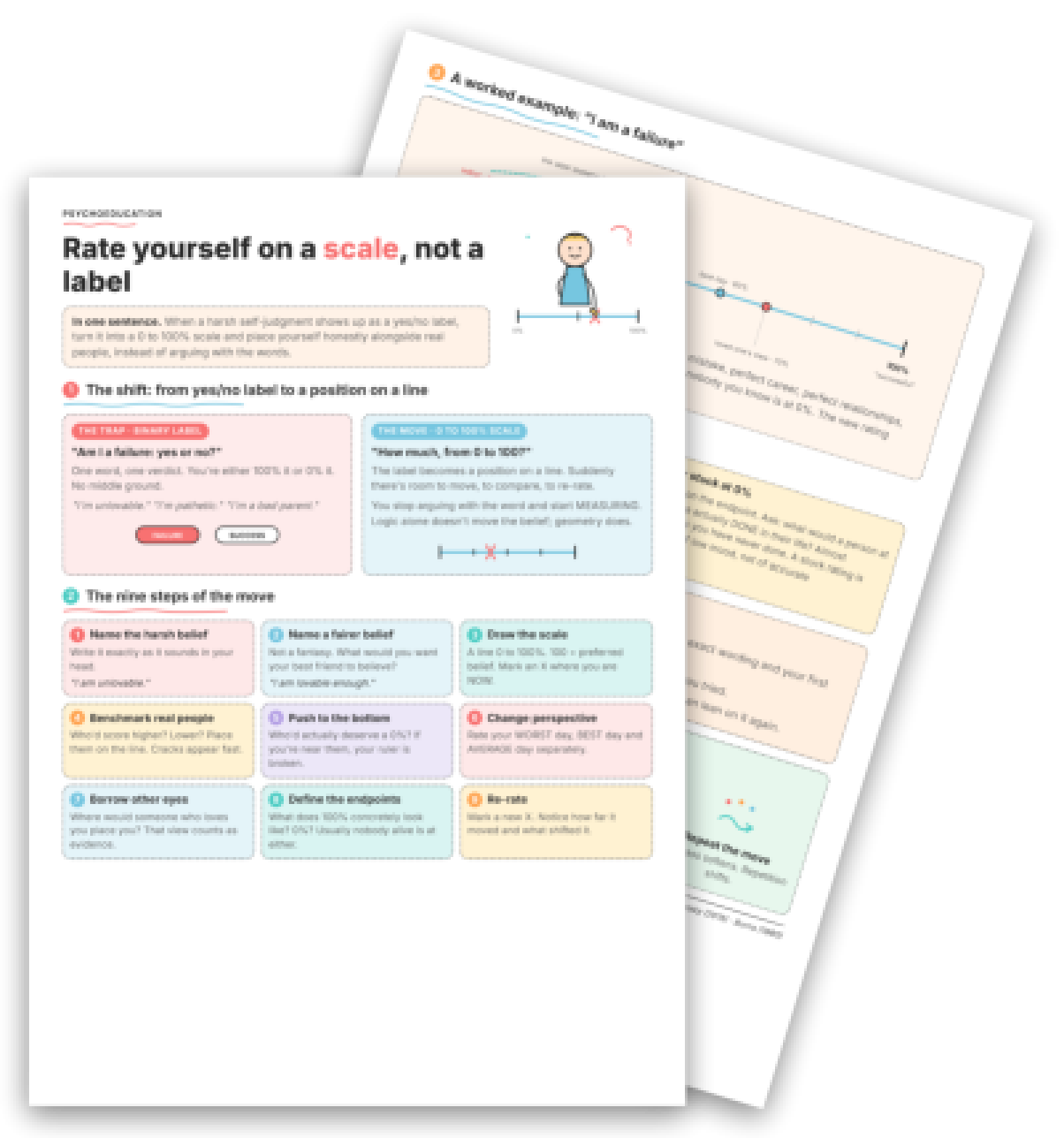
The fiche is structured across four panels, and its value in session comes precisely from what a 0-to-100% line drawn on paper shows that an oral explanation cannot: a spatial middle ground where real people can be placed.
Panel 1 contrasts the binary label trap (one word, one verdict, no movement) with the scale move (a position on a line that creates room to compare and re-rate). Showing this side-by-side contrast takes roughly thirty seconds and already disrupts the black-and-white frame.
Panel 2 lays out the nine steps of the full intervention: naming the harsh belief in the patient's own words, formulating a fairer alternative, drawing the scale, benchmarking real people above and below, pushing to the literal bottom endpoint, rating across worst day / average day / best day, borrowing a loved one's perspective, defining what 100% would actually require, and re-rating. Each step is brief and actionable. The sequence follows the logic of evidence-gathering familiar from examining the evidence on core beliefs, but the visual scale makes the movement legible in real time.
Panel 3 provides a worked example for "I am a failure", showing how successive benchmarks shift the initial 5% rating upward to around 45%, and how defining a realistic 100% endpoint (never makes a mistake, perfect career, perfect relationships, every single day) makes the label factually unsustainable.
Panel 4 supplies ready-to-use clinical questions ("What would 100% actually look like?", "Am I using a ruler no real person could pass?"), traps to watch for when a patient stays stuck at 0%, and a set of debriefing prompts explicitly labelled "To discuss in session."
> Key point: This fiche is a visual support that facilitates the explanation of dimensional belief rating in session. It is not a questionnaire the patient fills in alone; it is a shared artefact the clinician uses to make an abstract cognitive concept spatially concrete, then leaves with the patient as a reference between appointments.
Clinical library
750+ clinical tools
A library built with and for clinicians, ready to use in session and extend between appointments.
Access all the toolsSeveral resource types
Psychoeducation handouts
Understand at a glance
Interactive exercises
To do and fill in
Interactive programs
A structured path
Audios
Meditation and relaxation
Psychometric tests
Automatic scoring
When and How to Introduce It in Session
This fiche fits naturally once you have identified a recurring global self-evaluation in the patient's automatic thoughts or case formulation. It works well after initial core belief mapping but before deeper restructuring work, because it first loosens the binary grip on the belief.
It is particularly suited to patients presenting with Fennell's low self-esteem cycle, perfectionism with harsh self-appraisal, or persistent feelings of not being good enough. Use it with caution in acute depressive episodes where the 0% endpoint may feel validating rather than destabilising; in those cases, the "push to the bottom" step requires careful scaffolding.
To introduce it, you might say: "I'd like to try something visual. Instead of arguing with the word 'failure', let's give it a number and put some real people alongside it." Co-complete the scale in session, naming the benchmarks aloud together. The visual artefact does the work that repeated verbal challenging cannot.
For debrief, the fiche's built-in prompts guide the conversation: what moved the rating, what defined the endpoints, and what specifically caused any shift, so the mechanism can be re-used. Pair it with reinforcing the emerging alternative belief as follow-up homework.
The fiche does not replace a full cognitive case formulation; it operationalises one moment within it, converting an abstract TCC principle into something the patient can see, hold, and return to.
Use it with your patients
Share this tool in the mobile app and follow the work between sessions.
Sources
- James, I. A., & Barton, S. (2004). Changing core beliefs with the continuum technique. Behavioural and Cognitive Psychotherapy.
- Greenberger, D., & Padesky, C. A. (2016). Mind Over Mood: Change How You Feel by Changing the Way You Think (2nd ed.). Guilford Press.
- Leahy, R. L. (2017). Cognitive Therapy Techniques: A Practitioner's Guide (2nd ed.). Guilford Press.
Patient mobile app
Your session continues in your patients' pocket
Use with a patientYour resources, available everywhere
The handouts, exercises, programs and audios above: you choose which ones to make available to your patients, in the mobile app dedicated to them.
Psychoeducation handoutsInteractive exercisesInteractive programsAudiosPsychometric tests
And far more than a library
The app goes well beyond resources, to support your patients every day:
Standardized tests
Therapy journal
Gamification
Wellbeing challenges
Introspection prompts
Therapist homework
Related categories
Explore other clinical resources by category.

Mood
Evidence-based worksheets and clinical tools for mood disorders: CBT, ACT, and positive psychology resources for psychologists and therapists.

Identity
Clinical resources for self-identity work in therapy: CBT, ACT, schema tools for clinicians addressing self-concept, core beliefs, and identity disruption.

Cognition
Printable cognitive therapy worksheets and clinical tools for therapists: CBT, ACT, schema work, defusion, distortions, and belief restructuring.

Build awareness
Clinical worksheets and tools to build awareness in therapy: cognitive distortions, schemas, emotions, ACT and CBT resources for practitioners.

Restructure
Clinical hub for cognitive restructuring worksheets: distortion identification, belief disputation, ABC model, and schema work for evidence-based practice.

CBT
CBT worksheets, cognitive restructuring exercises & behavioral tools for clinicians. Evidence-based resources for every phase of cognitive behavioral therapy.